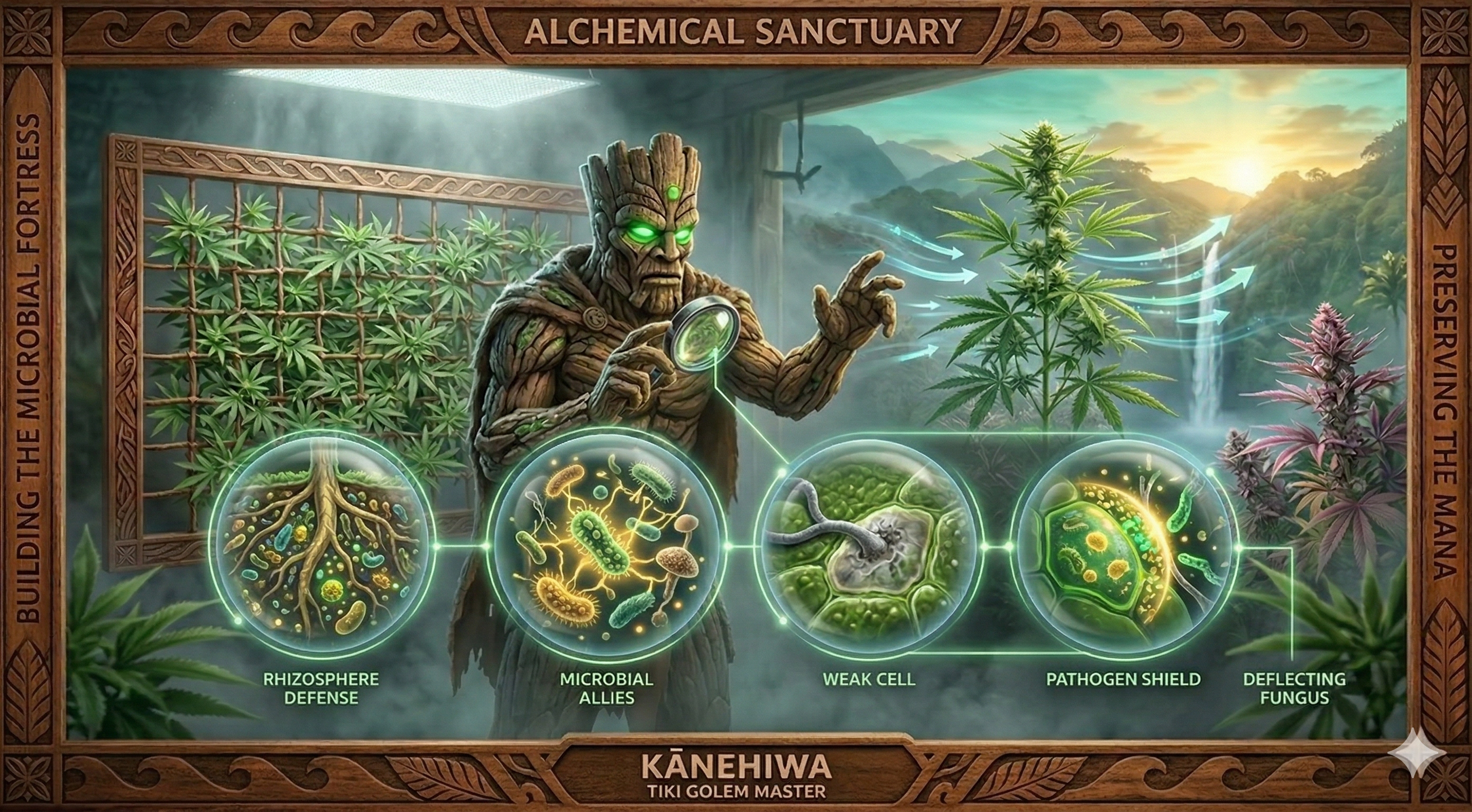
The Microbial Fortress
A sterile environment on Maui isn't about creating a dead vacuum — it's about building a microbial fortress. Populate your grow space so densely with beneficials that pathogens simply have no home to colonize. Kānehiwa walks you through our foundational guide to success.
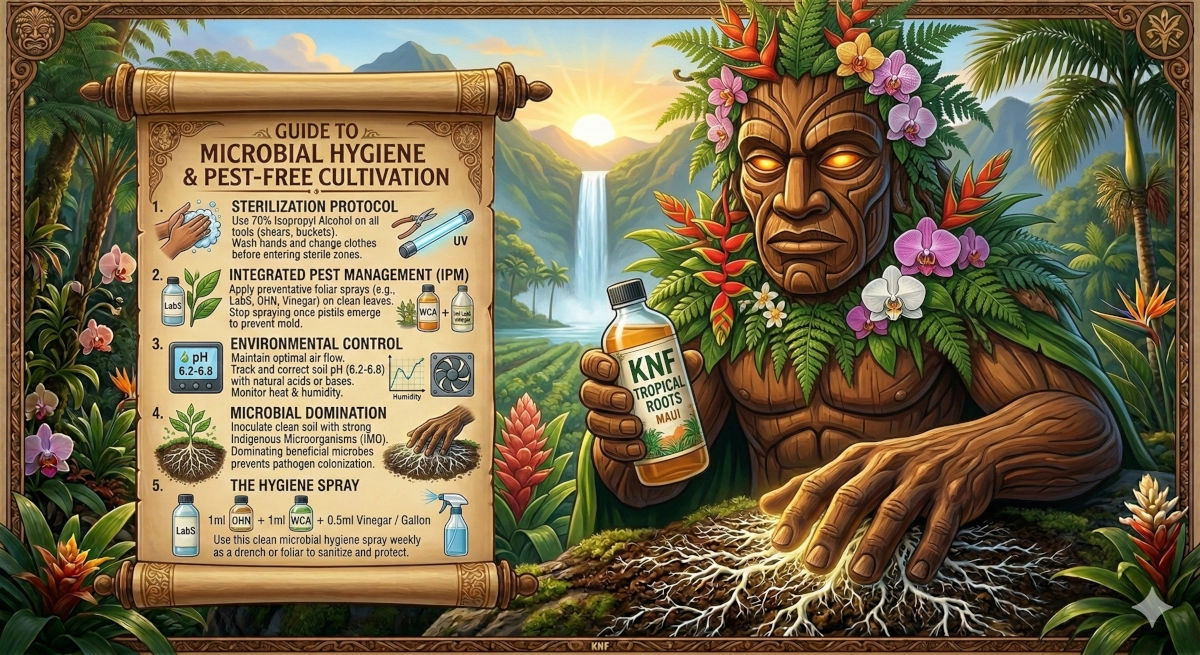
Before you add life, you must clean the slate. Pathogens often piggyback on the tools you use most.
🧹 Zone SanitizationEvery bucket, pot, tray, and shelf must be scrubbed with an approved sanitizer (Zerotol, Oxidate, or SaniDate). This kills lingering bacteria, fungal spores, and pest larvae hiding in the biofilm that builds up on surfaces between cycles.
🔪 Tool Protocol70% Isopropyl Alcohol is the industry standard for a reason. Dip, do not just spray your shears, scalpels, and grafting knives between every single plant. A quick spray leaves dry spots where pathogens survive — full submersion for 10 seconds is the only reliable method.
🚪 The Clean Zone TransitionYou need a physical space — a boot wash mat or an air shower — where you transition from "outside" clothes (contaminated) to "clean zone" clothes. This is non-negotiable for commercial success. Wash your hands for 30 seconds before touching anything in the sterile zone. Dedicate a pair of shoes that never leave the grow room.
Prevention is the only viable strategy. By the time you see a pest, you have already lost yield.
🍃 Foliar DominanceUse a rotate-and-dominance spray schedule. Apply your primary IPM — a LabS + OHN mix — to the leaves early (Seedling/Veg) to colonize the entire leaf surface with beneficials. If a mildew spore lands, there is no place for it to latch — the beneficials are already there.
🔄 Commercial AlternativesIf you're not running a full KNF program, these commercial products achieve similar foliar dominance and can be rotated alongside or in place of KNF inputs:
Lost Coast Plant Therapy — An all-in-one pesticide, miticide, and fungicide made from soybean oil, corn oil, and citric acid. Safe to use up through early flower and effective against spider mites, whiteflies, aphids, and powdery mildew. This is the closest commercial analog to a LabS + OHN foliar — it kills on contact and leaves a residual film that discourages re-colonization.
Athena IPM — A broad-spectrum insecticide and fungicide using food-grade oils and natural surfactants. Excellent as a preventive in veg — apply every 3–5 days to maintain a protective barrier on leaf surfaces. Works well in rotation with Lost Coast to prevent pest resistance.
Captain Jack's Dead Bug Brew — Contains Spinosad, a naturally derived bacterium that targets thrips, caterpillars, leaf miners, and fungus gnats. Unlike the oil-based products above, Spinosad works through ingestion — pests must eat treated leaf tissue. Use this as your rotation partner when you see chewing damage or thrip scarring. Note: Spinosad is toxic to bees — do not apply outdoors during pollinator-active hours.
Wettable Sulphur — One of the oldest and most effective fungicides in agriculture. Sulphur prevents and treats powdery mildew, rust, and other fungal pathogens by disrupting spore germination on contact. Apply as a foliar spray during veg at the manufacturer's recommended rate. Critical rules: Never apply sulphur within 2 weeks of any oil-based spray (Lost Coast, Athena, White Oil, or neem) — the combination causes severe phytotoxicity and will burn your plants. Never apply when temps exceed 85°F. Sulphur is your dedicated fungicide; the oil-based products are your dedicated insecticides — keep them separated in your rotation calendar.
Neem Seed Meal — A soil amendment (not a spray) made from cold-pressed neem seeds. Mix into your top layer of soil or use as a top dress at 1–2 tablespoons per gallon of soil. As it breaks down, it releases azadirachtin — a natural insect growth regulator that disrupts the life cycle of fungus gnats, root aphids, and other soil-dwelling pests. It also feeds beneficial soil biology. Re-apply every 3–4 weeks during veg. Unlike neem oil sprays, neem seed meal works systemically from the soil up and doesn't carry the oil-on-leaf risks that conflict with sulphur applications.
Diatomaceous Earth (DE) — Microscopic fossilized diatoms that physically shred the exoskeletons of crawling insects, causing them to dehydrate and die. Dust a thin layer on the soil surface, pot rims, and around the base of plants to create a physical barrier against fungus gnats, ants, and other crawling pests. Use food-grade DE only. Reapply after watering, as moisture renders it ineffective. DE is a mechanical kill — pests cannot develop resistance to it. Avoid inhaling the dust during application (wear a mask) and keep it off the leaves where it can clog stomata.
🛑 Stop Spraying EarlyCrucial Rule: Discontinue all foliar sprays once you see the first white pistils (flower) emerge. Spraying during the bloom phase introduces moisture into the buds, creating the exact humid environment mold needs. If you must apply IPM during bloom, switch exclusively to a soil drench.
🪤 Physical BarriersUse yellow sticky traps for gnats and flies, blue sticky traps for thrips — these are your monitoring sentries, not your primary defense. Screen your air intakes with fine mesh to prevent flying adults from entering your clean room.
Your HVAC and ventilation are your air filters. If they are compromised, so is your environment.
💨 Positive Air PressureYour clean room must have positive air pressure — air is pushed out through cracks and doorways, preventing contaminated air (and small flying insects) from rushing in when the door opens. This is achieved by pushing more air into the room than you exhaust.
🔬 HEPA FiltrationAll intake air must pass through a HEPA-rated filter to trap spores, pollen, and microscopic pests like broad mites. Replace or clean HEPA filters on a regular schedule — a clogged filter is worse than no filter because it restricts airflow without filtering effectively.
📊 VPD — The Ultimate Hygiene MetricVapor Pressure Deficit is where environment meets biology. By tracking and correcting your soil pH (6.2–6.8) and monitoring your heat and humidity to maintain proper VPD, you keep plants thriving. When plants are not stressed, their natural immune system — boosted by OHN — prevents the "alarm signal" that broadcasts their vulnerability to pests.
This is the Tropical Roots Maui superpower. Sterility in the soil is a death sentence — what you want is domination by beneficials.
🌱 Inoculate EarlyThe first moment you put a seedling or clone into soil, drench it with your strongest microbial inoculum. KNF IMO is the gold standard — it introduces thousands of indigenous microbial species collected from your local Maui environment. These organisms are already adapted to your climate, your soil, and your conditions.
🧬 Pathogen DominationA complex, diverse microbial network is your best defense against Fusarium, Pythium (root rot), and other soil pathogens. Dominating beneficial microbes prevent pathogen colonization. Pathogens are opportunistic — they exploit voids. If the "real estate" in your root zone is already 100% occupied by IMO, there is no place for root rot to colonize. This is the same principle as the foliar dominance in Step 2, but applied underground.
This final drench ties it all together — actively cleaning your root zone and reinforcing the microbial fortress week after week.
🧪 The RecipeUse a clean, natural microbial hygiene drench weekly to sanitize and protect. The base is a combination of LabS (lactic acid bacteria), OHN (oriental herbal nutrient), and WCA (water-soluble calcium) — all diluted at 1:1000 into your water. A splash of brown rice vinegar can be added as a mild natural sanitizer.
📅 ApplicationApply as a soil drench (not a foliar) once a week throughout the entire cycle. The vinegar acts as a mild sanitizer. The OHN boosts plant immunity and provides natural pest-repellent compounds. The WCA strengthens the structural integrity of plant cell walls, making them physically harder for pests to chew through. This is maintenance, not treatment — consistency is everything.
While both plants and fungi were once classified together in the botanical world, they are as different from each other as a sunflower is from a seagull. In the Tropical Roots Maui ecosystem, understanding this distinction is the key to mastering the "microbial fortress."
| Feature | Plants (Plantae) | Fungi (Fungi) |
|---|---|---|
| Energy Source | Autotrophs: Create their own food via photosynthesis. | Heterotrophs: Must consume organic matter (decomposers). |
| Cell Wall | Made of Cellulose. | Made of Chitin (same as shrimp shells). |
| Storage | Store energy as Starch. | Store energy as Glycogen (like humans). |
| Movement | Rooted, but grow toward light (Phototropism). | Grow toward food sources (Chemotropism). |
Plants are producers. They use chlorophyll to capture sunlight, CO₂, and water to create glucose. They are the foundation of the food chain, turning light into physical matter.
🍄 Fungi: The External StomachsFungi do not "eat" in the traditional sense. They secrete powerful enzymes into their environment to break down complex molecules (like fallen logs or dead insects) and then absorb the dissolved nutrients through their Hyphae.
Despite their differences, the most successful gardens rely on a "handshake" between the two. In a healthy living soil, Mycorrhizal fungi attach themselves to plant roots.
1. The DealThe plant gives the fungi excess sugar (carbon) produced via photosynthesis.
2. The PaybackThe fungi act as an extended root system, reaching deep into the soil to grab phosphorus and water that the plant roots can't reach on their own.
Not all fungi are friends. In the humid Maui air, certain fungi like Powdery Mildew or Botrytis (Bud Rot) act as parasites, stealing energy from the plant without giving anything back, eventually killing the host.
The DefenseThis is why we use LabS (Lactic Acid Bacteria) and OHN. By saturating the plant's surface with "good" microbes, we leave no room for the pathogenic "bad" fungi to land and take hold.
Cultivators use beneficial microbes to create a protective, living soil environment that enhances plant immunity and nutrient uptake.
Building this biological defense typically involves several types of beneficial microbes working in concert:
🍄 Mycorrhizal FungiThese fungi form a symbiotic relationship with cannabis roots, effectively extending the root system's reach to find water and nutrients. Research has shown they can enhance root mass by up to 700% — transforming a modest root ball into a vast underground network capable of mining minerals from soil far beyond the plant's natural reach.
🦠 Beneficial Bacteria (Rhizobacteria)Strains like Bacillus subtilis help break down organic matter into forms plants can easily absorb while also fighting off soil-borne pathogens. These bacteria occupy root surface sites that would otherwise be claimed by harmful organisms — competitive exclusion at the microscopic level.
🛡️ TrichodermaTrichoderma is an aggressive beneficial fungus that acts as a natural fungicide, protecting roots from diseases like root rot and "damping off." It parasitizes harmful fungi directly — wrapping around pathogenic hyphae and dissolving them with enzymes. In a living soil system, Trichoderma is one of your most powerful allies.
Beneficial bacteria and fungal spores (such as TerraGrow) are used to improve soil characteristics, increase nutrient availability, and enhance stress tolerance. A healthy root zone is the first line of defense — when beneficial colonies dominate every surface of the rhizosphere, pathogenic organisms simply cannot establish a foothold. For the KNF approach, IMO (Indigenous Microorganisms) is the foundation of root zone inoculation.
Essential for superior plant nutrition and soil biology, these fungi form symbiotic relationships with roots, acting as a natural shield. The mycorrhizal network extends far beyond what the roots can reach alone — delivering phosphorus, water, and micronutrients while receiving carbon sugars from the plant in return.
Products like Mammoth P are used to boost beneficial microbe activity, which can significantly increase bud yields (e.g., by 16.5%). These concentrated microbial populations accelerate nutrient cycling and unlock bound minerals in the soil that would otherwise remain unavailable to the plant.
Utilizing diverse plants in the garden encourages a robust, varied, and healthy microbial ecosystem that reduces disease outbreaks compared to monocultures. Each companion species brings its own microbial allies to the root zone — cover crops like clover fix nitrogen, while aromatic herbs like basil and cilantro can repel pests above ground.
Microbial shields prevent harmful molds, mildews, and parasitic bacteria from colonizing the plant. When every surface — from root tip to leaf canopy — is dominated by beneficials, pathogenic organisms find no vacant territory to exploit. LabS (Lactic Acid Bacteria) is your primary foliar colonizer, while OHN strengthens the plant's immune response from within.
📈 Increased Yield and QualityMicrobes help plants reach their "top-end genetic expression," leading to better branching, budding, and higher essential oil content. A thriving microbial ecosystem unlocks nutrients that would otherwise remain bound in the soil, feeding the plant a more complete diet and pushing terpene and cannabinoid production to their genetic ceiling.
💪 Stress ResiliencePlants with a healthy microbial fortress are better able to handle abiotic stresses like drought, heat, and transplant shock. The mycorrhizal network acts as a buffer — delivering water during dry spells and signaling the plant to activate defense pathways before visible damage occurs.
Several specific products are highly rated by experts and growers for establishing these microbial defenses:
An "instant compost tea" powder containing kelp, molasses, and beneficial microbes.
BenefitsPraised for creating stronger and more flavorful plants by quickly boosting the soil's microbial population. The molasses feeds existing beneficial colonies while the kelp provides trace minerals and growth hormones — a convenient all-in-one microbial boost.
A pure, single-species inoculant containing Rhizophagus intraradices — one of the most aggressive and well-researched mycorrhizal fungi. Available in granular and powder form for direct root contact application.
Best UseApply directly to the root ball at transplant or dust onto roots during up-potting. Mykos is favored by growers who want a fast-colonizing, no-filler mycorrhizal product that establishes the fungal network quickly. Particularly effective when combined with a bacterial inoculant like Tribus for full-spectrum root zone coverage.
A salmon and kelp formula rich with beneficial microbes and mycorrhizae. This liquid root stimulant combines marine-based nutrients with living biology to deliver a dual-action approach — feeding both the plant and the soil food web simultaneously.
Best UseApply as a root drench during transplant and throughout the vegetative stage to accelerate root development and microbial colonization. The salmon-derived amino acids provide readily available nitrogen while the kelp delivers natural growth hormones (cytokinins and auxins) that promote vigorous root branching. An excellent complement to dry mycorrhizal inoculants like Mykos.
A premium mycorrhizal inoculant available in both granular and liquid concentrate forms, containing a diverse blend of endomycorrhizal and ectomycorrhizal species along with beneficial bacteria and Trichoderma. Designed for maximum spore viability and rapid colonization.
Best UseApply the granular formula directly into the transplant hole for immediate root-to-spore contact, or use the liquid concentrate for established plants as a soil drench. Big Foot is valued for its high spore count per gram and broad-spectrum fungal diversity — giving the root zone multiple colonization strategies rather than relying on a single species.
Cannabis inflorescences (flowers) are prone to colonization by yeast and mold, which must be managed through Integrated Pest Management (IPM). When the beneficial fortress weakens — or environmental conditions tip out of balance — opportunistic pathogens move fast to claim territory.
This is a primary pathogen found in cannabis cultivation — one study of outdoor cannabis farms detected it in 34% of samples. Botrytis thrives in dense, humid canopies and attacks from the inside out, often going unnoticed until the damage is severe. It turns healthy flower tissue into grey, necrotic mush and can destroy an entire harvest in days if left unchecked.
Bacteria can form their own "fortresses" — biofilms — on grow room surfaces, irrigation lines, and reservoir walls. Once established, biofilm colonies become up to 1,000 times more resistant to antibiotics and disinfectants than free-floating bacteria. This is why preventive sanitation is critical: it's far easier to prevent a biofilm than to destroy one.
High humidity and poor airflow are the two greatest enablers of pathogenic colonization. Stagnant, moisture-laden air creates the perfect conditions for mold spores to germinate and for bacterial biofilms to spread. Maintaining proper VPD, consistent airflow across the canopy, and strategic defoliation are your primary environmental defenses.
In the humid Alchemical Sanctuary of Maui, where the moisture from Akaka Falls meets the warm tropical air, Gray Mold (Botrytis) and Powdery Mildew are the silent thieves of mana. Without the proper defensive strategy, a single night of heavy mist can compromise a world-class harvest. Building the "Biological Shield" requires a four-pronged approach: genetics, airflow, defoliation, and structural reinforcement.
Not all plants are built for the island's embrace. To win the war against mold, you must choose genetics that "breathe."
🌴 The Sativa AdvantageHawaiian landraces and Sativa-dominant hybrids often feature "foxtailing" or airy bud structures. This open architecture allows the Maui breeze to pass through the flower rather than getting trapped inside — a natural defense against moisture accumulation. These genetics evolved in tropical environments and carry inherent mold resistance.
⚠️ The Indica RiskDense, "rock-hard" Indica golf-ball buds are moisture traps. In the tropics, these require extreme environmental control — dedicated dehumidification, aggressive defoliation, and constant airflow monitoring — to survive the final weeks of bloom. If you choose to grow dense Indica genetics in Hawaiʻi, accept that the mold battle will be harder and plan accordingly.
Stagnant air is the breeding ground for fungal spores. Your goal is constant, gentle movement — not a hurricane, but an omnipresent breeze.
🌀 The Vortex EffectPosition fans to create a circular air pattern around the canopy. Never aim a high-powered fan directly at a plant, as this can cause "wind burn" — brown, crispy leaf edges that stress the plant and weaken its immune response. The ideal setup uses multiple low-speed oscillating fans creating overlapping airflow patterns with no dead zones.
📊 Micro-ClimatesUse a digital hygrometer to monitor the VPD (Vapor Pressure Deficit) at canopy level. If the air near the center of the plant is significantly more humid than the room reading, you are at risk. Place your sensor inside the canopy, not on the tent wall — the wall reading can be 10–15% lower than the actual humidity your buds experience.
To prevent the Microbial Fortress from becoming a "Fungal Trap," you must prune for airflow — not just light penetration.
🪒 The "Skirt" TechniqueRemove the bottom 20% of growth — the "lollipopping" method. This clears the space between the soil and the canopy, preventing moisture from rising into the buds. Lower growth that receives less than 150 PPFD is wasting the plant's energy anyway and creating a humidity reservoir below the canopy.
🍃 Selective PluckingAround week 3 and week 6 of flower, remove large fan leaves that are overlapping or "sweating" against each other. If two leaves touch, moisture collects between them — this is exactly where Powdery Mildew starts. Focus on interior leaves that block airflow to the densest bud sites. See the Vegetative Stage Guide for foundational pruning techniques.
In the Alchemical Lab, silica is the "armor" — the structural reinforcement that makes the difference between a plant that survives the tropical gauntlet and one that collapses under its own weight.
🔬 The ScienceSilica is incorporated into the plant's cell walls, making them physically tougher and harder for fungal hyphae to penetrate. Research shows that silica-supplemented plants develop a measurable increase in cell wall thickness — effectively building a physical barrier that Botrytis and PM spores struggle to breach.
⚗️ The InputUse a high-quality Ag-Sil (potassium silicate) or a natural volcanic silica source. Apply at the manufacturer's recommended rate throughout veg and into early flower (discontinue by week 4 of flower). This not only prevents mold but also helps branches support the weight of heavy tropical colas without snapping — a dual benefit in Hawaiʻi where both mold pressure and bud density are extreme.
Interestingly, the cannabis plant itself produces compounds that can fight off bacteria. The very resin that makes the flower valuable to cultivators also serves as the plant's own chemical defense system — a natural fortress within the fortress.
Research suggests that cannabinoids like cannabidiol (CBD) and cannabigerol (CBG) can disrupt the ability of bacteria to form biofilms, offering a potential natural antimicrobial solution. Where traditional disinfectants struggle to penetrate established biofilm colonies, these cannabinoids may weaken the protective matrix that bacteria build around themselves — making them vulnerable to the immune response of both the plant and the surrounding beneficial microbes.
Specific compounds in cannabis have shown effectiveness in killing bacteria that cause foodborne illnesses, such as L. monocytogenes and Staphylococcus. This emerging research highlights the dual nature of the cannabis plant — not only does it require protection from microbial threats, but it also produces its own arsenal of antimicrobial weapons encoded in the trichome resin.
Because of strict regulations on yeast, mold, and bacteria in legal cannabis, producers use several techniques to manage or eliminate unwanted microbes. Passing compliance testing requires a proactive, multi-layered approach — not a last-minute fix.
Systems like WillowPure use ozone to destroy yeast, mold, and bacteria (e.g., Aspergillus, E. Coli, Salmonella) on harvested flower, saving products from failing compliance tests. Ozone-based decontamination works by oxidizing microbial cell walls on contact — it's effective, leaves no chemical residue, and preserves terpene profiles when applied at proper concentrations.
Proper pruning techniques — especially "lollipopping" (removing lower growth that receives little light) — are crucial for improving airflow through the canopy and preventing mold. Strategic defoliation during weeks 3 and 6 of flower opens up the interior canopy, allowing air to circulate freely around the densest bud sites where moisture accumulates.
Regular cleaning of tools and containers — especially when moving from outdoors to indoors — is essential. Scissors, trays, pots, and any surface that contacts the plant should be sterilized with 70% isopropyl alcohol or a hydrogen peroxide solution between uses. Cross-contamination from unsterilized tools is one of the most common vectors for introducing pathogens into a clean environment.
Using treated, clean water — or ozonated water systems — prevents the introduction of harmful microbes through irrigation. Untreated water can carry Pythium, algae, and bacterial colonies directly into the root zone, undermining even the strongest microbial fortress from below.
🪶 Kānehiwa's Words
"The fortress is not built of stone — it is built of life. Every beneficial microbe is a warrior standing guard at the gate. Fill every corner with allies, and the invaders will find no place to plant their flag. This is the way of the grove: strength through abundance, security through diversity." — Kānehiwa
This guide is provided for educational purposes only. Always research local laws and regulations before cultivating. Tropical Roots Maui assumes no responsibility for actions taken based on this information.