Water-Soluble Calcium
Brew your own plant-available calcium from toasted eggshells and vinegar. The structural foundation every heavy-yielding plant needs.
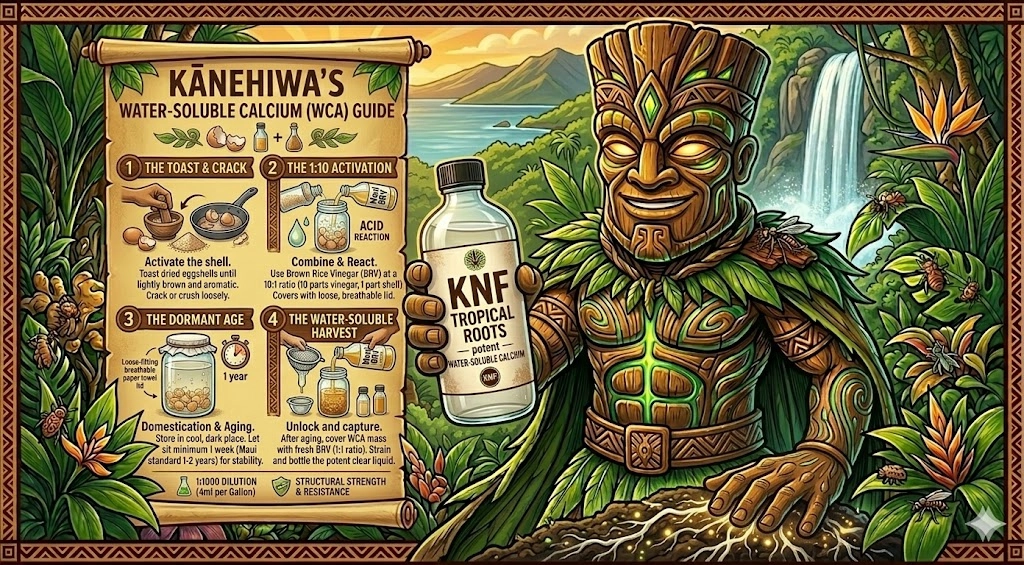
Why WCA?
In the Tropical Roots Maui philosophy, WCA is essential for preventing "floppy" plants and ensuring your stems are thick enough to support heavy yields.
🧱 Cellular StrengthCalcium is the "glue" that holds plant cells together. It forms the structural backbone of cell walls; without adequate calcium, new growth is weak, leaves curl, and roots become stunted. In cannabis, calcium deficiency shows up as brown spots on lower leaves and crumbly, brittle stems.
🛡️ Disease ResistanceStronger cell walls make it harder for pests and fungi to penetrate. Botrytis (bud rot), powdery mildew, and damping-off all attack through the cell wall. A calcium-fortified plant has a built-in armor that conventional growing overlooks.
🚚 Nutrient TransportCalcium helps the plant move other minerals more efficiently. It acts as a messenger within the plant, regulating the uptake and distribution of nitrogen, potassium, and magnesium. Think of it as the highway system that keeps all the other nutrients flowing.
Materials Needed
Everything you need is likely already in your kitchen.
The Brew: Step by Step
Wash your eggshells and remove the inner membrane if possible: this prevents "stinky" fermentation. Let them dry completely. Save shells over several days or weeks until you have a good batch.
Step 2 · The ToastCrush the shells into small pieces and toss them into a dry frying pan over medium heat. Toast them until they are slightly charred/brown: you'll hear them crackle and pop. Toasting removes organic matter and activates the calcium so the vinegar can dissolve it more efficiently.
Step 3 · The RatioUse a 1:10 ratio by weight or volume. For example, 1 tablespoon of charred shells to 10 tablespoons of vinegar. This ratio ensures the vinegar has enough acidity to fully dissolve the available calcium without becoming too dilute.
Step 4 · The ReactionPut the shells in a glass jar and slowly pour in the vinegar. It will bubble and fizz vigorously: this is the calcium being "freed" as the acetic acid dissolves the calcium carbonate. Leave headroom in the jar for the foam.
Step 5 · The WaitCover with a breathable lid (coffee filter or paper towel secured with a rubber band) and store in a cool, dark place for 7 to 10 days. The breathable cover allows CO₂ from the reaction to escape while keeping contaminants out.
Step 6 · The FinishOnce the bubbling stops and the shells sink to the bottom or stay suspended without movement, the process is done. The liquid should be clear to slightly amber.
Step 7 · StrainFilter the liquid through a fine mesh or cheesecloth into a clean glass bottle. It should smell like vinegar and toasted shells: earthy and sharp. Label it with the date. Stored in a cool, dark place, WCA keeps for 6 months or more.
How to Use WCA
WCA is a powerful "medicine" for your plants. Use it sparingly.
💧 Dilution Ratio1:1000, approximately 1ml per liter of water. This is a very dilute application; more is not better. Excess calcium can lock out other nutrients, particularly magnesium and potassium.
📅 When to Use| Stage | Purpose |
|---|---|
| Early Veg | Build strong stems and establish thick cell walls from the start. |
| Transition to Bloom | Crucial for preventing stretch and preparing branches for flower weight. |
| Late Bloom | Strengthens cell walls against moisture, helps prevent bud rot in dense colas. |
I. The Foundational Biology
🍄 IMO (Indigenous Microorganisms): From Rice Box to Black Gold
🧫 LabS (Lactic Acid Bacteria): The Clean-Up Crew
II. The Primary Growth Engines
🐟 FAA (Fish Amino Acids): The Nitrogen Engine
🌱 FPJ (Fermented Plant Juice): The Growth Hormone
III. Specialized & Bloom Nutrition
🦴 WCA (Calcium): The Cell Wall Builder
🔥 WCA-P (Calcium Phosphate): The Bloom Fuel
🛡️ OHN (Oriental Herbal Nutrient): The Immune Booster
IV. Application & Strategy
📋 KNF Feeding Schedule: Seed to Harvest Program
📊 KNF Feeding Chart: Printable Quick Reference
🐛 Pest & Disease Troubleshooting: Maui Edition
V. Foliar Techniques
🍚 BRV Foliar Spray: Feeding the Canopy
This guide is provided for educational purposes only. Always research local laws and regulations before cultivating. Tropical Roots Maui assumes no responsibility for actions taken based on this information.