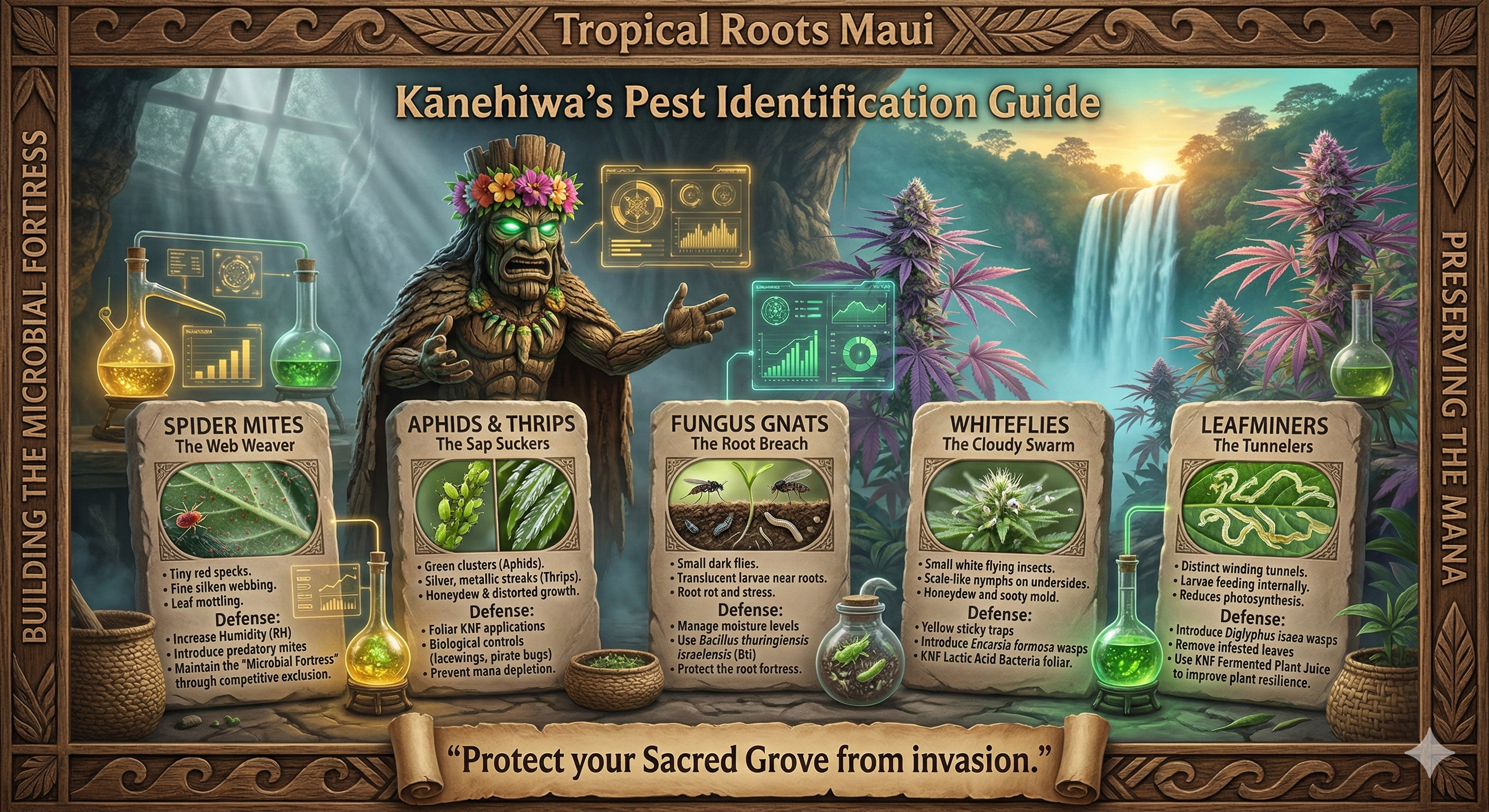
Kānehiwa's Pest
Identification Guide
Protect your Sacred Grove from invasion: identify the earliest signs of infestation before your Island Treasures succumb to The Grey Rot.
"Tending your grove requires a focused mind and a patient hand. Correct the mana of your plants, and they will rise to greet the sun with a powerful dance." Kānehiwa
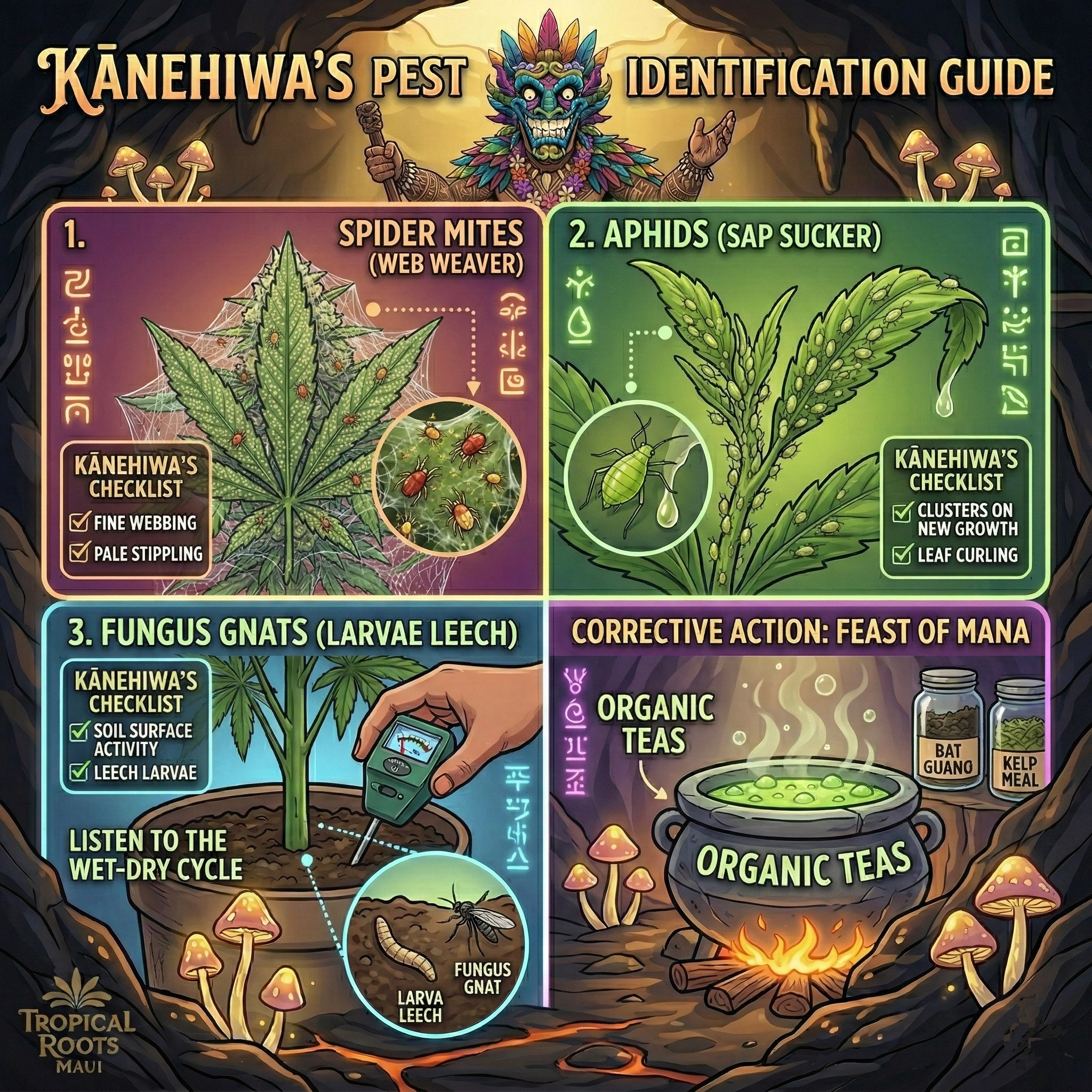
Use this visual reference to identify common pests at a glance: know your enemy before they know your grove.
Like guarding a sacred plant from The Grey Rot, a vigilant cultivator must watch for the earliest signs of invasion. Small dots on a leaf underside today become a full colony tomorrow. Inspect daily: use a magnifying glass to reveal what the naked eye cannot see.
A healthy plant with strong mana is naturally more resistant to pest pressure. Keep your Sacred Earth balanced, maintain proper airflow, and never let the environment invite invaders. Prevention is the first line of defense: a clean grove is a strong grove.
| Pest | Threat | Where to Look | Key Visual | First Action |
|---|---|---|---|---|
Web Weaver→ |
High | Leaf undersides, bud sites | Fine webbing, yellow stippling | Isolate & treat immediately |
Sap Sucker→ |
High | New growth, leaf undersides | Clusters, sticky honeydew | Remove by hand / spray |
Larvae Leech→ |
Medium | Soil surface, plant base | Small dark flies, wet soil | Dry out soil / sticky traps |
Tunnel Maker→ |
Stealth | Inside leaf tissue | Serpentine white tunnels | Remove leaves / neem drench |
Cloud Drifter→ |
High | Leaf undersides | White cloud when disturbed | Yellow traps / parasitic wasps |
Silver Scraper→ |
High | Leaf surfaces, buds | Silvery streaks, black frass | Blue traps / spinosad spray |
 Click to expand
Microscopic arachnids that appear as tiny dots (red, yellow, or green) on the underside of leaves. Nearly invisible to the naked eye, a magnifying glass overlay reveals their true form: eight-legged, oval-bodied invaders that multiply rapidly in warm, dry conditions.
Colonies explode in days. Without intervention, webbing engulfs entire bud sites, choking out light and air. Affected leaves dry out, curl, and die, spreading quickly from plant to plant through wind and contact.
Fine, delicate webbing around buds and leaves, especially where multiple branches overlap. Look also for pale yellow stippling, tiny light-colored dots scattered across the leaf surface like a constellation of damage.
"The Web Weaver is a silent thief. She weaves her trap in the shadows where branches meet, and by the time you see her silk, an army stands behind her. Look beneath the leaf, always beneath." Kānehiwa
Spider mites are year-round threats in Hawaiʻi's warm, dry microclimates, especially on the leeward sides of Maui and the Big Island where trade winds don't reach. Kona winds and drought conditions in summer can cause explosive population surges. Outdoor Maui growers should inspect daily during dry spells, and mist leaf undersides in the morning to disrupt their preferred low-humidity environment. Be especially vigilant during the dry season (May–October) when the Web Weaver thrives.
 Click to expand
Small, soft-bodied insects with distinctive pear-shaped bodies, most commonly pale green but also appearing in black, red, or yellow varieties. A magnified view reveals their delicate antennae and cornicles (twin tailpipes) that distinguish them from other small insects.
Aphids reproduce astonishingly fast: a single female can birth dozens of live young daily without mating. Left unchecked, they weaken the entire plant, stunt growth, and the sticky honeydew they leave behind invites black sooty mold, a secondary infection that blocks light from reaching leaves.
Large clusters on new, tender growth and leaf undersides. Their sap-sucking causes leaves to curl, wilt, and turn yellow. Look for the telltale sticky honeydew residue on leaves below the colony; it glistens under light and is the precursor to sooty mold.
"The Sap Sucker hides in the tender new leaves like a parasite at the heart of growth. She drinks the mana straight from the veins, and where she feeds, a black shadow follows. Watch the young shoots: they speak first." Kānehiwa
Hawaiʻi's tropical climate supports aphid reproduction year-round with no winter die-off to reset populations. The islands host several unique species, and the warm, humid conditions, particularly windward Maui's consistent moisture, accelerate the honeydew-to-sooty-mold cycle rapidly. On the upside, Hawaiʻi is home to natural predators like green lacewings and ladybugs (nā pōpoki liʻiliʻi) that can be encouraged as allies. Avoid broad-spectrum pesticides that kill these beneficial insects; they are the grove's natural guardians.
 Click to expand
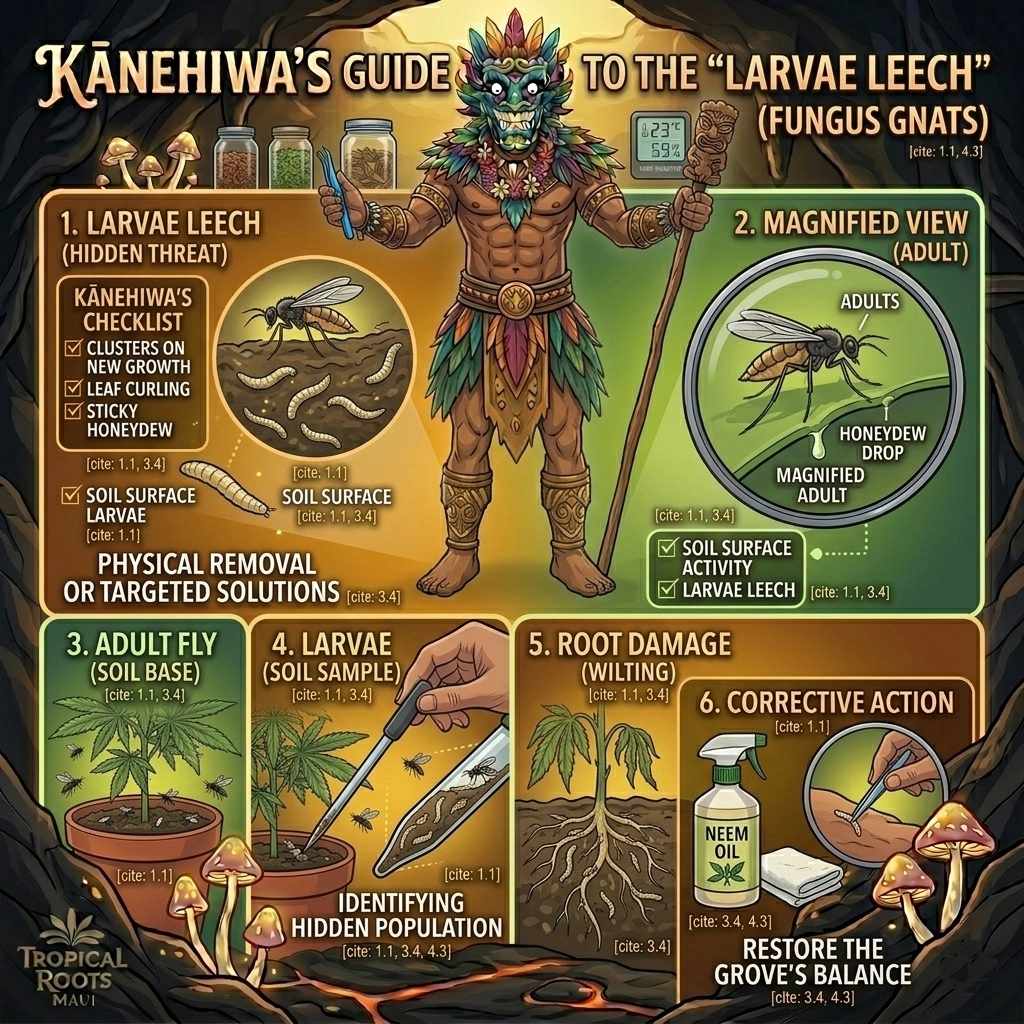
The adult Larvae Leech is a small, dark fly resembling a tiny mosquito with delicate wings and a segmented body, clearly visible under magnification. While the adults are merely annoying, the real danger lurks below: their larvae live hidden in the Sacred Earth, feeding on organic matter and tender root tissue.
Larvae damage the root zone, creating entry points for root diseases like pythium and fusarium. Heavily infested plants show unexplained wilting, slowed growth, and yellowing that mimics nutrient deficiency, the true cause hidden beneath the soil surface.
Adults flying around the base of the plant and soil surface: use a checklist to confirm their identity. They thrive in Sacred Earth that remains constantly wet. Follow the wet-dry cycle: let the top few inches of soil dry out between waterings to break their breeding cycle and reclaim the soil.
"The Larvae Leech is a deceiver. You see the dark fly circle, but the true enemy burrows in the Sacred Earth below. Let the soil breathe: the dry wind is her enemy. A wet grave is what she seeks for your roots." Kānehiwa
Hawaiʻi's persistent humidity and frequent rain, especially in upcountry Maui and windward valleys, create ideal breeding grounds for fungus gnats. The wet-dry cycle is harder to maintain when afternoon rains keep the soil surface moist. Island growers should use well-draining living soil mixes with extra perlite or cinder (pahoehoe rock) and raise containers off the ground to promote airflow beneath. Yellow sticky traps placed at soil level are essential monitoring tools in Hawaiʻi's never-ending gnat season.
 Click to expand
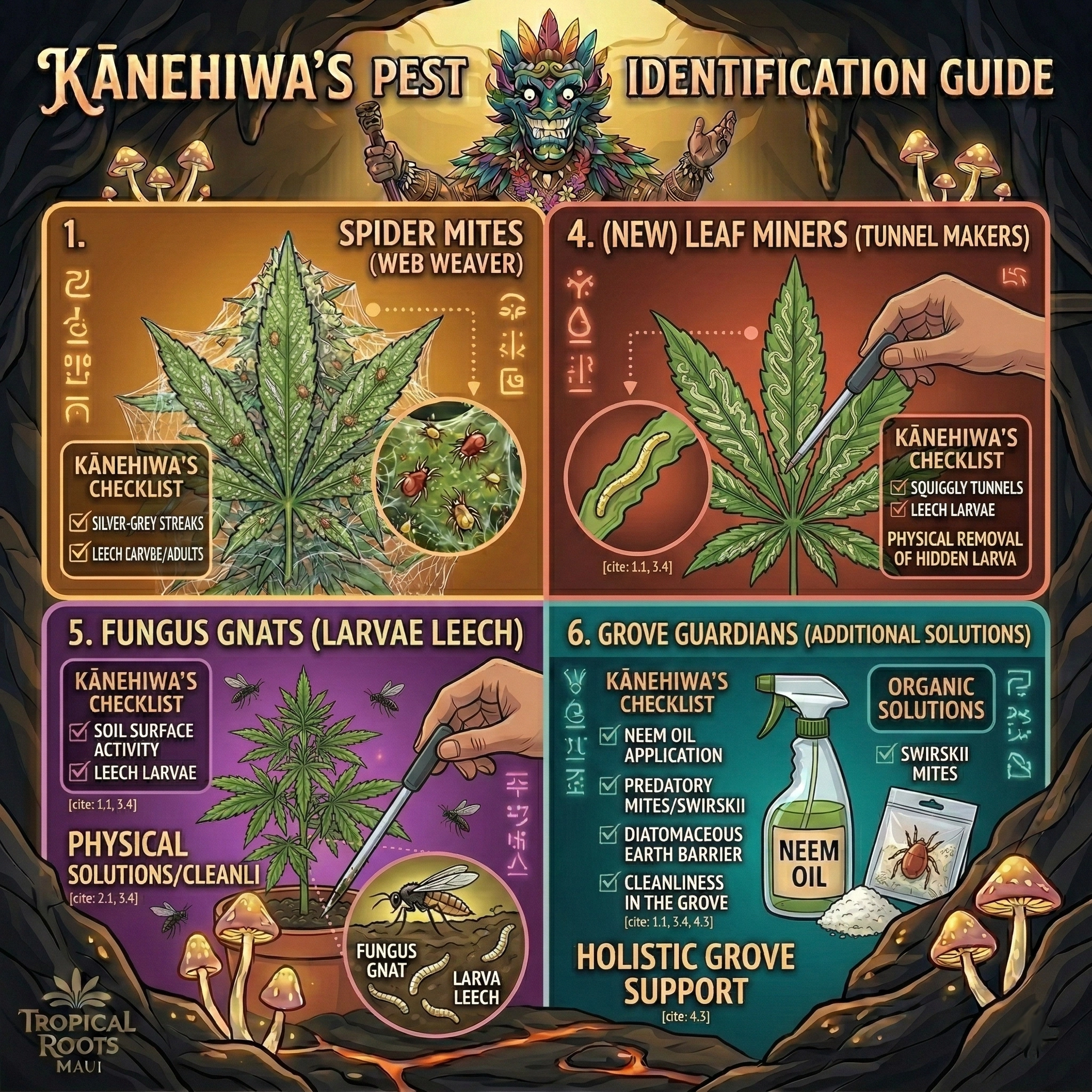
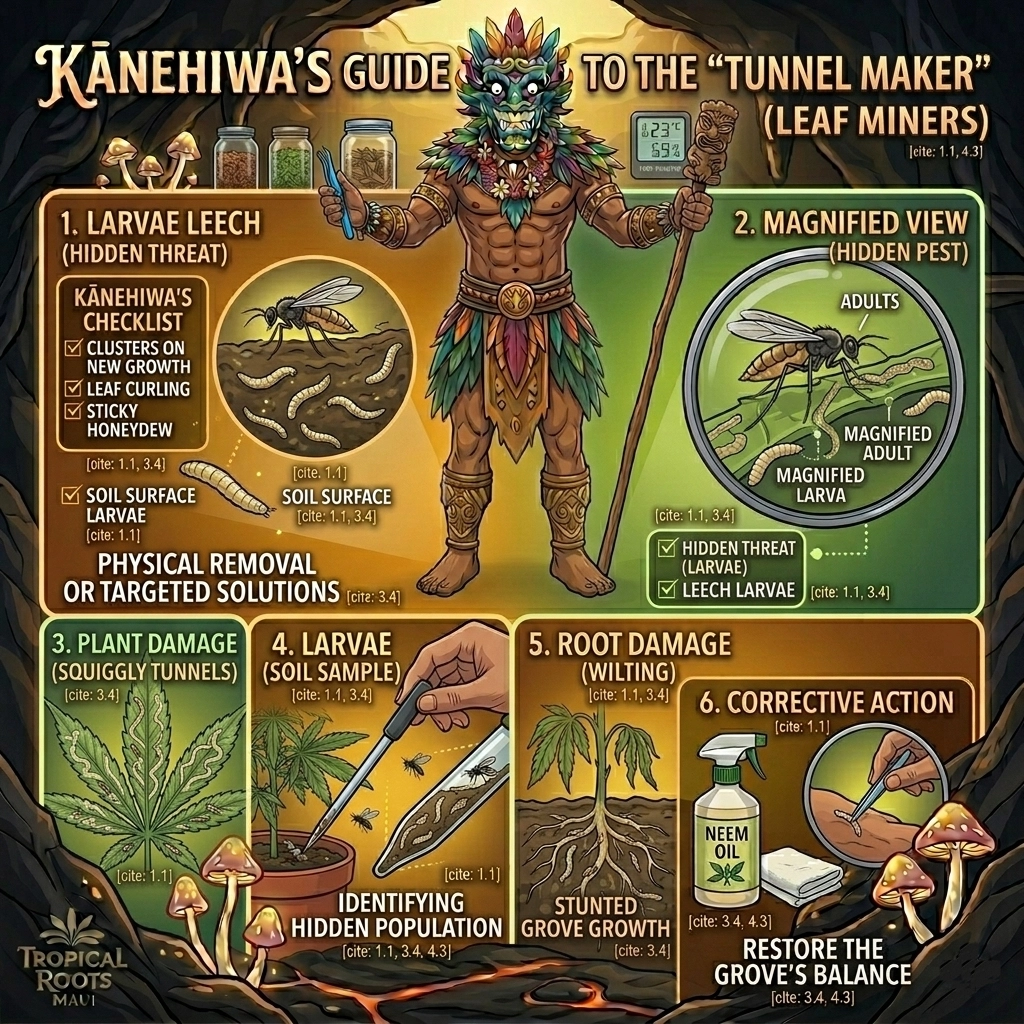
These are the hidden larvae of specific flies or moths, which live and feed exclusively inside the leaf tissue. The adult insect is small and rarely noticed; it lays eggs directly on the leaf surface. Once hatched, the larva burrows between the upper and lower layers of the leaf, carving "Mana Tunnels" as it consumes the internal tissue. The larvae themselves are rarely seen: only the unique trails of damage they leave behind reveal their presence.
A single Tunnel Maker larva can compromise multiple leaves as it feeds and grows, and because it lives inside the leaf tissue, it can be difficult to manage with surface treatments alone. By the time the squiggly tunnels are visible, the damage is already done. The best solution for a hidden threat is direct: use physical removal to pull the affected leaf and remove the danger entirely.
Look for unique "Squiggly Tunnels": light-colored, winding, serpentine mines that trace through the leaf blade. These Mana Tunnels appear as pale trails (often white or light green) that squiggle and wind across the leaf surface. The trails widen as the larva grows, and affected areas become papery and translucent.
"Shape the grove with a patient hand and a focused mind, and it will rise to greet the sun in a powerful dance. The Tunnel Maker hides within the leaf like a secret buried in the earth: you will not find her with your eyes on the surface. Look for the trails she leaves, the Mana Tunnels, and you will know she has passed." Kānehiwa
Hawaiʻi's year-round warmth means leaf miners never go dormant: multiple generations can cycle through a single growing season. The vegetable leaf miner (Liriomyza sativae) is particularly common across the islands. Maui growers should remove and destroy affected leaves immediately rather than composting them, as larvae can pupate in fallen debris. Neem oil applied as a foliar drench can deter egg-laying adults, and encouraging parasitic wasps, natural enemies already present in Hawaiʻi's ecosystem, is the most effective long-term island strategy.
 Click to expand
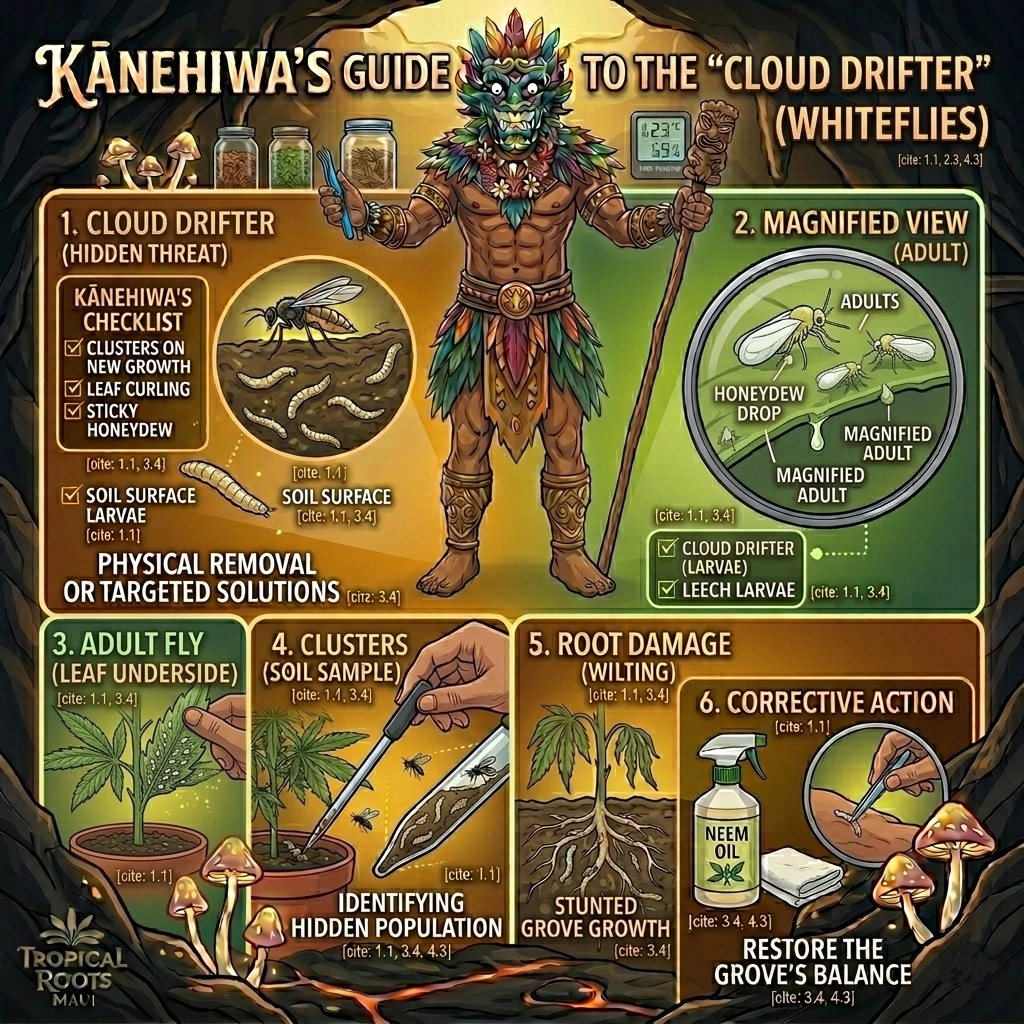
Tiny, moth-like insects with powdery white wings that congregate on the undersides of leaves. Despite their name, they are not true flies; they are closely related to aphids and scale insects. When disturbed, Cloud Drifters scatter in a distinctive white cloud, making them easy to identify. Both adults and nymphs feed by piercing leaf tissue and extracting phloem sap.
Like aphids, whiteflies excrete copious sticky honeydew that coats lower leaves and invites sooty mold. Heavy infestations cause widespread yellowing, leaf drop, and stunted growth. Their rapid reproductive cycle means a small cluster can become a full canopy infestation within two weeks in warm conditions.
Shake or brush a leaf gently: if a small white cloud of tiny insects erupts, you have Cloud Drifters. Check leaf undersides for clusters of pale, oval nymphs and tiny white adults. Look also for honeydew residue and the yellowing pattern that follows their feeding, similar to aphid damage but with the unmistakable white flutter.
"The Cloud Drifter is a ghost that feeds in daylight. She clings to the belly of the leaf and when you disturb her hiding place, she rises like mist off the morning valley. Where her cloud settles, the mana drains and the dark mold follows." Kānehiwa
The silverleaf whitefly (Bemisia tabaci) and greenhouse whitefly (Trialeurodes vaporariorum) are both well-established across the Hawaiian islands. Hawaiʻi's warm, frost-free climate allows populations to build continuously without seasonal die-off. Maui growers should deploy yellow sticky traps as early warning monitors and use reflective mulch around plant bases to disorient flying adults. The tiny parasitic wasp Encarsia formosa, available locally, is a highly effective biological control that thrives in Hawaiʻi's conditions.
 Click to expand
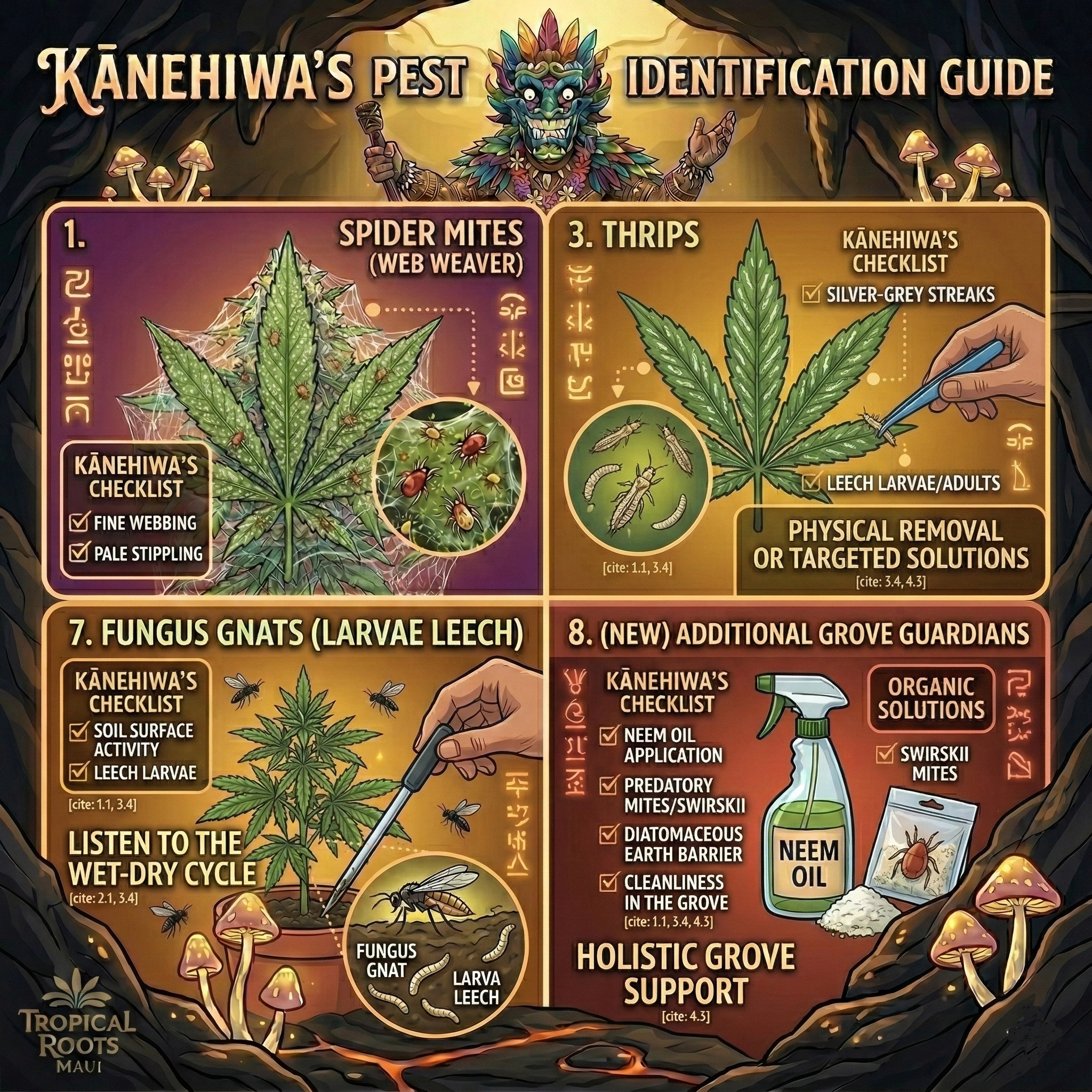
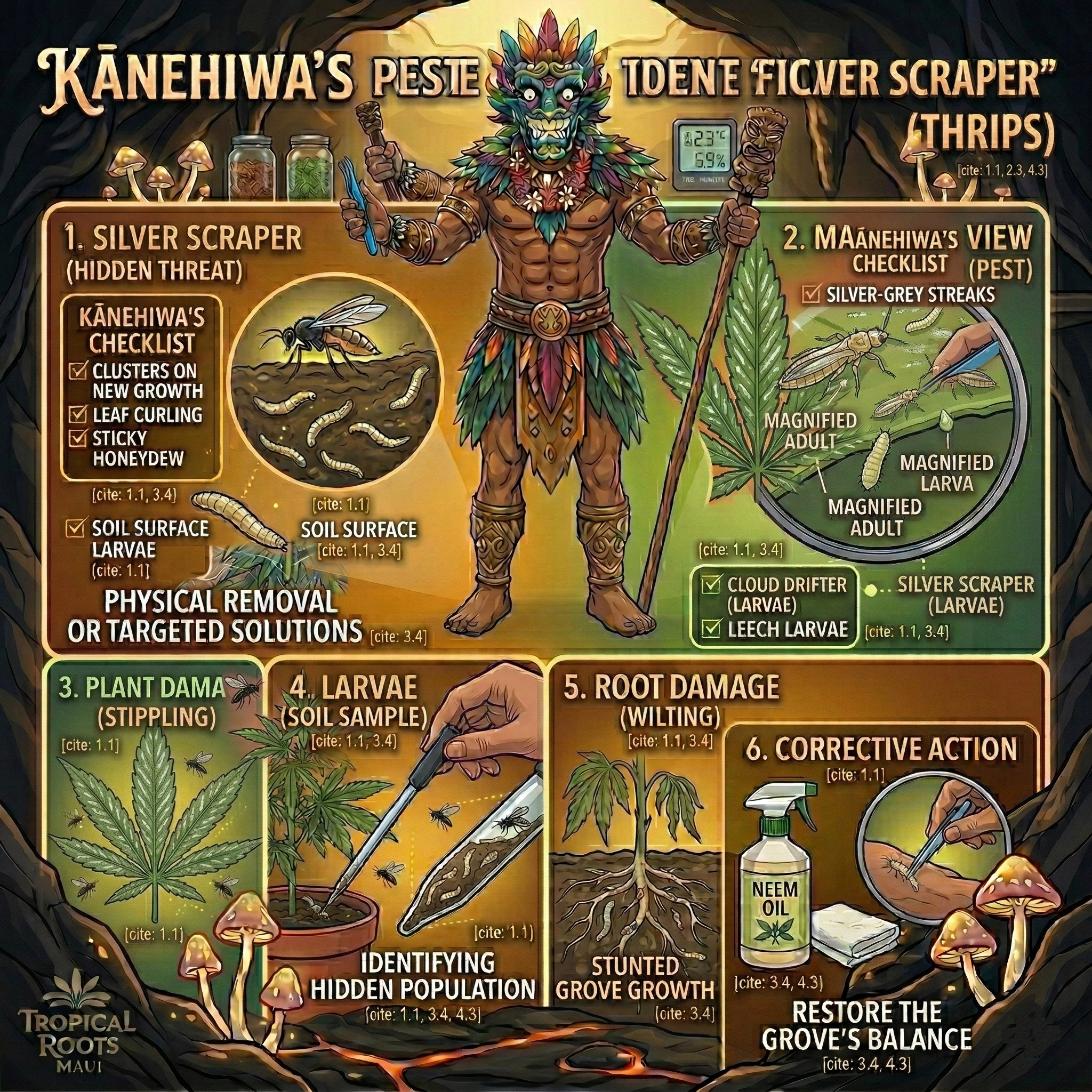
Thrips are tiny, slender insects (1–2mm) with fringed wings, ranging from pale yellow to dark brown or black. They are extremely fast-moving and hard to spot with the naked eye. Under magnification, their elongated bodies and feathery wings are distinctive. Silver Scrapers feed by rasping the leaf surface and lapping up the released cell contents, a uniquely destructive feeding style.
Thrips damage is cumulative and devastating. Heavy infestations scar buds and flowers, reducing quality and potency. They can also transmit viral diseases between plants, compounding the damage beyond their direct feeding. During flowering, thrips burrow deep into bud sites where they are nearly impossible to reach with sprays.
Look for silvery, metallic-looking streaks and patches on leaf surfaces: this is where the Silver Scraper has rasped away the upper cell layer, leaving behind a shimmering scar. Tiny black specks of frass (excrement) dot the damaged areas. Affected leaves may curl, distort, and develop a bronzed or papery texture over time.
"The Silver Scraper is the blade-dancer of the grove. She moves like the wind across the surface of the leaf, scraping the life from its skin and leaving a trail of silver scars. By the time you see her work, she has already moved on. Speed and vigilance are the only answers." Kānehiwa
Western flower thrips (Frankliniella occidentalis) and chilli thrips (Scirtothrips dorsalis) are among the most damaging pests in Hawaiʻi, affecting crops island-wide. The warm tropical climate allows thrips to complete a full lifecycle in as little as two weeks, creating overlapping generations that make control challenging. Maui growers should use blue sticky traps (thrips are more attracted to blue than yellow) alongside predatory mites like Amblyseius swirskii as biological allies. Spinosad-based organic sprays are effective but should be rotated to prevent resistance buildup.
Unlike mainland grows, Hawaiʻi has no hard frost to kill off pest populations. Insects breed year-round with no dormancy period, meaning infestations can build continuously without natural interruption.
Windward sides receive 60–120+ inches of rain annually. This persistent moisture accelerates fungal growth, creates ideal conditions for gnats, and promotes the sooty mold that follows aphid honeydew.
Consistent trade winds can spread mites and aphids between plants rapidly. Kona wind events bring hot, still air from the southwest: the perfect storm for spider mite explosions on leeward grows.
Hawaiʻi's ecosystem includes powerful natural predators: green lacewings, ladybugs, predatory mites, and geckos. Protect these allies by using organic IPM methods and avoiding broad-spectrum sprays that disrupt the natural balance.
Maui growers face unique challenges, but the island also provides unique tools. Work with the ʻāina, not against it. Neem oil, insecticidal soaps, and companion planting with local herbs like Hawaiian basil are your first line of island-friendly defense.
"The island gives and the island takes. Her rain feeds the roots, but it also feeds the enemy. A guardian of the grove must learn both sides of the rain: the blessing and the burden. Work with the ʻāina, and she will fight beside you." Kānehiwa
Confirm the pest using this guide. Use magnification. Know your enemy before you act.
Quarantine affected plants immediately. Stop the spread before treating the infestation.
Apply the appropriate organic treatment. Restore the grove's balance with patience.
A core principle of the grove: once a threat is Identified, a guardian must always Take Corrective Action. Restoration of the grove's mana requires multiple approaches; Kānehiwa recommends Organic Solutions to restore balance and prevent recurrence.
Maintain proper moisture balance in the Sacred Earth. Let the top few inches dry between waterings to break fungus gnat breeding cycles and promote healthy root development. Never saturation, always rhythm.
A staple of organic pest management. Apply neem oil as a foliar spray to deter soft-bodied pests like aphids and mites, and as a soil drench to disrupt leaf miner egg-laying. Safe for the grove when used correctly.
Introduce beneficial predatory mites to combat spider mites naturally. These allies hunt and consume pest mites without harming the plant. A living defense system that works with the grove's balance.
For hidden threats like the Tunnel Maker, direct removal of affected leaves is the most effective action. Remove and destroy; never compost infested material. Sometimes the simplest solution is the strongest.
This guide covers the most common pests encountered by home growers. Always confirm your identification before treating; misidentification can lead to unnecessary treatments that harm beneficial insects. When in doubt, isolate first and research second. For complete treatment protocols and organic solutions, visit the full knowledge base at tropicalrootsmaui.com.