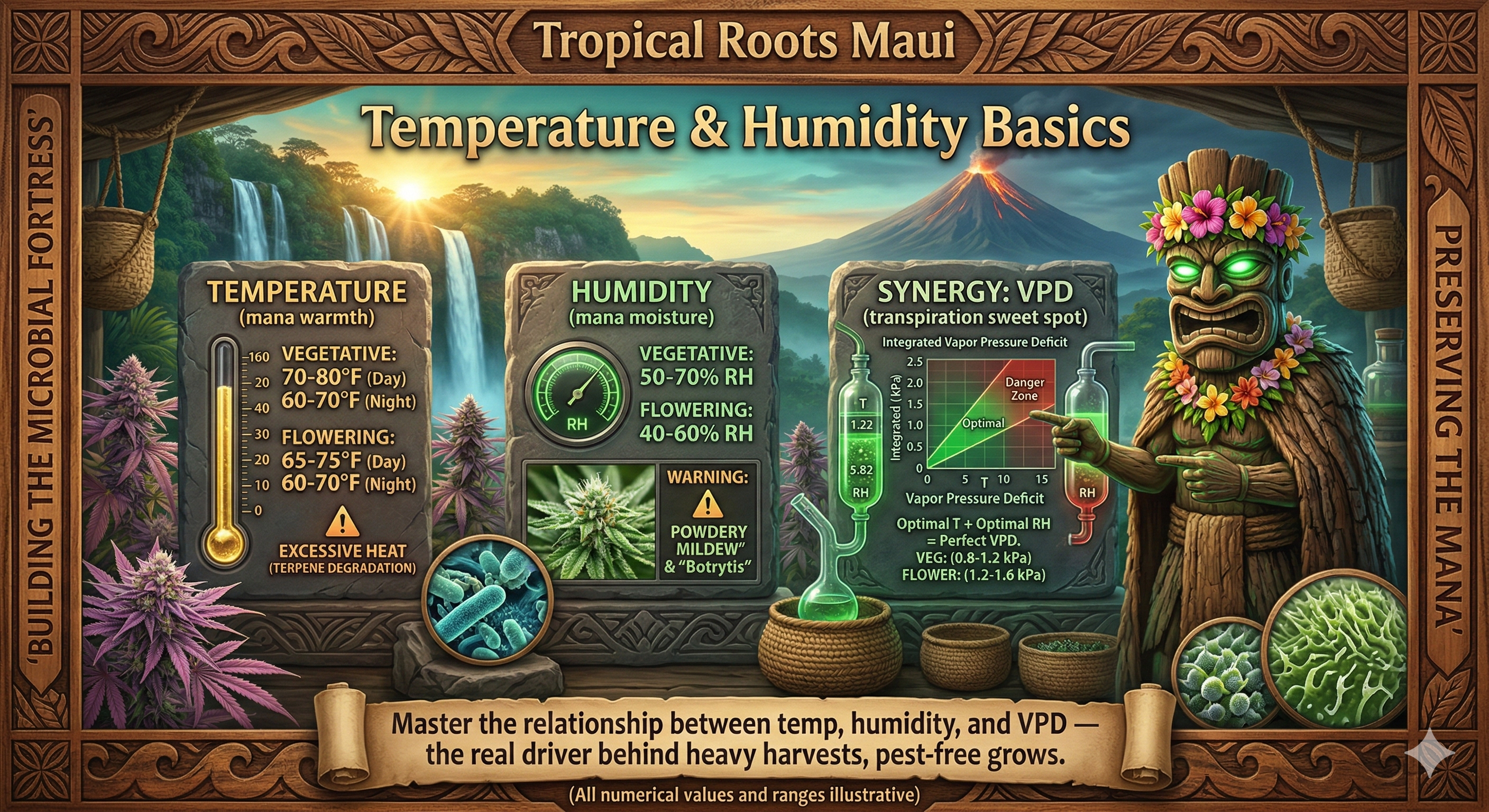
Temperature &
Humidity Basics
Master the relationship between temp, humidity, and VPD: the real driver behind heavy harvests, pest-free grows. Kānehiwa guides you through our foundational Temperature & Humidity Basics guide. Learn how to optimize Vapor Pressure Deficit (VPD) and lock in the ideal environment. (All data are illustrative).
| Growth Stage | Temp (Lights On) | Humidity (RH) | Target VPD |
|---|---|---|---|
| 🌱 Seedling / Clone | 75–82°F / 24–28°C | 70–80% | 0.4–0.8 kPa |
| 🌿 Early Veg | 75–85°F / 24–29°C | 60–70% | 0.8–1.0 kPa |
| 🍃 Late Veg / Transition | 72–82°F / 22–28°C | 50–60% | 1.0–1.2 kPa |
| 🌸 Early / Mid Flower | 70–80°F / 21–27°C | 40–50% | 1.2–1.5 kPa |
| 🍂 Late Flower / Ripening | 65–75°F / 18–24°C | 35–45% | 1.5–1.6 kPa |
-
1Raise Humidity / Lower Temp
In a small tent, your LED is the biggest source of heat, and heat drops relative humidity fast. If you're running too dry, dim your LED first before reaching for a humidifier. Less heat means the air holds onto moisture longer. If that's not enough, place a bowl of water or a damp towel in front of your intake fan to add moisture passively, a cheap and effective trick that doesn't require extra equipment. For exhaust, run it on a timed or temperature-triggered controller rather than full blast: this keeps humidity from being stripped out constantly.
🌺 Hawaiʻi Island Tip You'll rarely need this step on Maui: humidity is almost always too high, not too low. The only exception is indoor tents on the leeward side (Kīhei, Wailea) during dry summer months, where a window AC unit can strip RH below 40%. If that happens, just crack a mesh vent wider before adding any humidifier, the island air outside is usually all the moisture you need. -
2Lower Humidity / Raise Temp
Plants transpire through their leaves: the more leaf surface, the more moisture they release into the air. Lollipopping (removing fan leaves from the bottom third of the plant) meaningfully drops ambient humidity in the tent and improves airflow to the canopy. Make sure your oscillating fan is aimed between the plants, not just above them. Stagnant pockets of humid air between dense colas is where botrytis starts. For late flower, a small peltier dehumidifier usually won't cut it: you'll want a compressor-based unit placed outside the tent near the intake.
⚠️ Late Flower Warning 35–45% RH in late flower is non-negotiable. Dense Hawaiian genetics and heavy colas are highly susceptible to bud rot when humidity climbs above 50% in the final weeks. Don't wait for symptoms: dial it down early.🌺 Hawaiʻi Island Tip This is the single most critical step for Maui growers. Ambient RH of 65–85% is normal island-wide, which means the air entering your tent is already dangerously wet. A peltier dehumidifier won't cut it: invest in a compressor-based unit rated for at least 30 pints/day and place it outside the tent feeding dry air to the intake. During Kona wind events (southerly, hot, still air), humidity spikes island-wide and your dehumidifier runs nonstop; budget for the electricity accordingly. -
3The Lights-Off Danger Zone
The most common and costly mistake in small tent growing is ignoring the dark cycle. When the lights go off, temperature drops, and as temperature drops, relative humidity spikes. This is the window when powdery mildew and bud rot (Botrytis) strike. The fix is straightforward: keep your exhaust fan running through the dark period, and work to keep your lights-off temperature within 10°F of your lights-on temp. If your tent drops to 65°F at night, RH should be no higher than 45%.
A mini split, space heater on a thermostat, or even leaving your tent room's door open to warmer air can help hold nighttime temps steady. The smaller the temp swing, the smaller the RH swing.🌺 Hawaiʻi Island Tip Hawaiʻi's warm nights are a double-edged sword: temperature barely drops, but humidity climbs hard once lights-off removes the tent's only heat source. You won't need a space heater like mainland growers, but you absolutely need your exhaust fan and dehumidifier running through the entire dark cycle. Kona wind nights are the worst: hot, still, and saturated. If you run lights at night (recommended for Hawaiʻi), your "danger zone" is actually daytime when ambient temps peak and the tent sits dark and humid. -
4Measuring Like a Pro
Don't trust the reading on your humidifier's display or your fan controller's built-in sensor alone: they're rarely calibrated well. Use a dedicated hygrometer hung at canopy level, shaded from direct light by a small piece of cardboard or a large leaf. If the sensor sits in direct light from your LED, it will read several degrees warmer than the actual air temperature and throw off your whole picture. For true VPD accuracy, use an infrared thermometer to check the actual leaf surface temperature: leaves run 2–3°F cooler than the surrounding air, and it's the leaf temp that determines real transpiration rate.
Pro Measurement Tips- Hang hygrometer at canopy height, not on the tent floor or wall
- Shield it from direct light with a small "leaf hat" of cardboard
- Use an infrared thermometer to check leaf surface temp, usually 2–3°F below air temp
- Plug leaf surface temp into the VPD calculator above for the most accurate reading
- Check readings both during lights-on and lights-off: the dark cycle often tells a different story
🌺 Hawaiʻi Island Tip Place a second sensor outside your tent or room to track Hawaiʻi's ambient conditions in real time. The difference between a trade wind day (NE breeze, 60–70% RH) and a Kona wind day (S/SW, 75–85% RH) completely changes how hard your dehumidifier works. Smart controllers like the AC Infinity 69 Pro can automate fan speed based on humidity thresholds, essential for island growers who can't babysit conditions through every weather shift.
- Seedling: 75–82°F / 70–80% RH / VPD 0.4–0.8 kPa
- Early Veg: 75–85°F / 60–70% RH / VPD 0.8–1.0 kPa
- Late Veg: 72–82°F / 50–60% RH / VPD 1.0–1.2 kPa
- Early/Mid Flower: 70–80°F / 40–50% RH / VPD 1.2–1.5 kPa
- Late Flower: 65–75°F / 35–45% RH / VPD 1.5–1.6 kPa
- Dim the LED first to reduce heat before reaching for a humidifier
- Lollipopping drops humidity: the fewer leaves, the less the plant sweats
- Keep exhaust running during lights-off: humidity spikes when the light goes out
- Temp swing at lights-off should stay within 10°F of lights-on temp
- Hygrometer goes at canopy level, shaded from direct light, leaf temp reads 2–3°F cooler than air
This guide is provided for educational purposes only. Always research local laws and regulations before cultivating.