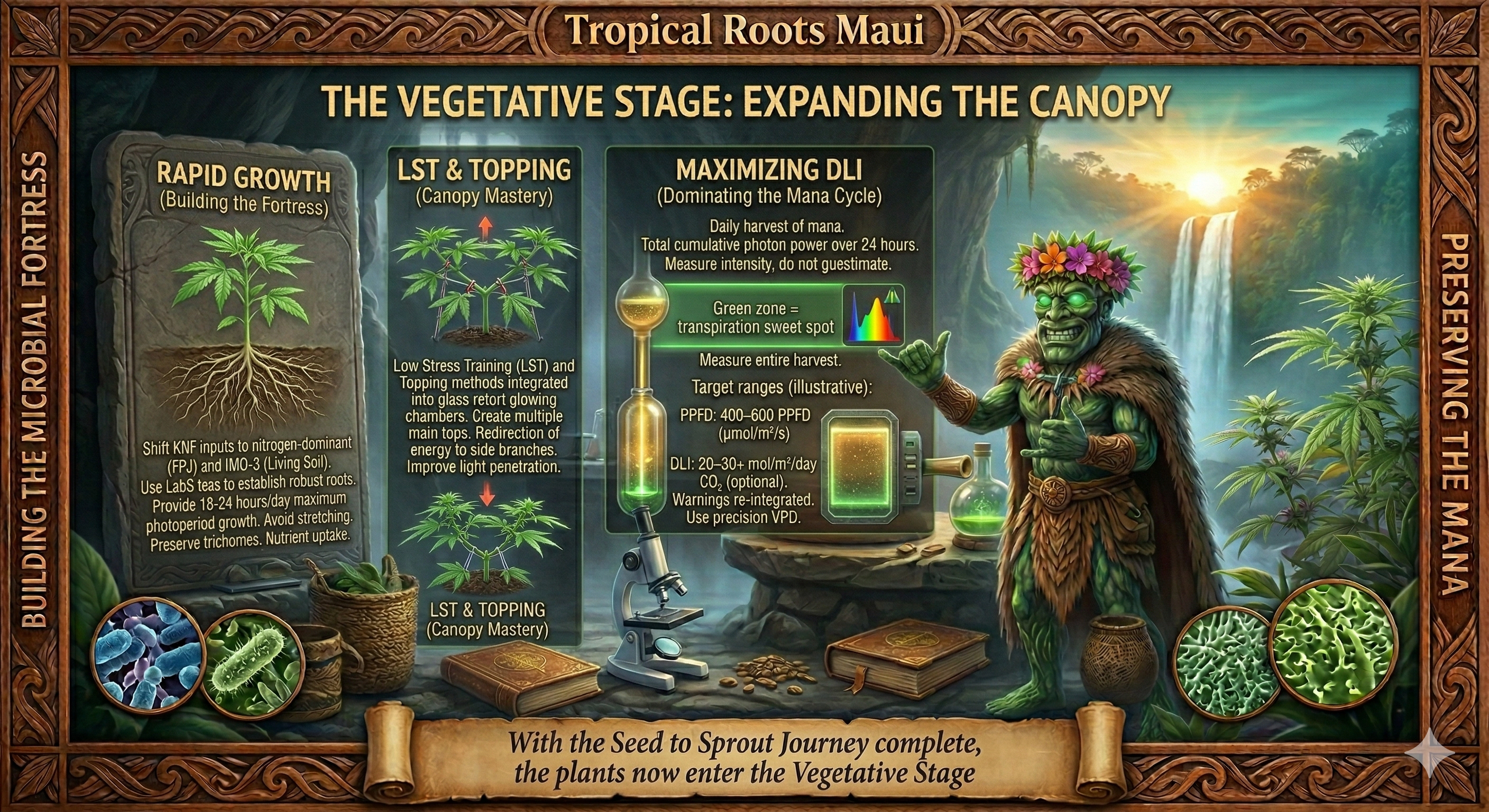
The Vegetative Stage
Expanding the Canopy
With the Awakening complete, the plants now enter the Vegetative Stage, a time of powerful, expansive growth. Kānehiwa guides you through transitioning inputs to FPJ and IMO-3, deploying precision training techniques, and optimizing DLI/VPD to dominate canopy space. (All data are illustrative).
The Vegetative Grove: Expanding the Canopy
This is the phase where your plants build the "solar panels" they will need for flowering.
🌱 Growth FocusThe goal is to develop a strong root system, thick stalks, and multiple sets of lush, green fan leaves. Every bit of vegetative growth translates directly into flower-producing potential.
☀️ The "Sacred Light"Kānehiwa recommends the 18/6 light schedule: 18 hours of "sun" and 6 hours of sacred rest. The young grove thrives on a diet of full-spectrum light, reaching for the energy with open palms. For guidance on dialing in your light intensity, see the DLI & PPFD Guide.
🌡️ EnvironmentA warmer, humid cave mimicking a bright tropical day is best: 70–85°F and 45–55% humidity. This balanced mana keeps the leaves from thirsting or drowning. For a deeper dive into VPD targets, visit the Temp & Humidity Guide.
Structuring for Strength: Training & Pruning
Do not let your grove grow wild. Like training a vine, you must direct its energy for a better harvest.
✂️ Topping & FIMingA true guardian is not afraid to prune. By removing the main growing tip, you encourage the plant to split into multiple main "trunks," creating a bushier, more productive grove. This is done between nodes 3 and 5. FIMing (pinching ~75% of the tip) produces a similar effect with slightly less stress.
🍃 DefoliationRemove any large, old leaves that are blocking light from the lower branches or restricting airflow. Kānehiwa warns: always listen to the plant's mana. Remove too many, and you weaken the grove's spirit. A good rule is never more than 20% of the canopy in a single session.
💨 AirflowA gentle trade wind must blow through the canopy. Clip an oscillating fan to the frame to build stronger stems and prevent stagnant air where rot or pests can hide. For detailed training techniques, see the Plant Training Mastery: Shaping the Mana.
Nourishing the Roots: Food & Water
The roots are the plant's anchor and its stomach. Respect them.
💧 The Wet-Dry CycleDo not drown the sacred earth. Water only when the top few inches of soil are dry to the touch. Allow the pot to become light before watering again, encouraging roots to seek new moisture. Overwatering is the number one killer of young plants.
However, if you are growing in living soil, never let the pot dry out completely. The beneficial microorganisms, fungi, and bacteria that make living soil work need consistent moisture to survive. A bone-dry pot kills the microbial life you've worked to build. The goal is moist but not soggy: think of a wrung-out sponge. Consider using living soil fabric pots with plastic-lined walls, like those from Grassroots Living, which retain moisture along the sides while still allowing drainage at the bottom, ideal for keeping the soil biology alive between waterings. See the Microbial Fortress Guide for how to build and maintain your root zone defense.
🪴 Bottom WateringPlace your pots in a tray or saucer and water from the bottom up. The soil wicks moisture upward through capillary action, encouraging roots to grow downward in search of water, building a stronger, deeper root system. Bottom watering also keeps the top layer of soil dry, which is your best natural defense against fungus gnats. These pests lay their eggs in moist topsoil; a dry surface breaks their life cycle without chemicals. Let the pot sit in water for 15–20 minutes until the top feels damp, then remove any excess.
This stage demands high amounts of Nitrogen (the N in N-P-K). Look for a standard vegetative nutrient formula or use compost teas rich in nitrogen and micronutrients. Always feed from the roots up, and watch for signs of deficiency or burn. For a hand-mixed organic approach, see the DIY Living Soil Guide.
🌿 Organic Nitrogen SourcesFor growers who prefer to keep it natural, there are plenty of organic ways to feed the grove during veg:
Earthworm Castings: The gold standard of organic amendments. Top-dress a handful around the base of each plant or brew into a tea. Gentle, slow-release nitrogen that won't burn, plus it's loaded with beneficial microbes.
Compost Teas: Brew aerated compost tea using worm castings, kelp meal, and a tablespoon of unsulphured molasses to feed the microbes. Apply as a soil drench every 1–2 weeks for a living soil boost.
Fish Hydrolysate: A cold-processed fish fertilizer (not fish emulsion, which is heat-treated). Rich in nitrogen and amino acids. Dilute per label and apply as a root drench. It smells strong but the plants love it.
Kelp Meal / Liquid Kelp: Not high in nitrogen on its own, but packed with growth hormones, micronutrients, and trace minerals that support vigorous vegetative growth. Great as a foliar spray or soil amendment.
Neem Seed Meal: A dual-purpose amendment that provides slow-release nitrogen while also deterring soil pests like fungus gnats and root aphids. Top-dress into the soil surface.
Alfalfa Meal: Contains triacontanol, a natural growth stimulant, alongside a solid nitrogen profile. Mix into the top layer of soil or brew into a tea.
Malted Barley: Freshly ground malted barley is rich in enzymes that break down organic matter and make nutrients available to roots. Sprinkle a light top-dress every week or two.
If leaves begin to yellow or show spots, consult the Plant Deficiency Guide to diagnose and correct the issue before it costs you growth.
This guide is provided for educational purposes only. Always research local laws and regulations before cultivating. Tropical Roots Maui assumes no responsibility for actions taken based on this information.