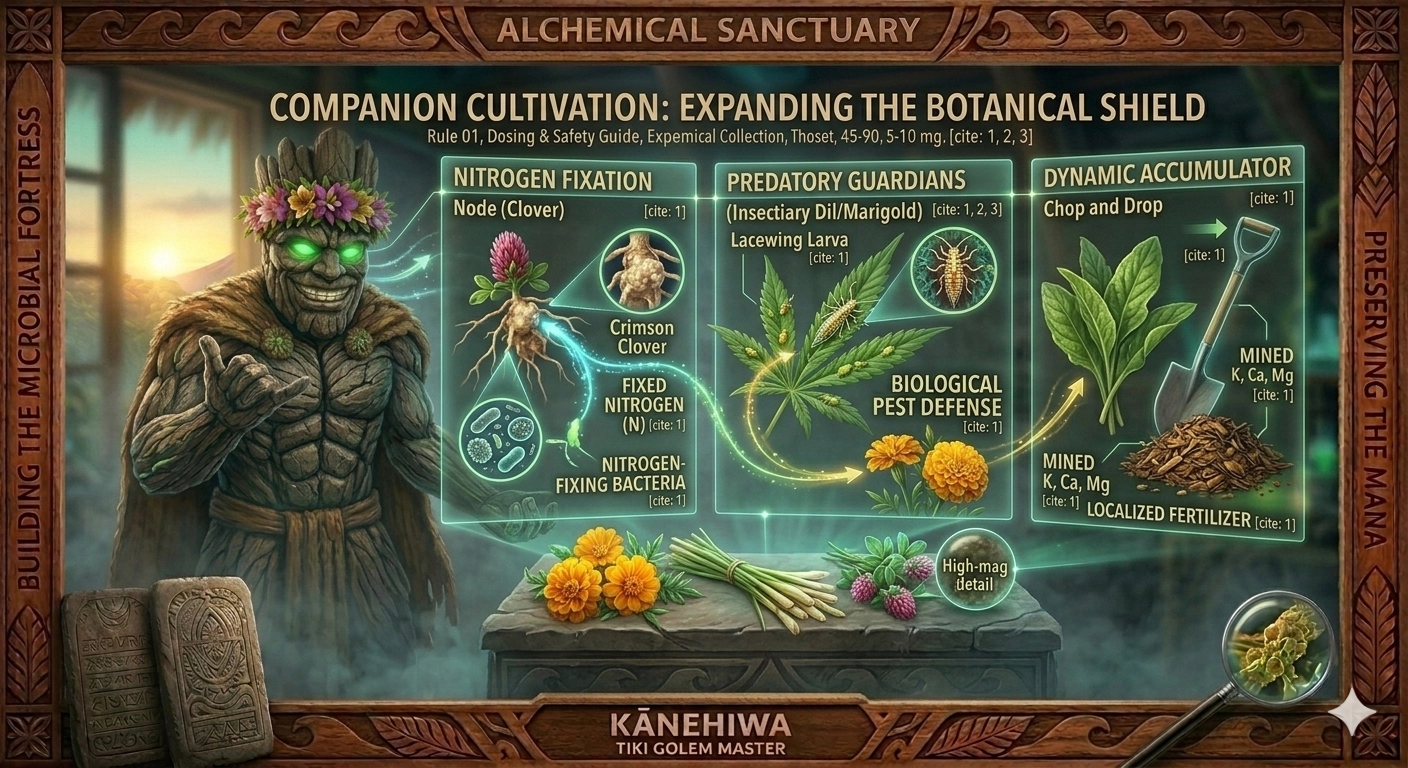
Companion Cultivation
Expanding the Fortress
The Botanical Shield · Nature's Defense for the Maui Grove
"Rather than fighting bugs with external sprays, we expand the fortress from the ground up. Nature's own chemical and biological defenses are the strongest shields."
In the humid Alchemical Sanctuary of Maui, where pests are year-round, IPM must be as natural and dynamic as the 'āina itself. By introducing specific companion plants, we surround our high-value cannabis phenotypes with a synergistic Botanical Shield that attracts guardians and repels thieves.
Exposed Maui soil is vulnerable soil. In a tropical environment, the topsoil must be shielded from intense UV light and heavy rain to protect the Microbial Fortress beneath.
A fast-growing cover crop that creates a dense green blanket over exposed soil. Clover is a master Nitrogen Fixer: it pulls free nitrogen from the atmosphere, stores it in root nodules, then releases fixed nitrogen to the cannabis during decomposition. A living fertilizer factory.
Grows rapidly to form a thick living mulch that suppresses weeds and shields the rhizosphere from UV degradation. Its white flowers attract beneficial pollinators and predatory insects. After flowering, chop it down; it decomposes quickly, returning phosphorus and calcium to the topsoil.
Not all fertilizer comes from a bottle. Certain plants excel at mining specific minerals deep in the Maui subsoil (far below where cannabis roots reach) and pulling them to the surface where they become available.
The king of dynamic accumulators. Comfrey's massive taproot reaches 6–10 feet deep, mining significant amounts of Potassium (essential for flowering), along with calcium, phosphorus, and trace minerals. Its large leaves decompose rapidly when chopped, creating a full-spectrum localized fertilizer.
A hardy perennial that accumulates potassium, phosphorus, copper, and sulfur from deep subsoil. Its fine, feathery flowers also serve double-duty as an insectary: attracting lacewings, ladybugs, and parasitic wasps. An IPM workhorse that feeds the soil and the guardian army simultaneously.
A strong fortress must have internal soldiers. Companion plants serve as the barracks for our Biological Guardians: the predatory insects that consume spider mites, thrips, and aphids before they can threaten your harvest.
Bright marigolds attract pollinators above ground while simultaneously repelling detrimental nematodes in the soil through root exudates. French Marigolds (Tagetes patula) are the most effective: their roots release thiopene, a compound toxic to root-knot nematodes. Plant them as a dense border around your cannabis.
Plants with abundant, fine-petaled flowers like dill are irresistible to Predatory Wasps, Lacewings, and Ladybugs. These beneficial insects are the true IPM champions, naturally consuming massive quantities of soft-bodied pests. A single lacewing larva can eat 200+ aphids per week.
| Guardian | Attracted By | Targets |
|---|---|---|
| 🐞 Ladybugs | Dill, Yarrow, Marigolds | Aphids, mealybugs, scale insects, mites |
| 🦟 Lacewings | Dill, Fennel, Yarrow | Aphids, thrips, whiteflies, spider mites, caterpillar eggs |
| 🐝 Parasitic Wasps | Dill, Cilantro, Buckwheat | Caterpillars, aphids, whiteflies (lay eggs inside pests) |
| 🪲 Ground Beetles | Clover ground cover | Slugs, cutworms, root maggots, soil-dwelling larvae |
Sometimes the best defense is confusing the enemy. We use plants with intense volatile odors to mask the mana scent of our cannabis, making it difficult for pests to locate your high-value phenotypes by smell.
Lemongrass is a powerful natural source of Citronella, which deters mosquitoes, whiteflies, and other flying pests. It also contains Myrcene, the same terpene dominant in cannabis, creating an aromatic overlap that confuses pest navigation. Plant dense clumps on the windward perimeter of your grove.
Maui basil emits strong, peppery volatiles rich in Eugenol and Linalool. When planted on the perimeter, these aromatic compounds create a chemical camouflage that disrupts pest orientation: flying insects searching for cannabis by its terpene signature instead encounter a wall of conflicting signals.
Spacing matters: Keep aromatic perimeter plants at least 3–4 feet from cannabis to prevent root competition and ensure the cannabis terpene profile isn't contaminated during flowering. The odor screen works through airborne volatiles, not root-zone interaction.
| Companion | Role | Key Benefit | Placement |
|---|---|---|---|
| ☘️ Crimson Clover | Living Mulch | Nitrogen fixation, soil cover, weed suppression | Understory / ground cover |
| 🌾 Buckwheat | Living Mulch | Fast cover, pollinator attractor, phosphorus return | Understory / between rows |
| 🌿 Comfrey | Dynamic Accumulator | Deep potassium mining, chop & drop fertilizer | Borders / 2–3 ft from cannabis |
| 🌼 Yarrow | Accumulator + Insectary | Multi-mineral mining, attracts lacewings & wasps | Borders / interspersed |
| 🌻 Marigolds | Pest Deterrent | Nematode suppression, pollinator attractor | Dense border ring |
| 🌿 Dill | Insectary | Attracts predatory wasps, lacewings, ladybugs | Within 3 ft of cannabis |
| 🍋 Lemongrass | Odor Screen | Citronella deters flying pests, Myrcene camouflage | Windward perimeter |
| 🌿 Maui Basil | Odor Screen | Eugenol & Linalool volatiles disrupt pest navigation | Outer perimeter, 2 rows deep |
On Maui's wet side (Haiku, Nahiku), fungal pressure is your primary enemy: prioritize airflow plants like dill and yarrow that don't create dense moisture traps. On the dry side (Kihei, Lahaina), spider mites are the main threat: focus heavily on lacewing-attracting insectary plants and lemongrass borders.
Maui's volcanic soil is naturally rich in trace minerals and iron but often low in available nitrogen and potassium. This makes crimson clover (nitrogen) and comfrey (potassium) the two most important companions for island cannabis; they fill the exact gaps that volcanic soil leaves open.
Consider integrating Hawaiian native plants into your companion scheme. 'Ōlena (Hawaiian turmeric) has natural anti-fungal properties in the root zone. Noni leaves can be used as a mulch with mild pest-deterrent qualities. Working with native species honors the 'āina while building a more resilient ecosystem.
Unlike mainland growers with distinct seasons, Maui's year-round growing means year-round pest pressure. Rotate your cover crops quarterly: buckwheat in spring, clover through summer, then back to buckwheat. This prevents any single pest population from establishing permanently in the understory.
For educational purposes only. This guide covers organic companion planting strategies for legal cannabis cultivation. Always follow local agricultural regulations and laws. Results vary by climate, soil type, and pest pressure. The information provided is not a substitute for professional agricultural consultation.