Reading Trichomes
When to Harvest
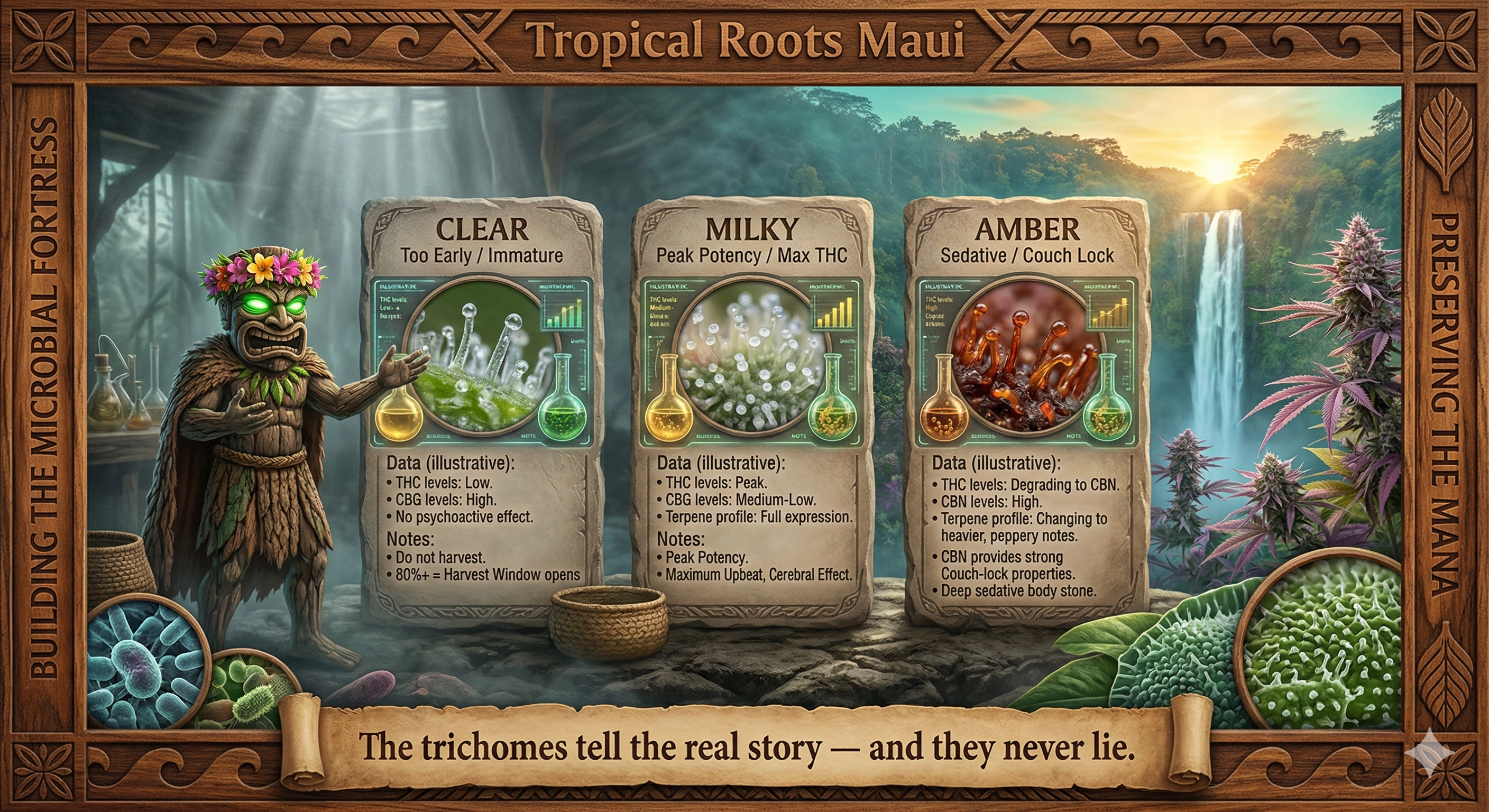
Look past the pistils. The trichomes tell the real story, and they never lie. Kānehiwa guides you through the Tropical Roots Maui definitive guide to trichome maturity. Learn to identify the transition from clear to peak milky and final amber states to lock in your desired potency.
Knowing exactly when to harvest is the difference between a "heady" uplifting buzz and a "heavy" couch-lock effect. To get it right, you need to look past the orange hairs (pistils) and focus entirely on the trichomes: those tiny resin glands that look like glass mushrooms. You can't see them with the naked eye. Use a 60x jeweler's loupe or a digital USB microscope to get a clear view of those resin heads.
Stage
Trichomes look like clear glass beads, transparent all the way through. See the left column of the Trichome Maturity Guide above for reference.
The plant is still producing cannabinoids. THC levels are very low.
If harvested now, the flower will be weak and may cause "racy" anxiety or headaches.
Wait. The mana is still building.
Cloudy" Stage
The heads turn from clear to an opaque, plastic-white color, like frosted glass. Compare with the center column of the Trichome Maturity Guide above.
THC levels are at their absolute maximum.
The most "psychoactive" and energetic high. Perfect for those legendary Hawaiian Sativa-leaning strains.
You are in the harvest window. Most growers aim for 80–90% milky trichomes.
Stage
The milky heads begin to turn a golden or honey-brown color. See the right column of the Trichome Maturity Guide above for the amber transition.
THC is beginning to degrade into CBN (Cannabinol).
CBN is known for its heavy, sedative, and relaxing "couch-lock" properties. Great for medical use or nighttime relaxation.
If you see more than 20–30% amber, harvest immediately, unless you want a very sleepy effect.
Trichomes on sugar leaves mature much faster than those on the actual buds (calyxes). Always judge your harvest based on the trichomes tucked inside the flower itself.
While trichomes are the gold standard, look at the hairs too. When 70–90% of the white hairs have turned orange/brown and curled in, you are officially in the "trichome-watching" zone.
Some island growers swear by giving the plants 48 hours of total darkness right before the chop to "stress" the plant into one last resin push.
You can't see trichome stages with the naked eye. Use a 60x jeweler's loupe or a digital USB microscope to get a clear view of those resin heads.
| Desired Effect | Trichome Appearance |
|---|---|
| ⚡ Uplifting / Cerebral |
10% Clear
90% Milky
|
| ⚖️ Balanced / Full Potency |
90% Milky
10% Amber
|
| 🌙 Sedative / Relaxation |
70% Milky
30%+ Amber
|
| Week | Pistil Color % | Trichome Status | Notes (Smell, Density, Fade) |
|---|---|---|---|
| Week 7 | White/Orange % |
Clear Milky Amber |
|
| Week 8 | 50% Orange/Red |
Clear Milky Amber |
|
| Week 9 | 50% Orange/Red |
Clear Milky Amber |
|
| Flush | 80++ Red/Curled |
Clear Milky Amber |
Estimating Your Hashish Yield
Calculating your expected hashish yield from raw cannabis flower depends on several variables, primarily the quality of your starting material and the extraction method used (Ice Water Hash vs. Dry Sift). On average, most cultivators expect a return between 10% and 20% of the starting dry weight, though "washing" fresh frozen material results in different ratios.
Typical Yield Ranges:
The math changes significantly with "Live" extraction (Fresh Frozen). Since fresh plants are roughly 75% to 80% water weight, the starting weight is much higher, but the final resin weight remains the same.
| Material Type | Expected Yield | Example |
|---|---|---|
| Dried Flower | 12% – 20% | 1,000g dry → 150g hash |
| Fresh Frozen | 3% – 5% | 1,000g wet → 40g hash |
Note: A 4% yield on Fresh Frozen is often considered excellent: it is roughly equivalent to a 16%–20% yield on the same material if it had been dried.
"Capitate-stalked" trichomes (the ones with large bulbous heads) break off easily and provide the highest yield. If the strain has "sessile" (headless) trichomes, your yield will be significantly lower regardless of how "frosty" it looks.
Your total yield is the sum of all collected bags. However, "Full Melt" is usually only found in the 73µ to 90µ range.
Over-agitating increases yield but introduces chlorophyll and plant contaminants, turning the hash green and lowering quality. Gentle is better: prioritize quality over quantity.
🌺 Rosin Press Return: If you plan to press your hash into Live Rosin, expect a 60% to 80% return from the hash weight, depending on the pressure and temperature of your press. The calculator below includes this step.
⚗️ Hash Yield Calculator
Enter your starting material details below to estimate your expected hashish and rosin yields.
Calculation: 100g × 10% = 10g (low) | 100g × 12.5% = 12.5g (mid) | 100g × 15% = 15g (high)
Ice Water Hash Extraction
Once you've dialed in your harvest window using trichome reading, the next step for many cultivators is solventless extraction. Ice water hash (bubble hash) separates the trichome heads from the plant material using nothing but ice, water, and agitation.
| Micron | Grade | Use |
|---|---|---|
| 160µ – 120µ | Work Grade | Edibles, Topicals |
| 90µ – 73µ ⭐ | Full Melt | Dabbing, Rosin Press |
| 45µ – 25µ | Food Grade | Infusions, Joints |
This guide is intended for adults in jurisdictions where cannabis cultivation is legal. Always research your local laws before growing. Harvest windows vary by strain, environment, and personal preference: use this as a starting point, not a hard rule.