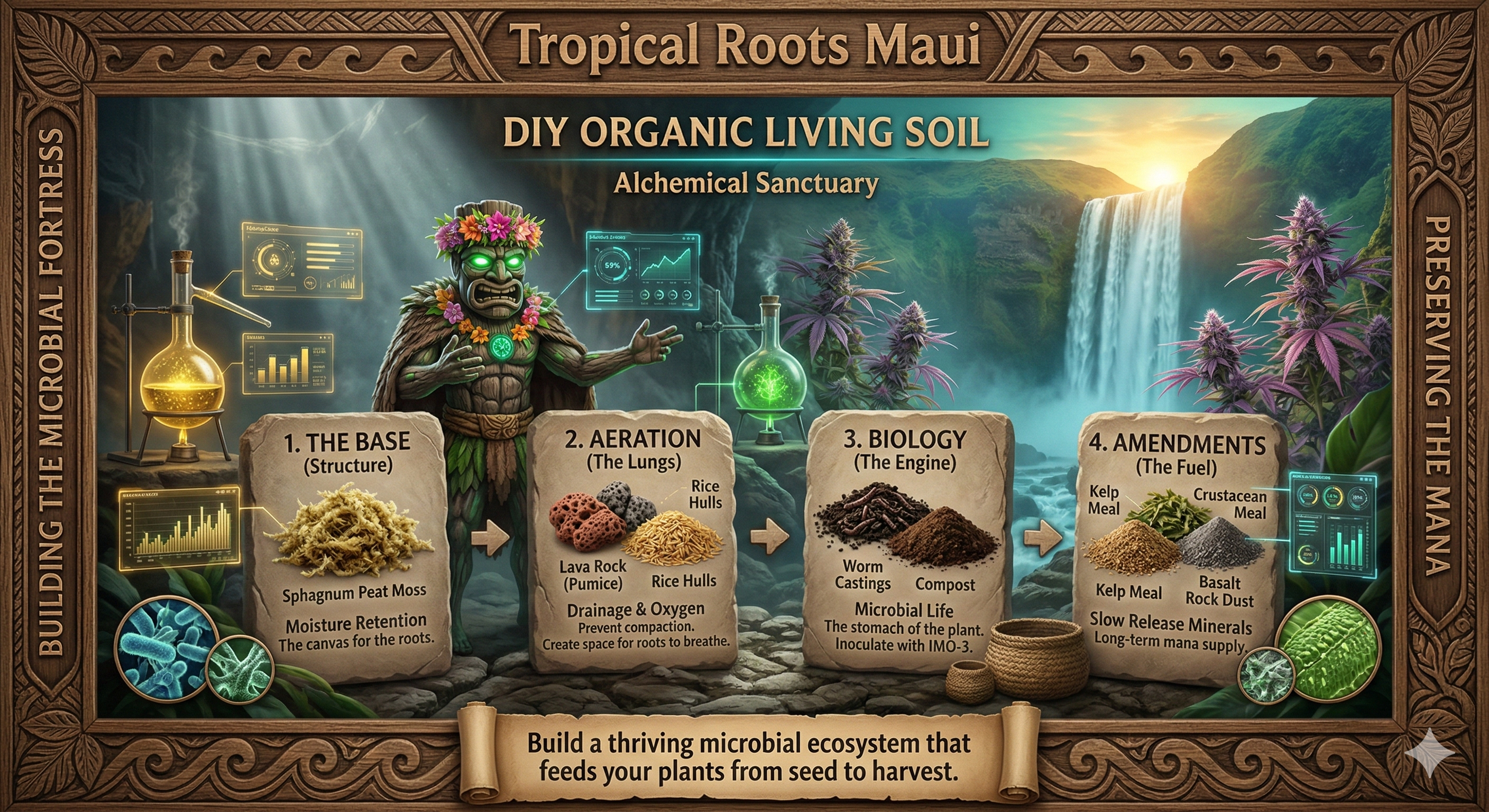
DIY Organic
Living Soil
Feed the soil, not just the plant. Kānehiwa breaks down the four pillars of a true living soil system: Structure, Aeration, Biology, and Amendments. By mimicking nature's forest floor, you build a self-sustaining microbial fortress that fuels your Maui cultivars from seed to harvest.
-
1Build the Base Soil
Build the base by volume: 30% coco coir, 30% compost, and 10% charged biochar, then blend in your aeration: 20% pumice and 10% rice hulls. Coco replaces peat as a neutral-pH, renewable base that thrives in tropical heat and humidity. Because coco binds calcium and magnesium, the Dolomite and Gypsum in the amendment list carry extra weight here. Don't skip them.
💡 Tip Charge your biochar first: soak it in compost tea or a Cal-Mag/EWC slurry for 1–2 weeks. Raw biochar is a nutrient sponge and will pull feed away from your plants until it's saturated.🌺 Hawaiʻi Island Tip Swap the pumice for local volcanic cinder (pahoehoe): it's cheap and abundant on-island, holds trace minerals from Maui's volcanic soil, and never breaks down. Hawaiʻi's tropical rains and high humidity waterlog standard mixes fast, so lean toward the higher end of aeration (30–40% total) rather than the mainland standard of 25%. -
2Inoculate with Microbes
Add your choice of microbial inoculant: ReCharge, Fish Sh!t, Mammoth P, or all three. Also add Mycorrhizae at this stage: coco is inert and carries no native fungal life, so inoculating is especially important in a coco-based mix. These organisms are the engine of living soil: they break down organic matter into forms the plant can absorb. See the Microbial Fortress Guide for a deep dive into recommended products and how each microbe type protects your root zone.
New soil needs 3–4 weeks to "cook" before nutrients become fully available to plants. Don't rush it.🌺 Hawaiʻi Island Tip Hawaiʻi's year-round warmth drives microbial activity: your soil can finish cooking in 2–3 weeks instead of 4–6. Store cooking soil in a shaded area, never in direct tropical sun. Maui's intense UV and heat can push soil temps above 130°F in a black container, killing the beneficial microbes you just added. A covered lānai or carport is ideal. -
3Veg Stage: Seedlings & Clones
Start seedlings and clones in plain buffered coco (or a light 50/50 coco-and-compost blend) with no added nutrients. Once they're ready to pot up into 1-gallon veg containers, top dress with 1 Tbsp of GAIA 4-4-4 per gallon of soil and repeat every 3 weeks. Add ½ Tbsp of EWC with every feeding.
Calculating Total GAIA 4-4-4- 6 weeks veg → 2 Tbsp total
- 9 weeks veg → 3 Tbsp total
- Add ½ Tbsp EWC with every feeding regardless
🌺 Hawaiʻi Island Tip Outdoor Maui seedlings grow faster than mainland timelines assume: you may need to pot up sooner and top-dress earlier. Watch root development, not the calendar. If roots are circling the bottom of the container, she's ready to move up regardless of how many weeks have passed. Hawaiʻi's warmth and long days push vegetative growth aggressively. -
4Flower Stage: Transplant Day
On transplant day into your flowering container, top dress or mix in 2 Tbsp of GAIA 2-8-4 per gallon of soil plus 1 cup of EWC. If the plant looks hungry at all, add an extra 1 Tbsp of GAIA 4-4-4 on the same day.
🌺 Hawaiʻi Island Tip Transplant in the late afternoon or on an overcast day: Hawaiʻi's midday sun combined with root disturbance can devastate a plant in transition. If growing outdoors, the near-constant 12/12 tropical light cycle means photoperiod plants may begin flowering almost immediately after transplant. Have your bloom amendments ready from day one. -
5Flower Stage: Feeding Schedule
Follow this top-dress schedule through flower:
Week Action Transplant 2 Tbsp GAIA 2-8-4 + 1 cup EWC per gal. Add 1 Tbsp 4-4-4 if plant looks hungry. Week 3 Top dress: 2 Tbsp GAIA 2-8-4 + 1 cup EWC. Week 6 Same as Week 3. Stop Molasses Mondays if plant finishes in 9–10 weeks. Week 9 Repeat Week 3 only if strain finishes in 11+ weeks. Week 10–11 Water only: no more nutrients. 🌺 Hawaiʻi Island Tip Hawaiʻi's warmth speeds nutrient breakdown in living soil: top-dress amendments become available faster than mainland estimates. Watch for signs of overfeeding (dark green leaves, tip burn) and back off if needed. Conversely, heavy tropical rains on outdoor plants can flush nutrients through the pot quickly. If you get a multi-day downpour, re-top-dress with a light EWC layer afterward to replenish what washed through. -
6Molasses Mondays
Every Monday, mix ½ Tbsp of unsulfured blackstrap molasses into 4L (1 gallon) of water and water both veg and flowering plants with it. This feeds the microbial life in the soil, keeping the food web active and thriving. Add your other microbes (ReCharge, Fish Sh!t, Mammoth P) on this same day.
⚠️ Important Stop all Molasses feedings 2–3 weeks before harvest. You want the soil biology to wind down cleanly before the finish line.🌺 Hawaiʻi Island Tip Molasses water can attract ants and fruit flies in Hawaiʻi's tropical environment: both are far more aggressive on-island than the mainland. Apply early in the morning and avoid letting sugary runoff pool in saucers. If ants become a problem, place pots on stands with legs sitting in water-filled trays to create a moat. Diatomaceous earth around pot bases also helps. -
7Reusing Soil
One of the best parts of living soil is that it gets better with age. After harvest, revive the soil with just ½ cup of Dolomite Limestone and 1–2 cups of EWC per 5 gallons. The microbe population is already established: give them something to eat and they'll rebuild the nutrient profile before your next run.
Make sure to keep microbes replenished throughout every grow cycle. A living soil without active biology is just dirt.🌺 Hawaiʻi Island Tip Island growers can reuse soil year-round with no winter dormancy: microbial populations stay active through all seasons in Hawaiʻi. Between cycles, top-dress with EWC and dolomite, add fresh mycorrhizae, and let it rest just 1–2 weeks before replanting. Store resting soil in a covered, shaded spot and keep it lightly moist: never let it bake dry in the sun or the biology dies.
🌱 Autoflower Soil Mix
A lighter, self-feeding soil mix designed specifically for autoflowers. Lower amendment ratios prevent burning sensitive auto genetics, while the slow-release organic inputs carry the plant from seed to harvest with water-only feeding. Fills one 6-gallon container: scale proportionally for different pot sizes.
| Amount | Ingredient | Role |
|---|---|---|
| Base Mix · parts by volume | ||
| 30% | Coco Coir | Neutral-pH, renewable base: water retention & aeration; buffer or pre-charge raw coco |
| 30% | Compost | Nutrient-rich, microbial life: the biological heart of the mix |
| 10% | Biochar | High-CEC carbon that houses microbes: charge before use |
| Aeration · parts by volume | ||
| 20% | Pumice | Permanent aeration that never compacts, or local volcanic cinder |
| 10% | Rice Hulls | Biodegradable aeration: adds plant-available silica |
| Amendments · cups per gallon of soil | ||
| 0.5 | Worm Castings | Gentle all-purpose NPK, microbes & humic acids |
| 0.25 | Bone Meal | Slow-release phosphorus & calcium |
| 0.25 | Kelp Meal | Micronutrients, growth hormones & potassium |
| 0.25 | Dolomite Lime | Calcium & magnesium: key in coco, which binds Ca/Mg |
| 0.25 | Azomite | 70+ trace minerals from volcanic dust |
| 0.125 | Gypsum | Calcium & sulfur without shifting pH: great for coco |
| 0.125 | Rock Phosphate | Long-term phosphorus reservoir through flower |
🌺 Kānehiwa's Autoflower Tips for Hawaiʻi: Autoflowers are ideal for the tropics: they don't depend on photoperiod, so the near-constant 12-hour tropical daylight won't trigger early flowering. You can run 4–5 outdoor cycles per year on Maui. Swap the pumice for local volcanic cinder for superior drainage in heavy tropical rains. Bone meal attracts ants, mongoose, and feral cats on the islands: bury amendments well below the surface and cover with mulch. If growing outdoors, raise containers off the ground to prevent root rot during downpours.
This soil is designed to carry an autoflower from seed to harvest with water-only feeding. If you notice yellowing late in flower, a light top-dress of EWC or a compost tea will revive the biology without stressing the plant.
Whatever brand you choose, make sure it carries the OMRI certification.
This guide reflects a personal organic growing methodology and is provided for educational purposes only. Results will vary based on environment, genetics, and inputs. Always research local laws and regulations before cultivating.