History & Heritage Kānehiwa Edible & Infusion Recipes Grow Guides & Tutorials About Contact The Sacred Grove →
KNF Series · The Sixth Input

Lactic Acid Bacteria (LabS)

A powerful probiotic — essentially "plant yogurt" — that outcompetes bad bacteria and fungi, breaks down organic matter, and makes nutrients more available to your roots.
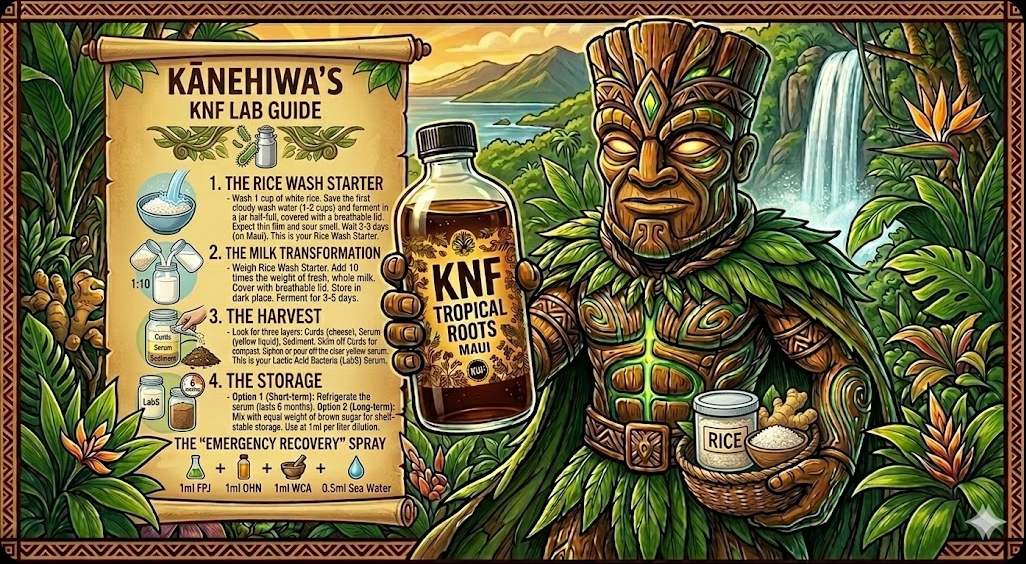
A high-quality, polished illustration featuring the character Kānehiwa, a wooden tiki-style deity with glowing eyes, standing in a lush, clean Maui landscape. To his left, a large parchment scroll titled Kānehiwa's KNF Lab Guide provides a 4-step infographic for making Lactic Acid Bacteria (LabS). The steps illustrate the rice wash starter, the 1:10 milk transformation, harvesting the serum from curds, and storage options. At the bottom of the scroll, an Emergency Recovery Spray recipe is listed with icons for FPJ, OHN, WCA, and Sea Water. Kānehiwa holds a glass bottle of KNF serum and a woven basket containing a jar of rice, a bowl of cooked rice, and fresh ginger. The scene is free of insects and microbes, focusing on a sanitized, professional botanical aesthetic with vibrant Hawaiian flora.
🧫 Type Fermented Serum
⏱️ Brew Time 5–8 Days
💧 Dilution 1:1000
📊 Level Beginner
🛡️ Disease Suppression

The ultimate weapon against Powdery Mildew and soil-borne pathogens. LabS colonies outcompete harmful fungi and bacteria for resources.

♻️ Nutrient Cycling

Solubilizes phosphates and decomposes dry amendments (like Down to Earth) faster — unlocking nutrients weeks sooner than water alone.

💨 Odor Control

Neutralizes the smell of funky ferments or stagnant soil. LabS bacteria consume the volatile compounds that cause foul odors.

🧪 Materials Needed

🍚 Rice Wash Water — the cloudy first rinse
🥛 Fresh Milk — cow's milk, whole (raw is ideal)
🫙 Glass Jars — wide-mouth, various sizes
Breathable Cover — coffee filter + rubber band
🤎 Brown Sugar — for shelf-stable storage (optional)
1

Phase 1: The Rice Water Starter

This first phase captures the wild lactic acid bacteria that are naturally present in the air and on your rice grains. You're creating the starter culture that will seed the milk transformation.

1
Rinse & Collect: Rinse one cup of white rice in water. Collect the first "cloudy" wash — about 1–2 cups. This starchy water is the food source for the bacteria.
2
Ferment: Pour the cloudy water into a glass jar — fill it only halfway (the bacteria need airspace). Cover with a breathable lid (coffee filter + rubber band).
3
Wait: Store in a dark place for 2–3 days. It's ready when it smells slightly sour and has a thin film on top. This is your "Rice Wash Starter."
🌺 Hawaiʻi Island Tip In Maui's warmth, 2 days is usually enough — check on day 2. The tropical temperatures accelerate fermentation significantly. If it smells rotten instead of pleasantly sour, the wrong organisms won. Discard and start over — use organic white rice if available, as it carries more diverse beneficial microbes than heavily processed rice.
2

Phase 2: The Milk Transformation

Now you use your starter culture to selectively breed lactic acid bacteria in milk. The LAB consume the lactose (milk sugar) and produce lactic acid, which separates the milk into curds and a clear serum — your LabS.

1
The 1:10 Ratio: Pour your Rice Wash Starter into a larger jar and add 10× the amount of milk. Example: 100ml of rice water into 1000ml of milk.
2
The Separation: Cover with a breathable lid and let it sit in the dark for 3–5 days. Don't stir or disturb it — the bacteria need stillness to work.
3
The Result: You will see three distinct layers form — this is exactly what you want:
🧀 Top Layer Floating yellow/white "cheese" (curds)
Middle Clear, yellowish liquid — this is your LabS Serum
🔽 Bottom Sediments (discard)
4
Harvest: Carefully skim off the cheese (it makes great compost or chicken feed!). Siphon or pour out the clear yellow liquid into a clean bottle. Discard the sediment. You now have raw LabS Serum.
🌺 Hawaiʻi Island Tip On Maui, the milk transformation happens faster — check at 3 days rather than waiting the full 5. Hawaiʻi's warmth means the LAB are more active, but it also means the curds can go "off" if left too long. Local whole milk from Maui dairies produces excellent results — the fresher the milk, the cleaner the separation. If you keep chickens or have neighbors who do, the cheese curds are a prized protein-rich treat for the flock.
3

How to Store LabS

🤎 Shelf-Stable (Recommended)

Mix the LabS Serum with an equal weight of brown sugar. The sugar puts the bacteria into a dormant state — alive but sleeping — ready to reactivate when diluted in water. Stores at room temperature for up to a year.

❄️ Refrigerated

If you don't add sugar, store the raw serum in the fridge for up to 6 months. Keep it sealed — it will slowly continue to ferment at fridge temperature, but much more slowly.

🌺 Hawaiʻi Island Tip In Hawaiʻi's heat, the brown sugar method is strongly recommended — raw LabS left at tropical room temperature will over-ferment and lose potency within weeks. Store your sugar-preserved LabS in dark glass bottles in the coolest interior room, never on the lānai or in a hot garage. Label every batch with the date — you'll be making this regularly once you see what it does.
4

How to Use LabS

Dilution ratio: 1:1000 (approximately 1ml per liter or 4ml per gallon). LabS is gentle enough for weekly use throughout the entire grow cycle.

💧 Soil Drench

Use weekly to keep your rhizosphere healthy and teeming with beneficial bacteria.

🌿 Foliar Spray

Use to prevent or treat Powdery Mildew. Spray early morning for best results.

♻️ Compost Booster

Spray directly onto mulch or compost pile to speed up decomposition dramatically.

🌺 Hawaiʻi Island Tip LabS is your secret weapon against Maui's relentless humidity-driven PM pressure. Combine it with OHN for a foliar spray that both repels pests and suppresses fungi — the one-two punch described in the Pest & Disease Troubleshooting Guide. For outdoor container grows, a weekly LabS soil drench after rain helps rebalance the microbiome that heavy tropical downpours disrupt.
💡
The "Amendment Activator": If you're using Down to Earth 4-4-4 or other dry organic amendments, a LabS drench right after top-dressing will "wake up" the biology and get those nutrients into your plant weeks faster than water alone. The lactic acid bacteria break down the organic compounds into plant-available forms — think of it as giving your soil a digestive enzyme.
📚 KNF Series
🌿 Words of Kānehiwa 🌿 The Invisible Army

"You cannot see them, but they are there — billions strong, working through every grain of soil. LabS is not a product you apply. It is an army you recruit. Feed them, and they will fight every battle your roots cannot."

"The same wisdom that turns milk into cheese turns dead soil into living earth. Fermentation is the oldest technology on this planet — older than fire, older than the wheel. When you brew LabS, you are practicing the first science."

"A healthy rhizosphere smells like the forest floor after rain. If your soil smells wrong, it is telling you the biology is wrong. LabS is how you reset the conversation between roots and earth."

This guide is provided for educational purposes only. Always research local laws and regulations before cultivating. Tropical Roots Maui assumes no responsibility for actions taken based on this information.