Pest & Disease Troubleshooting
Year-round tropical pest pressure demands year-round defense. Here's how to use your KNF inputs to combat the most common issues in Maui gardens.
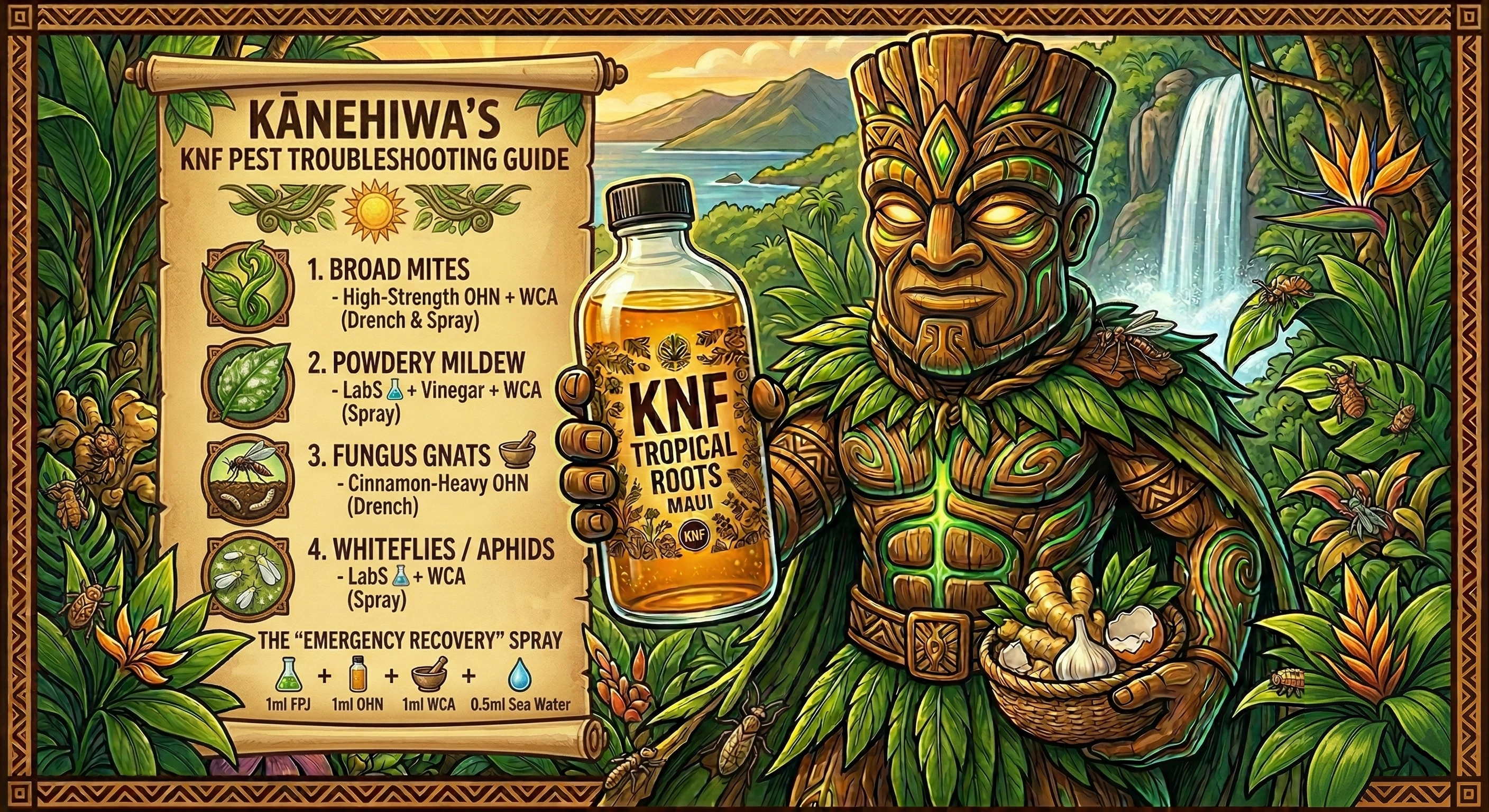
Broad Mites & Russet Mites
The Signs: Twisted, shiny, "plastic-looking" new growth. Leaves curling upward (canoeing) and brittle stems. These microscopic mites are invisible to the naked eye. By the time you see the damage, they've already been feeding for days.
Why? OHN acts as a systemic repellent: the garlic and ginger compounds make the plant taste and smell unpleasant to mites. WCA hardens the cell walls, making it physically difficult for these microscopic pests to pierce the plant tissue.
Foliar spray every 3 days for two weeks. Ensure you spray the underside of the leaves: this is where mites live and feed. Two weeks covers multiple life cycles to break the infestation.
Powdery Mildew (PM)
The Signs: White, flour-like spots on leaves that spread quickly in high humidity. Often starts on lower leaves with poor airflow and can spread to the entire canopy within days if unchecked.
Why? The acidity of the Brown Rice Vinegar changes the pH on the leaf surface, making it inhospitable for fungi. OHN provides antifungal properties from the garlic and cinnamon compounds, and WCA strengthens the leaf's "skin" so spores can't penetrate.
Spray immediately at the first sign of a spot. Do not wait for it to spread. Increase airflow in your tent! Add an extra oscillating fan aimed at the lower canopy where PM typically starts.
Fungus Gnats
The Signs: Small black flies jumping off the soil surface; slow, stunted growth due to larvae eating root hairs underground. You'll see adults hopping around when you water.
Why? Cinnamon is a natural fungicide and repellent that disrupts the gnat's life cycle in the soil. If you have pure Cinnamon OHN (extracted separately from your blend), use that specifically for maximum potency against soil-borne pests.
Drench the soil once every 4 days until the adults disappear. Crucially: let the top inch of soil dry out between waterings: gnat larvae need consistently moist topsoil to survive. Drying the surface breaks their breeding cycle.
Whiteflies & Aphids
The Signs: Tiny white moths fluttering when you shake branches, or green/black clusters on stems and new growth. Sticky "honeydew" residue on leaves: this sugary secretion attracts ants and can grow sooty black mold.
Why? LAB helps break down the sticky honeydew left by pests and outcompetes any opportunistic molds (like sooty mold) that try to colonize the residue. OHN keeps the bugs from returning: the garlic compounds are particularly effective as an aphid repellent.
Foliar spray once every 3 days until the population is eliminated. Pay special attention to stem junctions and the underside of new growth: these are the favorite hiding spots.
Leaf Miners
The Signs: Winding, squiggly white or pale "trails" visible inside the leaf tissue, like tiny tunnels drawn across the leaf surface. Affected leaves may yellow, curl, or drop early. The larvae live and feed between the upper and lower leaf surfaces, making them difficult to reach with contact sprays.
Why? OHN's garlic and ginger compounds act as a systemic deterrent that makes the leaf tissue unpalatable to egg-laying adult flies and moths. FPJ strengthens the leaf surface and promotes rapid new growth to replace damaged tissue. Because the larvae are protected inside the leaf, prevention is far more effective than treatment.
Preventative foliar spray twice a week during active growing periods. For active infestations, remove and destroy all affected leaves immediately: the larvae will continue feeding and pupating if left on the plant. Spray remaining foliage every 2 days for 2 weeks to intercept the next generation of egg-laying adults.
✂️ The Manual FixUnlike most pests, leaf miners can't be killed in place with a spray because they're sandwiched inside the leaf. Your most effective tool is pruning. Remove every leaf with visible trails and bag and discard them. Don't compost them, as the pupae can survive in your pile and reinfest. After pruning, hit the remaining canopy hard with the OHN + FPJ protocol above.
Spider Mites
The Signs: Tiny yellow or white speckles on the tops of leaves (stippling) as the mites suck chlorophyll from below. Fine webbing between leaves and at branch junctions. By the time you see webs, the infestation is severe. Check the undersides of leaves with a loupe or phone camera: two-spotted spider mites appear as tiny moving dots.
Why? OHN's garlic and cinnamon compounds are potent acaricides: they disrupt the mites' ability to feed and reproduce. WCA coats the leaf surface with a thin calcium film that makes it physically harder for mites to pierce the cell walls and feed. Together, they create an environment hostile to mite colonization.
Foliar spray every 2 days for 2 weeks minimum: spider mites reproduce extremely fast and have a lifecycle of about 5–7 days. You must spray through at least 3 full generations to break the cycle. Drench the undersides of all leaves: this is where they live and lay eggs. After the initial 2-week blitz, continue once weekly as a preventative.
🌡️ Environmental ControlSpider mites thrive in hot, dry conditions. Raise your humidity to 55–65% during the treatment period to slow reproduction. Good airflow also helps: stagnant air creates the warm pockets mites love.
Caterpillars & Budworms
The Signs: Irregular holes chewed through leaves, dark pellet-like droppings (frass) on leaves and in bud sites, and in late flower: brown, mushy spots inside buds where caterpillars have burrowed in and their frass has triggered bud rot. The corn earworm / tobacco budworm (Helicoverpa) is the most destructive: it burrows directly into developing flowers.
Why? OHN's strong garlic and ginger compounds act as a moth and butterfly deterrent: the adult females find the scent repulsive and avoid laying eggs on treated plants. This is primarily a prevention strategy. Once caterpillars are inside buds, no spray can reach them without saturating (and potentially rotting) the flower.
Preventative spray twice a week from the onset of flower: this is when moths begin targeting your plants as egg-laying sites. For active infestations, hand-pick every caterpillar you can find daily at dusk when they're most active and visible on the plant surface. Inspect every bud site: gently squeeze the base of each cola and watch for frass or movement.
✂️ The Bud SurgeryIf you find brown, mushy spots in your buds, the caterpillar has already done its damage. Cut the affected section out immediately and inspect surrounding bud sites. The frass left inside creates a perfect environment for botrytis (bud rot), so removal must be fast and thorough. Spray the wound site with diluted OHN to prevent secondary infection.
🚨 The "Emergency Recovery" Spray
If your plants look generally stressed (droopy, yellowing, or recovering from a storm or heatwave):
🗓️ Maui Maintenance Schedule
Don't wait for bugs to show up. In our climate, a "Clean Sweep" spray of OHN and WCA once a week is the difference between a successful harvest and a total loss.
This weekly preventative spray creates a persistent defense layer on the leaf surface that repels pests and inhibits fungal germination. Combined with the TRM Maintenance Cocktail from the OHN guide, it forms a complete organic IPM (Integrated Pest Management) strategy that replaces every bottle in your pest spray kit.
I. The Foundational Biology
🍄 IMO (Indigenous Microorganisms): From Rice Box to Black Gold
🧫 LabS (Lactic Acid Bacteria): The Clean-Up Crew
II. The Primary Growth Engines
🐟 FAA (Fish Amino Acids): The Nitrogen Engine
🌱 FPJ (Fermented Plant Juice): The Growth Hormone
III. Specialized & Bloom Nutrition
🦴 WCA (Calcium): The Cell Wall Builder
🔥 WCA-P (Calcium Phosphate): The Bloom Fuel
🛡️ OHN (Oriental Herbal Nutrient): The Immune Booster
IV. Application & Strategy
📋 KNF Feeding Schedule: Seed to Harvest Program
📊 KNF Feeding Chart: Printable Quick Reference
🐛 Pest & Disease Troubleshooting: Maui Edition
V. Foliar Techniques
🍚 BRV Foliar Spray: Feeding the Canopy
This guide is provided for educational purposes only. Always research local laws and regulations before cultivating. Tropical Roots Maui assumes no responsibility for actions taken based on this information.