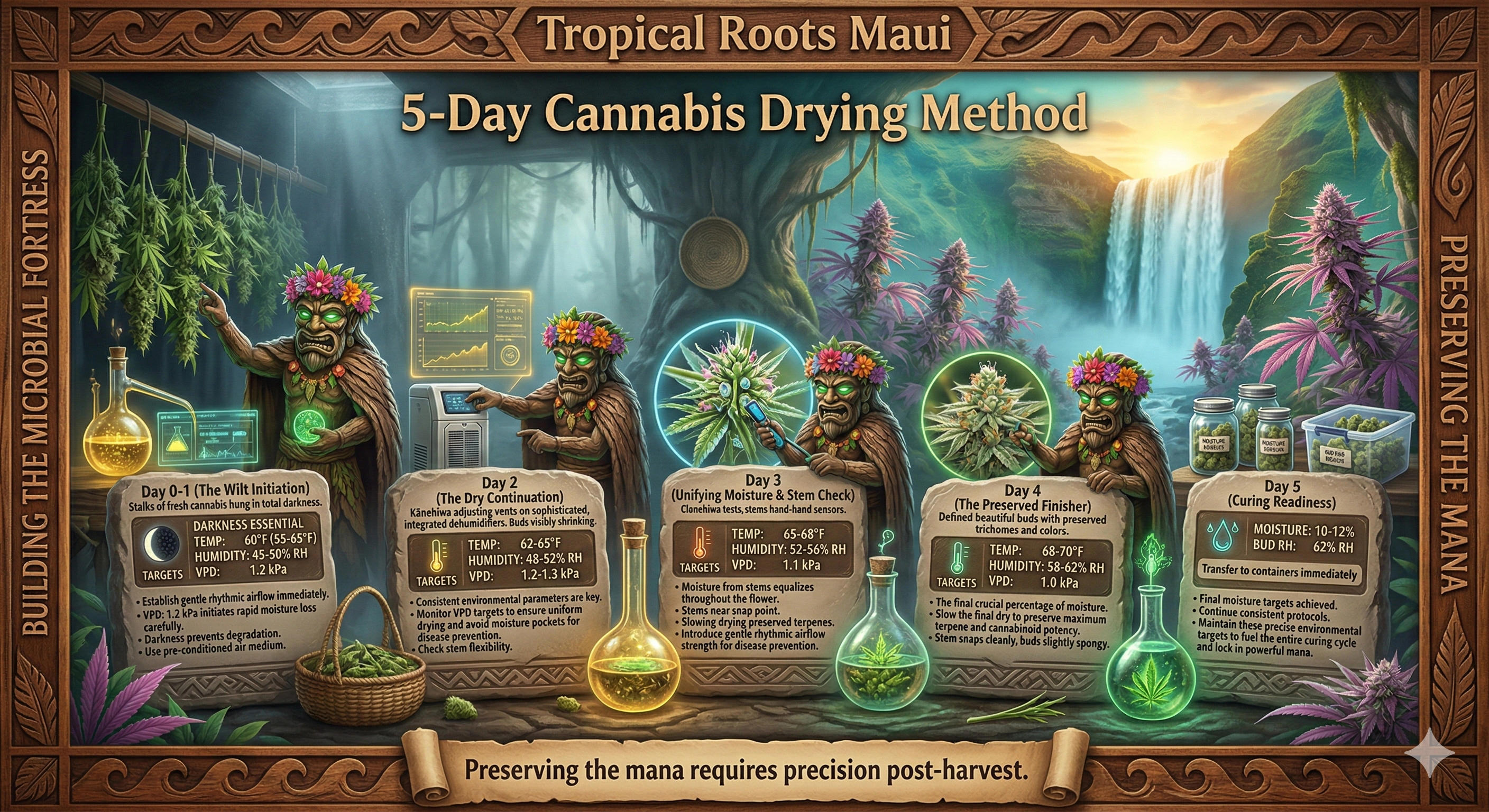
5-Day Cannabis
Drying Method
Lock in the mana. Our precise 5-day drying method designed for fast, preserved potency. Master initial wilt, check for stem snap, preserve terpenes, and achieve final moisture for curing readiness. Kānehiwa explains the Rapid Island Cure: designed for perfect consistency and aroma. (All values illustrative).
-
1Harvest Timing
Cut your plants during the final hour of their dark cycle. At this point the plant has been respiring through the night: stomata are open, internal pressure is low, and chlorophyll degradation is already underway. Harvesting in darkness gives you a head start on breaking down the compounds responsible for that harsh grassy taste in an under-dried flower.
💡 Why it matters Darkness accelerates chlorophyll degradation throughout the dry. A clean, dark environment from the first cut means cleaner-tasting flower at the end.🌺 Hawaiʻi Island Tip If you run lights at night (recommended for Maui tent growers), your dark cycle ends at sunrise: harvest in the early morning before the day heats up. Terpenes are volatile and Hawaiʻi's daytime temps accelerate their loss the moment you cut. Get branches onto the drying line fast; don't leave cut material sitting in a warm room. -
2Prep and Hang
Separate your plant into individual branch sections: not whole plants, not single buds. This gives each piece enough surface area to breathe evenly without creating pockets of trapped moisture. Hang them with even spacing so air can circulate on all sides. Nothing should be touching.
Wet trimming fan leaves before hanging speeds moisture loss and gives you a cleaner hang. Sugar leaves can be left on to slow the process slightly if your environment runs dry.🌺 Hawaiʻi Island Tip In Hawaiʻi's humidity, wet trim everything: leave no fan leaves and consider trimming sugar leaves tight. Every bit of extra plant material holds moisture that your dehumidifier has to fight. If you're drying in a tent, reduce the drying space: hang a tarp or use a 2×2 tent as a dedicated drying chamber. A smaller sealed space is far easier to control than an open room in island conditions. -
3Phase 1: Hours 0 to 48
Set your environment to 72°F / 55% RH / 1.2 kPa VPD and hold it there for the first 48 hours. At these conditions the surface moisture begins evaporating at a controlled rate while adhesion forces inside the plant start pulling internal moisture toward the surface, like a slow wick drawing water up from the core outward. The goal here is to start the process gently so the outer layers don't lock up before the inside has a chance to drain.
🔬 The ScienceThis phase runs on Fick's Law of diffusion: moisture moves from high concentration (inside the bud) to low concentration (the drying air) through the plant tissue. Starting with moderate VPD ensures the gradient isn't so steep that the surface seals before the interior drains.
🌺 Hawaiʻi Island Tip Hitting 55% RH is the hardest target in Hawaiʻi's drying process: ambient air walks in at 70–80%. Your dehumidifier must be running before you hang a single branch. A compressor-based unit rated 30+ pints/day is the minimum for a small drying space on Maui. Seal every gap: duct tape tent zippers, stuff towels under doors. Any leak lets island air flood your carefully controlled environment. -
4Phase 2: Hours 48 to 72
At hour 48, step up to 74°F / 52% RH / 1.39 kPa VPD. Surface moisture is mostly gone now and the drying process needs more drive to pull the remaining internal moisture upward and out. The slight increase in temperature and VPD accelerates transpiration without pushing too hard: the flower should feel noticeably drier by the end of this phase but not crispy.
🌺 Hawaiʻi Island Tip If your dehumidifier is struggling to hold 52%, don't open the room: reduce the space instead. Hang a plastic tarp to shrink the drying area. On Kona wind days (southerly, hot, still air) humidity spikes island-wide and your dehumidifier will run nonstop. Check the drain reservoir frequently: a full bucket means it stops working and RH climbs silently. Use a continuous drain hose if your unit supports it. -
5Phase 3: Hours 72 to 120
At hour 72, move to the final settings: 75°F / 50% RH / 1.5 kPa VPD. Hold these conditions for the remaining 48 hours. This phase drives residual moisture in the near-surface layers down to a final moisture content of around 10%: the sweet spot for jarring and cure. Stems should snap cleanly, not bend.
✅ Ready Check Pinch a small stem: if it snaps with a clean crack, you're at target moisture. If it bends or feels rubbery, give it a few more hours. Don't rush this step: jarring too early leads to mold during cure.🌺 Hawaiʻi Island Tip Mold can develop in hours, not days, in tropical conditions. During this final phase, visually inspect every branch at least twice daily: gently spread dense colas and look for any grey fuzz or off smell deep inside. If you spot even a trace, remove that branch immediately. Hawaiʻi growers lose more flower to mold in the drying phase than at any other point in the grow cycle. -
6Day 5: Buck, Trim, and Jar
After 5 days the flower comes off the rack. Buck the buds from the branches, do your final trim, and get everything into jars immediately. Seal the jars and begin your cure: burp daily for the first two weeks, then less frequently as the cure progresses. The fast-dry method produces flower that's ready for cure without the extended chlorophyll exposure that makes slow-dried cannabis taste harsh in the first few weeks.
Store jars in a cool, dark place at 58–62% RH. Boveda or Integra packs are recommended to maintain humidity during cure.🌺 Hawaiʻi Island Tip "Cool and dark" is hard to find on Maui: room temps of 78–82°F are common year-round. Store cure jars in the coolest interior closet away from exterior walls that absorb sun. A small wine cooler set to 65°F makes an excellent cure chamber for island growers. Boveda 58% packs are essential, not optional: without them, Hawaiʻi's ambient humidity will creep into your jars every time you burp and restart mold risk all over again.
The classic 60°F / 60% RH method has real downsides. Surface moisture evaporates quickly, creating a gradient that disrupts internal moisture balance. High internal moisture (~30%) creates ideal conditions for mold. And time, not temperature, is the biggest driver of terpene degradation. Fewer days drying means more terpenes preserved.
Moisture moves through plant tissue from high to low concentration. If surface evaporation is too aggressive, the outer layers dry and harden before internal moisture can migrate out, locking in water that then leads to inconsistent cure or mold. Controlled VPD progression keeps the gradient moving at a pace the tissue can follow.
Yes, terpenes are volatile and heat accelerates their loss, but the relationship between time and terpene loss is stronger. A 5-day dry at 72–75°F preserves more terpenes than a 14-day dry at 60°F. Shorter drying periods at slightly higher temps outperform prolonged drying at lower temps when it comes to aroma and flavor retention.
Chlorophyll is the compound responsible for the harsh "green" or "grassy" taste in freshly dried flower. Darkness is the primary catalyst for its breakdown. By keeping the entire dry in a dark, controlled environment, you accelerate this process naturally, so the flower is tasting cleaner before it even hits the jar.
- Harvest in the final hour of the dark cycle
- Separate branches: nothing hanging in clumps
- Phase 1 (0–48 hrs): 72°F / 55% RH / 1.2 kPa VPD
- Phase 2 (48–72 hrs): 74°F / 52% RH / 1.39 kPa VPD
- Phase 3 (72–120 hrs): 75°F / 50% RH / 1.5 kPa VPD
- Target 10% final moisture content: stems snap clean
- Buck, trim, and jar immediately on day 5
- Cure at 58–62% RH, burp daily for the first two weeks
This guide reflects a personal growing methodology and is provided for educational purposes only. Always research local laws and regulations before cultivating.