KNF Feeding Schedule
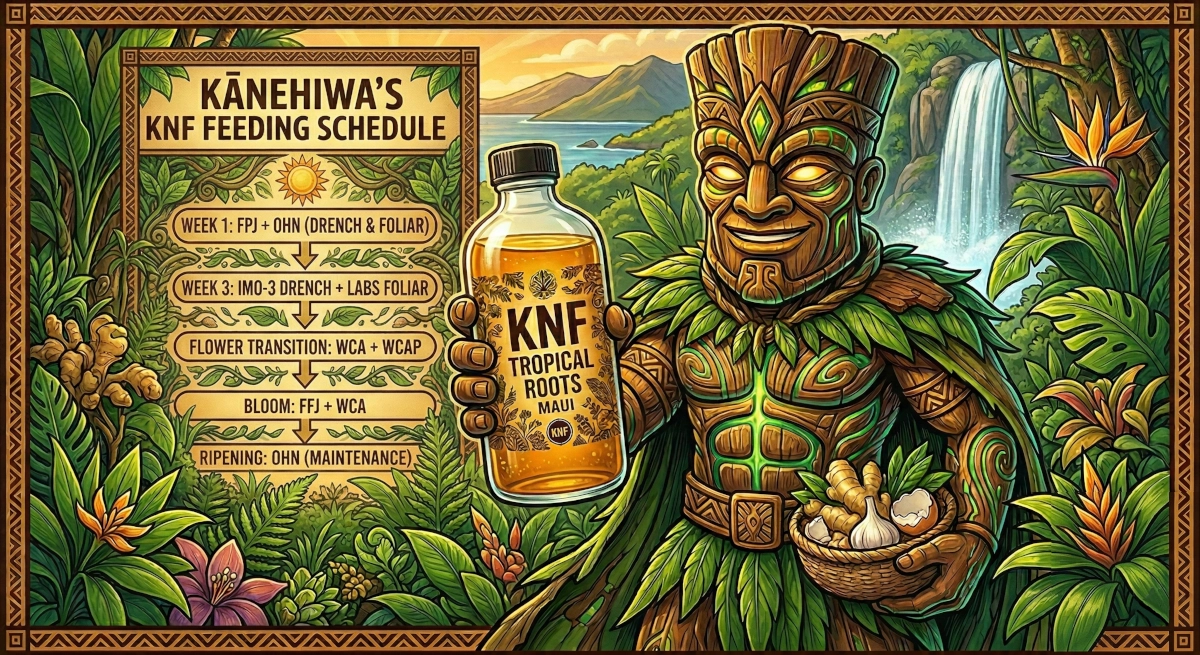
The complete feeding program using the KNF inputs you've mastered: five phases from seedling to harvest with every ratio and timing laid out.
Seedling & Early Veg: Weeks 1–2
Root development and biological inoculation.
🧪 InputsUse IMO as a soil top-dress to inoculate the root zone with indigenous microorganisms from day one. Apply FPJ to provide growth hormones that drive early root and leaf development. Add OHN to protect vulnerable young tissues: seedlings are at their most susceptible to damping-off and fungal attack.
📅 Frequency1× per week soil drench (FPJ + OHN at 1:1000) and 1× per week light foliar spray (OHN at 1:1000). Keep the foliar spray light: seedling leaves are delicate.
Late Vegetative: Weeks 3–4
Explosive foliage growth and stem strength.
🧪 InputsContinue FPJ to drive vegetative expansion. Increase WCA here to ensure your stems are thick enough to support the coming flower weight: this is where structural integrity is built. Maintain OHN as your weekly immune shield.
📅 Frequency1× per week soil drench (FPJ + WCA + OHN) and 2× per week foliar spray (WCA + OHN). The doubled foliar frequency ensures calcium is being delivered directly to the growing tips where it's needed most.
The Transition / "The Flip": Weeks 5–6
Signaling the plant to stop growing leaves and start growing flowers.
🧪 InputsSwitch from FPJ (growth) to WCA-P (bloom/energy). This is the most critical window for phosphorus. WCA-P signals the plant to redirect its energy from leaves to flowers. Keep WCA in the mix for structural support during the stretch, and OHN for ongoing immune defense.
📅 Frequency2× per week soil drench (WCA-P + WCA + OHN). The doubled soil drench frequency ensures the phosphorus signal is strong and consistent during this critical window. No foliar spray during the flip: focus all energy into the root zone.
Mid-Bloom: Weeks 7–10
Trichome production and bud density.
🧪 InputsUse FFJ (Fermented Fruit Juice) to provide potassium for terpene and resin production: this is what drives the flavor and aroma of your final product. Keep WCA in the mix to prevent mold and bud rot by maintaining strong cell walls. Continue OHN as the immune backbone.
📅 Frequency1× per week soil drench (FFJ + WCA + OHN) and 1× per week foliar spray (OHN only). Stop all foliar sprays by Week 8 to avoid moisture sitting in buds: from this point on, feed through the roots only.
Ripening & Flush: Final 1–2 Weeks
Improving flavor and "burning off" stored nutrients.
🧪 InputsStop all nutrient inputs. Feed with clean water only to allow the plant to metabolize its stored nutrients, resulting in a cleaner, smoother smoke. A final dose of OHN helps the plant finish with a strong immune response: some growers report this results in deeper colors (purpling) as the plant directs its remaining energy into anthocyanin production.
📅 FrequencyWater only, every 2–3 days or as the soil dries. Apply a single final OHN drench (1:1000) at the start of the flush period, then only clean water until harvest.
📊 Quick Reference Mixing Guide
All ratios per liter of water unless noted. Always mix OHN and WCA into water first before adding FPJ/FFJ.
| Input | Veg Ratio | Bloom Ratio | Main Benefit |
|---|---|---|---|
| FPJ | 1ml / L | N/A | Leafy growth |
| WCA | 1ml / L | 1ml / L | Strong stems |
| WCA-P | N/A | 1ml / L | Flower energy |
| FFJ | N/A | 1ml / L | Big, tasty buds |
| OHN | 0.5ml / L | 0.5ml / L | Immune health |
I. The Foundational Biology
🍄 IMO (Indigenous Microorganisms): From Rice Box to Black Gold
🧫 LabS (Lactic Acid Bacteria): The Clean-Up Crew
II. The Primary Growth Engines
🐟 FAA (Fish Amino Acids): The Nitrogen Engine
🌱 FPJ (Fermented Plant Juice): The Growth Hormone
III. Specialized & Bloom Nutrition
🦴 WCA (Calcium): The Cell Wall Builder
🔥 WCA-P (Calcium Phosphate): The Bloom Fuel
🛡️ OHN (Oriental Herbal Nutrient): The Immune Booster
IV. Application & Strategy
📋 KNF Feeding Schedule: Seed to Harvest Program
📊 KNF Feeding Chart: Printable Quick Reference
🐛 Pest & Disease Troubleshooting: Maui Edition
V. Foliar Techniques
🍚 BRV Foliar Spray: Feeding the Canopy
This guide is provided for educational purposes only. Always research local laws and regulations before cultivating. Tropical Roots Maui assumes no responsibility for actions taken based on this information.