Introduction to KNF
Korean Natural Farming: using indigenous microorganisms and local organic materials to build a self-sustaining soil ecosystem.
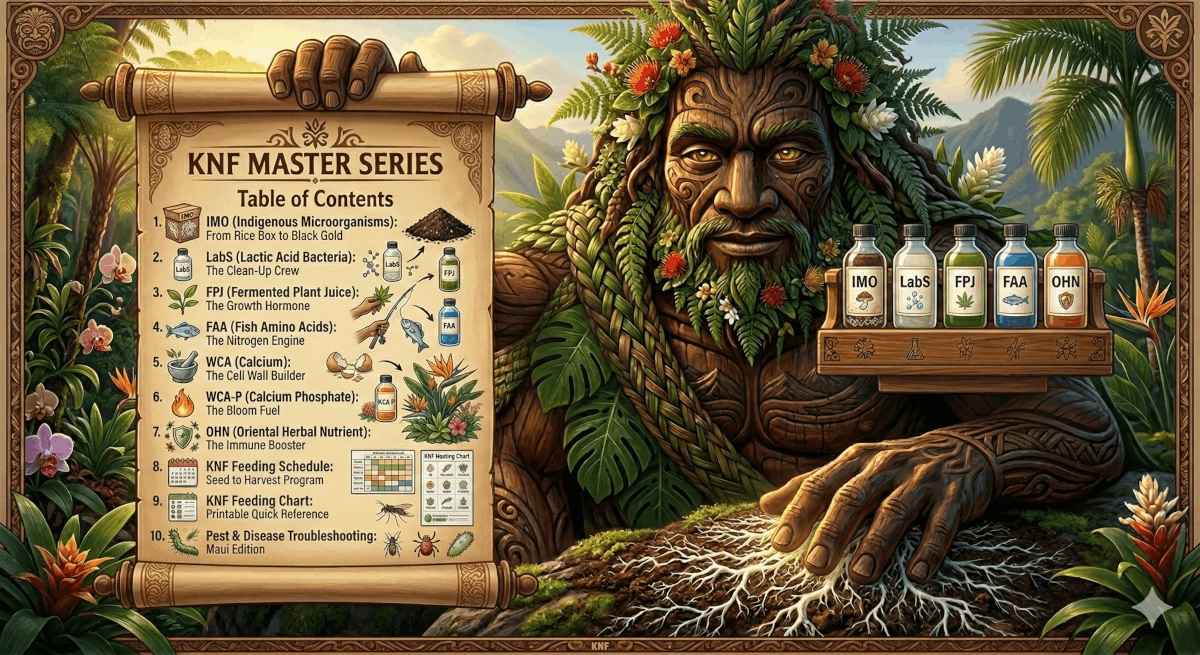
The Core Philosophy: Feed the Soil, Not the Plant
Korean Natural Farming reverts to an ancient wisdom: cultivating a diverse "microbial army" in the soil, rather than feeding plants directly with water-soluble salts as modern traditional farming does. These microbes break down organic matter and deliver nutrients to the roots in a form the plant can easily digest.
Instead of relying on store-bought chemicals, KNF teaches you to work with nature: collecting beneficial organisms from your own environment, fermenting local plants and fruits into powerful fertilizers, and building a soil food web that sustains itself season after season.
The result is healthier plants, richer terpene profiles, and a growing method that costs almost nothing once you understand the process.
The "Big 5" KNF Inputs
To get started with KNF, you'll be creating several fermentations using simple ingredients like brown sugar, rice, and local plants. These are the five foundational inputs:
The "soul" of KNF. You collect local microbes from a healthy nearby forest or field to inoculate your soil. These organisms are already adapted to your specific climate, humidity, and temperature, making them far more effective than any bottled product shipped from the mainland.
Made from fast-growing plant tips and brown sugar. It's like a growth hormone smoothie for your crops: packed with enzymes, growth hormones, and chlorophyll that drives vigorous vegetative development. Use the newest, most actively growing shoot tips for the strongest FPJ.
Created from potassium-rich fruits to fuel the flowering and fruiting stages. The natural sugars and potassium in ripe fruits, once fermented with brown sugar, become a bioavailable bloom booster that promotes flower set, resin production, and terpene development.
Made from toasted eggshells dissolved in vinegar. This strengthens plant cell walls, prevents blossom end rot, and improves overall structural integrity. WCA is especially important during the transition from vegetative growth into flower, when calcium demand spikes. See the full WCA Brewing Guide.
A fermented tincture of garlic, ginger, cinnamon, licorice, and angelica used to boost plant immunity and ward off pests. OHN works as both a foliar spray and a soil drench; it's the "immune system booster" of the KNF toolkit. The garlic and ginger provide antimicrobial properties while the other herbs stimulate systemic resistance. See the full OHN Brewing Guide.
Why KNF is Perfect for Tropical Environments
Most ingredients are found in your kitchen or backyard: bamboo shoots, papaya, banana, rice, eggshells, and brown sugar. Once you master the fermentation process, your input costs drop to nearly zero.
🌡️ Climate ResilienceIndigenous microbes are already adapted to your specific humidity and temperature, making them far more effective than "bottled" microbes shipped from different climates. A microbe that evolved in a Maui forest knows how to survive Maui conditions; one grown in a lab in Oregon does not.
♻️ Zero WasteKNF turns agricultural "waste" into high-quality inputs. Overripe fruit, eggshells, fish scraps, plant trimmings: everything that would go to the compost bin or trash becomes a powerful tool in the KNF system.
Getting Started: IMO-1 Collection
The journey begins with IMO-1: the collection process. This is the foundation of everything in KNF.
🍚 The Rice Box MethodCook rice until it is slightly undercooked (about 70% done, still firm in the center). Fill a clean wooden box or cedar container loosely with the rice; do not pack it down. The gaps allow airflow, which microbes need to colonize.
🌲 PlacementCover the box with a rigid mesh screen (window screen or hardware cloth) secured tightly with wire or clamps, not just a cloth and rubber band. Place it in a shaded, undisturbed area of a healthy forest or field: under leaf litter, near the base of old-growth trees, or in a bamboo grove. The goal is to "trap" the local beneficial fungi and bacteria that already thrive in that ecosystem.
Leave the box for 3–5 days. When you return, the rice should be covered in a fragrant white mycelium; this is your indigenous microbial culture. If you see black, green, or pink mold, the collection failed. Discard and try again in a different location.
🍯 PreservationOnce you have a successful IMO-1 collection, mix the colonized rice with an equal weight of brown sugar in a clay pot or glass jar. The sugar acts as a preservative and food source, keeping the microbes alive and dormant until you're ready to use them. This becomes IMO-2: the activated starter culture you'll expand into your soil.
Your KNF Starter Kit
Everything you need to start your first round of KNF inputs. Most of these can be found at local Maui stores: Costco, Target, Mana Foods, or even the small markets in Napili.
🍚 1. Base IngredientsThe Three Golden Rules
To truly master Korean Natural Farming, especially here in Maui where the humidity and heat act as an "accelerant" for biology, these three rules separate a successful practitioner from someone with a jar of moldy rice.
🥇 Rule 1: The "Golden Rule" of DilutionIn KNF, less is almost always more. Because these inputs are fermented and bio-available, they are incredibly potent.
The Danger: Using a 1:100 ratio instead of 1:1000 can "fry" your microbes and cause nutrient lockout or leaf burn. That's a 10× overdose, and your plant will show it within hours.
The Fix: If you aren't sure, go leaner. A 1:2000 dilution is still powerful medicine for a plant. You can always apply again; you can't un-apply.
KNF is not a "set it and forget it" system. The inputs have different lifespans:
FPJ & FFJ: Best used within 6 months to a year. Over time, they lose their hormonal "punch" as the volatile growth compounds degrade.
OHN & LabS: These are your "vintages." Properly made and stored, they can last for years and actually become more stable over time.
The Warning: If any input (other than FAA) starts to smell like death, rotten eggs, or vomit: throw it out. A healthy KNF ferment should smell sweet, boozy, or vinegary. Never sour-putrid.
The most common mistake is trying to "buy" KNF in a bottle. The true power of KNF is the "I" in IMO: Indigenous.
Microbes collected from a forest in Oregon won't survive a July afternoon in Lahaina. To get the best results, collect your IMO-1 from a healthy, undisturbed area as close to your grow site as possible. The microbes under a local mango or banyan tree are already adapted to our UV levels and humidity. They are "island-tough."
The Nutrient Antagonism Chart
One technical detail that is often overlooked is how KNF inputs interact with each other. Some combinations are synergistic; others can cause minerals to "bind" and fall out of solution, making them unavailable to your plant.
✅ Great CombinationsWCA (Calcium) + FAA (Nitrogen): the Veg power couple. Calcium hardens the stems while nitrogen drives leaf expansion. Use together throughout vegetative growth.
WCA-P (Phosphorus) + WCA (Calcium): the "Bloom Duo." Phosphorus triggers and fuels flower production while calcium prevents bud rot and maintains structural integrity.
⚠️ The Critical Mixing RuleNever mix your concentrated inputs together in a jar before adding water. Always add them one by one to a full bucket of water to prevent the minerals from binding and precipitating out of solution. When concentrated calcium meets concentrated phosphorus without dilution, they form insoluble calcium phosphate crystals, locking both nutrients away from your roots.
The correct order: water first → OHN + WCA → then FPJ/FFJ/FAA last. See the Feeding Chart for the full mixing protocol.
The KNF Production Calendar
KNF Production Calendar: Tropical Roots Maui
Work backward from your planned seed-pop date. Maui timelines: shave 20–30% off each window.
📅 Production Calendar
Since some inputs take months to finish, you need to "work backward" from your planned seed-pop date. Here's the timeline to have everything ready on day one:
| Start Date | Task: Start These Ferments | Why? |
|---|---|---|
| 4 Months Before | FAA (Fish Amino Acids) | Takes the longest to break down animal proteins. |
| 2 Months Before | OHN (The 5 Herbs) | Needs time for the double-extraction and aging. |
| 1 Month Before | IMO-1 & IMO-2 | You want your indigenous microbes active and ready for soil prep. |
| 2 Weeks Before | WCA & WCA-P | Extraction takes 7–10 days; gives you time to strain and bottle. |
| 1 Week Before | LabS (Lactic Acid Bacteria) | Only takes about a week to go from rice-water to serum. |
| 3 Days Before | FPJ (Plant Juice) | Best used fresh; start this just as your seeds are germinating. |
KNF Water Science: Fixing Maui Tap Water
The water coming out of the tap in Lahaina and Napili often contains chlorine or chloramines to keep it safe for drinking, but these chemicals are designed to kill microbes, the exact opposite of what we want for KNF.
💧 The Dechlorination ProcessKNF microbes prefer a slightly acidic environment: 5.8–6.2 pH. Instead of using synthetic "pH Down" chemicals:
To Lower pH: Use your Brown Rice Vinegar (BRV). It lowers pH while adding beneficial organic acids that feed soil biology, a win-win.
The Buffer: Your WCA (Calcium) naturally helps stabilize pH levels so they don't swing wildly after you feed. This is one of the reasons WCA appears in almost every phase of the Feeding Schedule: it's not just about calcium, it's about pH stability.
The KNF Nutritive Cycle
There is one final "secret" that ties the whole Tropical Roots Maui philosophy together. KNF isn't just a collection of recipes; it's a language for talking to your plants. Understanding the Nutritive Cycle allows you to stop following a chart and start responding to what the plant actually needs.
🌱 The Three Stages of Plant LifeIn KNF, we categorize a plant's life into three distinct physiological states, each requiring a different "cocktail" of your inputs:
Vegetative Growth (The "Childhood"): Focus is on nitrogen and rapid cell division.
Primary Inputs: FAA (Power), FPJ (Hormones), OHN (Protection).
The Changeover (The "Puberty"): This is the most critical 2-week window when the plant decides to stop making leaves and start making flowers.
Primary Inputs: WCA-P (Phosphate energy) and WCA (Calcium strength).
Reproduction (The "Adulthood"): Focus is on moving sugars into the flowers and fruits.
Primary Inputs: FFJ (Potassium/Sugars) and WCA (to keep the structure from collapsing under bud weight).
A common mistake is using FPJ (Fermented Plant Juice) all the way through harvest.
FPJ tells the plant: "Grow more leaves and stems!"
FFJ (Fermented Fruit Juice) tells the plant: "Put all your energy into the flowers and seeds!"
The Switch: If you keep using FPJ too late into the flowering stage, you'll end up with "leafy" buds and less resin. Switch to FFJ as soon as you see the first "pom-poms" (pistils) forming. This is the signal that the plant has committed to reproduction, and you need to match that commitment with the right fuel. See the Feeding Schedule for exact timing.
🌅 The "Morning vs. Evening" ApplicationOn Maui, the sun is intense. When you apply your KNF foliar sprays matters as much as what's in the bottle:
Morning (Before 8 AM): Best for FPJ and FAA. The plant's stomata (pores) are open and ready to absorb growth hormones as the day begins.
Evening (After 5 PM): Best for OHN and LabS. These microbial inputs prefer the cooler, darker hours to establish themselves on the leaf surface without being fried by the tropical UV.
When you bottle your finished inputs (like FPJ or FAA), do not tighten the cap all the way for the first few weeks.
Fermentation is a living process. It will continue to off-gas carbon dioxide. If you seal a bottle too tight, it can literally explode or "burp" a mess all over your grow room.
The Fix: Keep the cap loose or use a breathable lid until the bubbling completely stops. Once it's fully stable, you can seal it for long-term storage.
I. The Foundational Biology
🍄 IMO (Indigenous Microorganisms): From Rice Box to Black Gold
🧫 LabS (Lactic Acid Bacteria): The Clean-Up Crew
II. The Primary Growth Engines
🐟 FAA (Fish Amino Acids): The Nitrogen Engine
🌱 FPJ (Fermented Plant Juice): The Growth Hormone
III. Specialized & Bloom Nutrition
🦴 WCA (Calcium): The Cell Wall Builder
🔥 WCA-P (Calcium Phosphate): The Bloom Fuel
🛡️ OHN (Oriental Herbal Nutrient): The Immune Booster
IV. Application & Strategy
📋 KNF Feeding Schedule: Seed to Harvest Program
📊 KNF Feeding Chart: Printable Quick Reference
🐛 Pest & Disease Troubleshooting: Maui Edition
V. Foliar Techniques
🍚 BRV Foliar Spray: Feeding the Canopy
This guide is an introduction to the principles and philosophy of Korean Natural Farming. Individual recipes for each input (IMO, FPJ, FFJ, WCA, OHN) will be covered in dedicated step-by-step guides. Always research your local laws and regulations before cultivating.