History & Heritage Kānehiwa Edible & Infusion Recipes Grow Guides & Tutorials About Contact The Sacred Grove →
KNF Series · The Nitrogen Engine

Fish Amino Acids (FAA)

A massive shot of organic nitrogen and bio-available amino acids — the "heavy lifting" fertilizer for when you want dark green fan leaves and explosive structure during veg. On an island, it's one of the easiest and cheapest inputs to make.
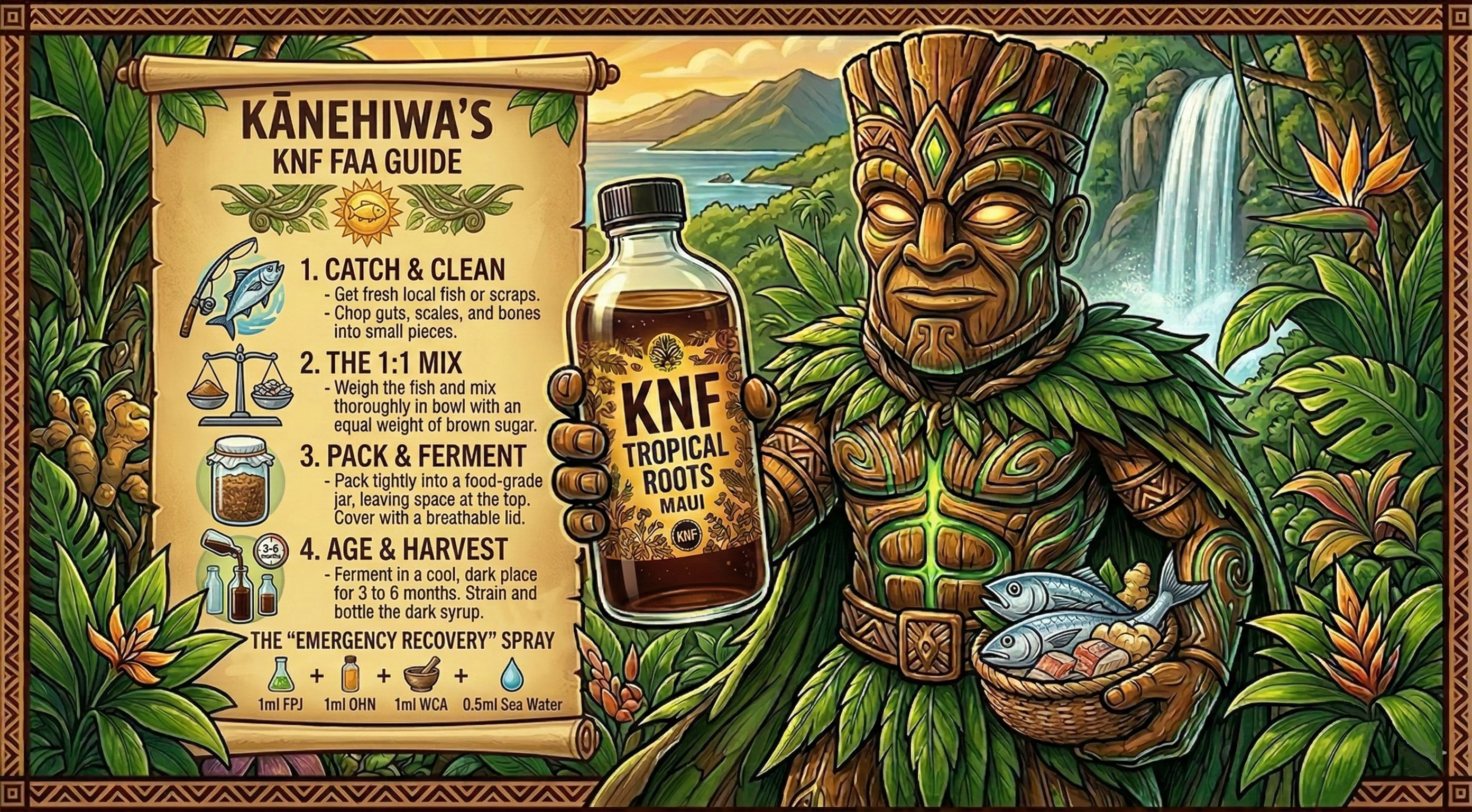
Fish Amino Acids (FAA) Guide — Tropical Roots Maui
🐟 Type Fermented Fish
⏱️ Brew Time 3–6 Months
💧 Dilution 1:1000
📊 Level Intermediate
💪 High Nitrogen

The primary nitrogen source for the vegetative cycle — builds plant structure, thick stems, and those huge dark green fan leaves.

🧬 Bio-Available Aminos

The "building blocks" of proteins, delivered pre-digested. The plant saves energy on synthesis and focuses entirely on growth.

🦠 Microbial Food

A feast for the fungi and bacteria in your soil — the amino acids and fats in FAA supercharge the microbial population in your rhizosphere.

🧪 Materials Needed

🐟 Fish Scraps — heads, guts, scales, bones
🤎 Brown Sugar — equal weight to the fish
🛡️ OHN & BRV — small amount to prevent rot
🫙 Large Glass/Plastic Jar — food-grade
🌺 Hawaiʻi Island Tip On Maui, FAA is one of the cheapest inputs to make — head to Māʻalaea Harbor or the Kahului fish counter. Ask for fish scraps and you'll often get them free or nearly free. Blue-backed fish like ʻōpelu (mackerel scad) and akule (bigeye scad) are traditionally preferred in KNF for their high nutrient content and are abundant in Hawaiʻi waters. The fresher the scraps, the better the ferment — try to process them the same day you pick them up.

Step-by-Step: Brewing FAA

1
Source Your Fish: Get fresh fish scraps — heads, guts, scales, and bones. The fresher, the better. Do not use cooked fish or canned fish — the heat from cooking destroys the enzymes you need for proper fermentation.
2
Chop: Chop the fish parts into small pieces to increase the surface area for the microbes to work. The smaller the pieces, the faster and more complete the breakdown.
3
The 1:1 Ratio: Weigh the fish, then mix it thoroughly in a bowl with an equal weight of brown sugar. The sugar draws moisture out of the fish through osmosis and feeds the fermentation organisms.
4
The Safety Addition: Add 1–2ml of OHN and Brown Rice Vinegar to the mix. This ensures that "good" fermentation takes over and prevents a foul, rotten smell. The OHN and BRV steer the microbial community in the right direction from day one.
5
Pack & Seal: Pack the mixture into your jar, leaving 1/3 of the space at the top. Cover the top with a thick layer of brown sugar — the "sugar cap." This barrier prevents mold from forming on the surface while the anaerobic fermentation takes place below.
6
Ferment: Cover with a breathable lid. Store in a cool, dark place for 3 to 6 months. Animal proteins are harder to break down than plant matter, so FAA takes significantly longer than FPJ to complete.
7
Harvest: The fish will eventually liquefy into a dark, thick, oily syrup. Strain the liquid through cheesecloth and store it in glass bottles. Label and date every batch.
⚖️ Two Methods: Aerobic vs. Anaerobic

FAA can be fermented two different ways, and each produces a slightly different result. The steps above describe the traditional anaerobic (sealed) method, but an aerobic (open-air) method is also widely used.

🫙 Anaerobic (Sealed)

Sugar cap, breathable lid, 3–6 months. Slower breakdown produces a darker, oilier syrup with deeper amino acid profile. Less smell during fermentation. The "traditional KNF" method.

🫧 Aerobic (Bubbled)

Air stone + pump in an open bucket, 2–4 weeks. Faster breakdown via aerobic bacteria. Produces a thinner, lighter liquid. More smell but much faster.

Aerobic Method: Mix the same 1:1 fish-to-sugar ratio in a 5-gallon bucket with enough dechlorinated water to cover the material. Drop in an air stone with a pump running 24/7 — the constant oxygen keeps beneficial aerobic bacteria thriving and prevents the putrefaction that would occur in a stagnant open container. Add 1–2ml of OHN at the start. Stir daily. The fish will break down in 2–4 weeks. Strain and use the same way as anaerobic FAA.

Which is better? Neither — they serve different needs. The anaerobic method is more concentrated and shelf-stable, making it ideal for long-term storage and the "slow drip" approach to feeding. The aerobic method is faster and more practical if you need FAA now and don't want to wait months. Many growers keep an anaerobic jar as a "mother batch" for the shelf while running quick aerobic batches for immediate use.

🌺 Hawaiʻi Island Tip — Aerobic FAA in the Tropics The aerobic method works exceptionally well in Maui's warm climate — the heat accelerates bacterial activity, often finishing a batch in as little as 2 weeks. The downside: the smell is significantly stronger than the sealed method. Brew aerobic FAA outside, downwind of your living space, and cover the bucket with a mesh screen to keep flies out while allowing airflow. A shaded spot under a carport or behind the garage is ideal. The trade winds will carry the smell away — just make sure it's not carrying it toward your neighbor's lānai.
🌺 Hawaiʻi Island Tip Ferment anaerobic FAA indoors in the coolest room of the house — never on the lānai or in a shed. Maui's heat speeds up fermentation but also increases the risk of putrefaction if the temperature gets too high. The smell will be strong during fermentation (even with OHN), so a garage or storage closet with ventilation works well. Expect your batch to be ready in 3–4 months in tropical temps rather than the 6 months mainland guides suggest. When harvesting, the liquid should smell like strong fish sauce — pungent but not rotten. If it smells like death, the ferment failed.

How to Use FAA

Dilution ratio: 1:1000 (approximately 1ml per liter or 4ml per gallon). FAA is extremely potent — overusing it leads to nitrogen toxicity (dark, clawed leaves with burnt tips).

🌿 Early to Mid-Veg

Your primary nitrogen source. Use as a soil drench weekly for explosive vegetative growth.

🚫 Stop at Transition

Stop using FAA when you flip to bloom. Too much nitrogen in flower ruins flavor and causes airy buds.

💧 Application

Best as a soil drench. You can foliar spray it, but be warned: it smells like fish, and your neighbors (or your indoor tent) will notice. Water it directly into the soil rather than leaving it on the surface.

🌺 Hawaiʻi Island Tip In Hawaiʻi's warmth, FAA applied to the soil surface attracts ants, flies, and mongoose in minutes. Always water it deeply into the root zone with a follow-up of plain water to push it below the surface. For outdoor container grows, apply FAA in the early evening when insect activity is lower, and cover the soil surface with a layer of mulch immediately after drenching. Indoor tent growers — run your exhaust fan on high for a few hours after applying. The smell is temporary but potent.
⚠️
TRM Warning: Because of the smell, FAA can attract pests like ants or flies if used outdoors. Always dilute it properly at 1:1000 and water it into the soil rather than leaving it on the surface. In an indoor tent, the fishy smell will linger for a few hours after application — plan accordingly.

🤔 FAA vs. FPJ — Which One?

🌱 FPJ (Fermented Plant Juice)

Use for fast growth, hormones, and general health. It's "cleaner" and easier for the plant to take up daily. Think of FPJ as the everyday multivitamin.

🐟 FAA (Fish Amino Acids)

Use for raw power and nitrogen. It's the "heavy lifting" fertilizer for when you want massive plants. Think of FAA as the protein shake after leg day.

💡
The "N-Boost Stack": During peak vegetative growth (Weeks 3–4), combine FAA with FPJ for maximum effect — FAA provides the raw nitrogen while FPJ delivers the growth hormones and enzymes. Use FAA as a soil drench and FPJ as a foliar spray on the same day for a synergistic push that will have your plants exploding with growth. Follow the ratios in the KNF Feeding Schedule.
📚 KNF Series
🌿 Words of Kānehiwa 🌿 The Ocean's Gift

"The ocean feeds the land, and the land feeds the plant. When you ferment the fish, you are completing a circle that began a thousand years before you were born. This is not waste — it is the most concentrated form of life the sea can offer."

"FAA is patience in a bottle. Three months of waiting for three weeks of explosive growth. The grower who cannot wait for the ferment will never understand the rhythm of the plant."

"On this island, the fish come to us. The harbor gives what the harbor gives. Do not waste a single head, a single gut, a single scale. Every piece of that fish is a meal your plant has been waiting for."

This guide is provided for educational purposes only. Always research local laws and regulations before cultivating. Tropical Roots Maui assumes no responsibility for actions taken based on this information.