Water-Soluble Calcium Phosphate
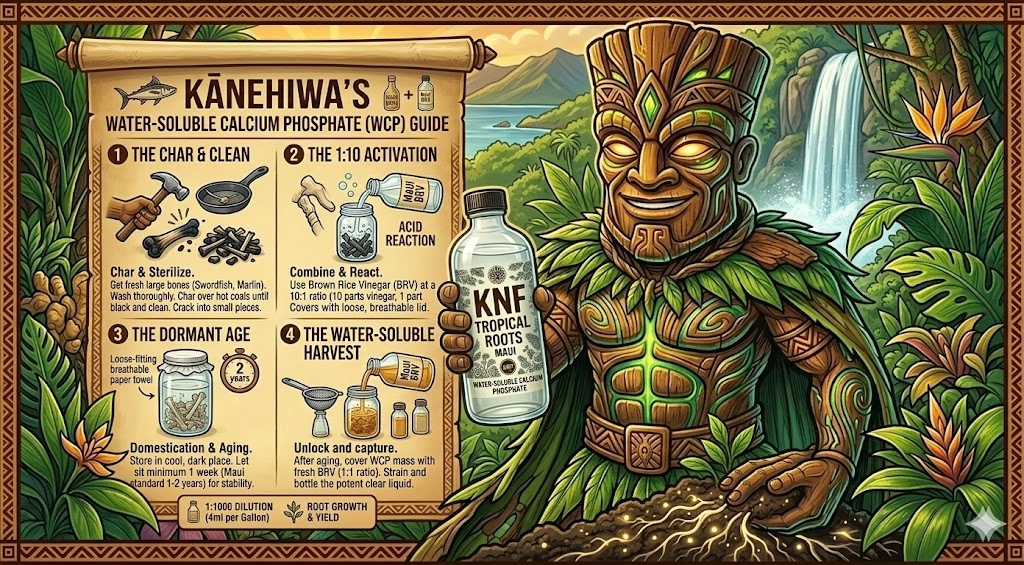
Charred bones dissolved in vinegar, the KNF input that signals your plant to stop growing leaves and start growing flowers.
The Source: Animal Bones
To make WCA-P, you need bones. You can use leftover bones from a meal: pork, beef, or poultry all work. In the spirit of KNF, using what you have available on the island is ideal.
🦴 Why Bones?Animal bones are roughly 70% calcium phosphate by weight. When charred and dissolved in vinegar, these minerals become water-soluble and immediately available to the plant. Unlike commercial bloom boosters that use refined chemical salts, bone-derived calcium phosphate carries a full spectrum of trace minerals that support the transition to flower.
⚡ WCA vs WCA-PWCA (eggshells) is nearly pure calcium carbonate, great for cell walls and structure. WCA-P (bones) delivers both calcium and phosphorus, making it a dual-purpose input that strengthens structure while fueling flower development. They are companions, not substitutes.
Materials Needed
The Brew: Step by Step
Boil the bones to remove all remaining fat, meat, and marrow. This is crucial: any leftover fat will go rancid and ruin your input. Boil for 30–60 minutes, scraping off any remaining tissue. Let them dry completely.
Place the clean, dry bones on a hot grill or in a fire. You want to burn them until they are blackened and charred, but not until they turn to white ash. The ideal char is a deep, matte black: the bones should be brittle enough to break with your hands but still hold their shape.
Charring removes the organic compounds (collagen and fat) and leaves behind the mineral matrix of calcium and phosphorus in a state the vinegar can easily dissolve. If you go too far and the bones turn to white ash, the minerals become less soluble; pull them off the heat when they're still black.
Use a 1:10 ratio: for example, 100g of charred bones to 1000ml of vinegar. Crush or break the charred bones into smaller pieces first to increase surface area and speed up the dissolution.
Step 4 · The ReactionPlace the charred bones in your glass jar and slowly add the vinegar. Like the eggshell WCA, it will bubble and fizz as the minerals are extracted. The reaction may be less vigorous than with eggshells since bone mineral is denser, but it should still produce visible fizzing.
Step 5 · FermentCover with a breathable lid (coffee filter secured with a rubber band) and store in a dark place for 7 to 10 days. Swirl the jar gently every couple of days to help the vinegar access all surfaces of the bone fragments.
Step 6 · StrainOnce the bubbling has completely stopped, strain the liquid through cheesecloth or fine mesh into a clean glass bottle. The finished WCA-P should be a slightly cloudy, amber liquid with a sharp vinegar smell. Label with the date and store in a cool, dark place.
How to Use WCA-P
WCA-P is specifically used to signal the plant to stop growing leaves and start growing flowers.
💧 Dilution Ratio1:1000: approximately 1ml per liter of water. Apply as a foliar spray or soil drench. Like all KNF inputs, less is more: consistency beats concentration.
📅 When to UseThe "Changeover" Period: Apply during the first two weeks of the flip to 12/12 (or when you see the first "buttons" of flowers forming). This is the critical window where the plant decides how aggressively to transition: WCA-P gives it the phosphorus signal to commit fully to bloom.
Root Stress Recovery: WCA-P is also excellent for helping plants recover from transplant shock or root damage. The phosphorus supports rapid root regeneration while the calcium stabilizes the stressed cell walls.
Which One Do I Use?
Here's how the core KNF inputs compare: each has a specific role in the plant's life cycle.
| Input | Source | Main Goal | Best Timing |
|---|---|---|---|
| FPJ | Fast-growing plant tips | Growth & Enzymes | Early to Mid Vegetative |
| WCA | Eggshells | Structural Strength | All Stages (especially Veg) |
| WCA-P | Charred Bones | Flowering & Roots | Transition to Bloom |
| FFJ | Ripe Fruits | Potassium & Fruiting | Mid to Late Flower |
| OHN | Garlic, Ginger, Herbs | Immunity & Pest Defense | All Stages (preventative) |
For a full overview of all five KNF inputs, see the Introduction to KNF Guide. For WCA specifically, see the Water-Soluble Calcium (WCA) Guide.
I. The Foundational Biology
🍄 IMO (Indigenous Microorganisms): From Rice Box to Black Gold
🧫 LabS (Lactic Acid Bacteria): The Clean-Up Crew
II. The Primary Growth Engines
🐟 FAA (Fish Amino Acids): The Nitrogen Engine
🌱 FPJ (Fermented Plant Juice): The Growth Hormone
III. Specialized & Bloom Nutrition
🦴 WCA (Calcium): The Cell Wall Builder
🔥 WCA-P (Calcium Phosphate): The Bloom Fuel
🛡️ OHN (Oriental Herbal Nutrient): The Immune Booster
IV. Application & Strategy
📋 KNF Feeding Schedule: Seed to Harvest Program
📊 KNF Feeding Chart: Printable Quick Reference
🐛 Pest & Disease Troubleshooting: Maui Edition
V. Foliar Techniques
🍚 BRV Foliar Spray: Feeding the Canopy
This guide is provided for educational purposes only. Always research local laws and regulations before cultivating. Tropical Roots Maui assumes no responsibility for actions taken based on this information.