BRV Foliar Spray
Feeding the Canopy
Brown Rice Vinegar · The Cuticle Catalyst & Pathogen Shield
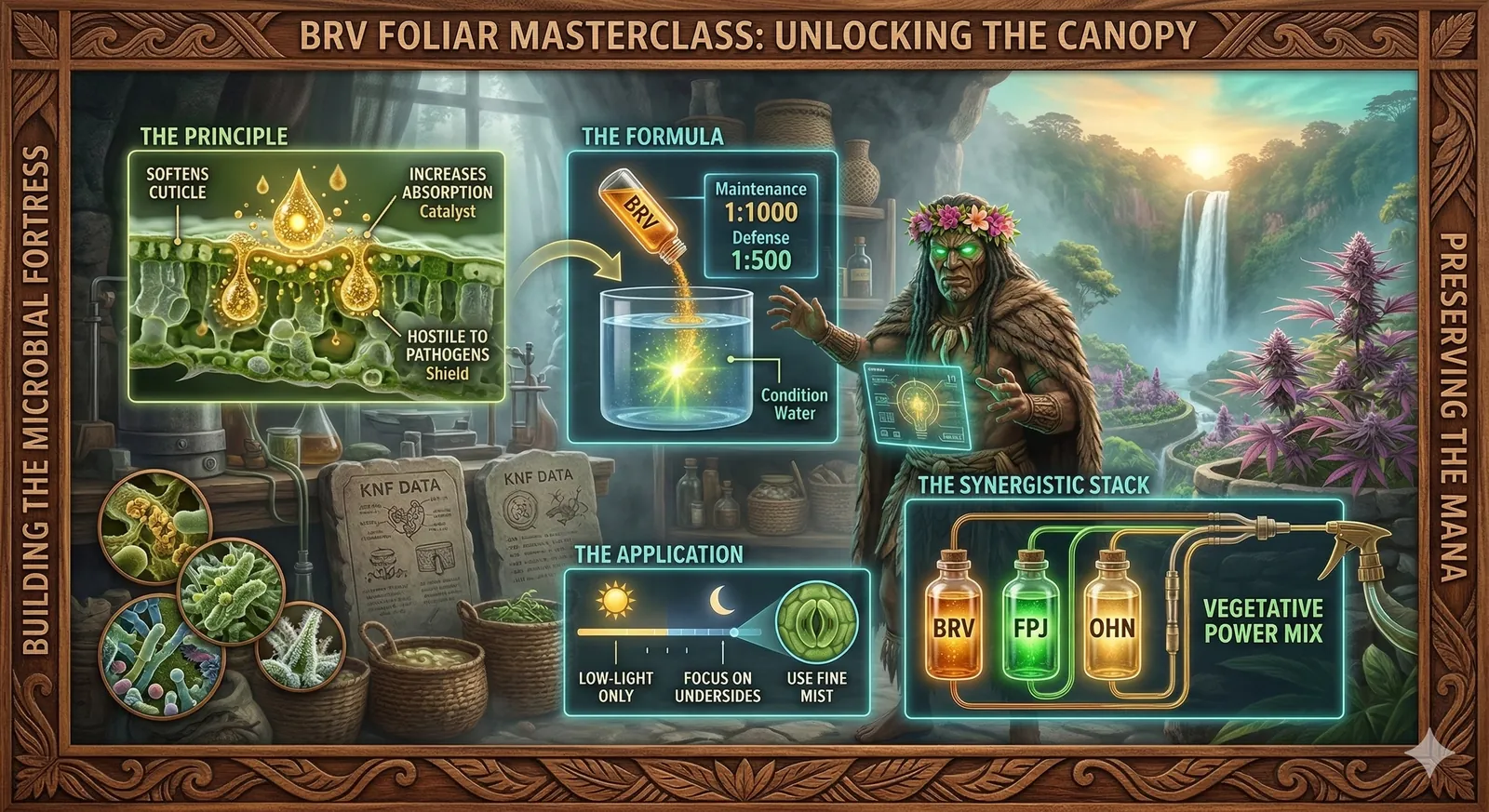
A Masterclass guide featuring Kānehiwa, the Golem Master, explaining the alchemical process of using Brown Rice Vinegar (BRV) foliar sprays. Learn how BRV softens the leaf surface to enhance nutrient absorption and fortify the microbial fortress.
"BRV is the key that opens the leaf. Without it, your foliar inputs knock on a closed door."
Brown Rice Vinegar is mildly acidic and loaded with organic acids. When applied as a foliar spray, it gently softens the waxy cuticle of the cannabis leaf, transforming it from a sealed barrier into a receptive surface that absorbs your KNF inputs directly into the vascular system.
BRV is mildly acidic and loaded with organic acids. When applied as a foliar spray, it gently softens the waxy cuticle of the cannabis leaf, the plant's outer armor that normally blocks absorption.
By softening the leaf surface, BRV dramatically increases the absorption rate of your other KNF inputs like FPJ (Fermented Plant Juice) or FAA (Fish Amino Acid). Without BRV, these inputs sit on the waxy cuticle and evaporate. With BRV, they penetrate directly into the mesophyll tissue where they're metabolized immediately.
The slight drop in pH on the leaf surface creates a hostile environment for pathogenic fungi like Powdery Mildew (PM) and Botrytis spores. Most fungal pathogens thrive at neutral-to-alkaline pH; BRV shifts the leaf surface acidic, effectively fortifying the microbial fortress at the canopy level. Regular BRV applications are one of the best preventative measures against PM in humid climates.
Beyond absorption and defense, BRV stimulates vegetative growth, increases wax production post-absorption (the plant rebuilds its cuticle thicker after each spray), and builds more resilient leaves overall. Over time, BRV-treated plants develop noticeably thicker, darker leaves with stronger pest resistance: the leaf itself becomes a shield.
In biological alchemy, less is often more. BRV is highly potent and must be diluted properly to avoid burning the delicate leaf tissue.
| Application | Ratio | Per Gallon | Use Case |
|---|---|---|---|
| 🌿 Standard Maintenance | 1:1000 | 4 ml (~¾ tsp) | Weekly foliar for cuticle conditioning and general absorption boost |
| 🛡️ Pathogen Defense | 1:500 | 8 ml (~1½ tsp) | Active PM pressure, high humidity periods, or post-rain canopy treatment |
Mixing order matters: Always mix BRV into the water first to condition the water before adding living microbes or other ferments (FPJ, LABs, OHN). Adding BRV last can shock and kill the beneficial organisms in your stack. BRV conditions the water → then add biological inputs.
The stomata (the plant's breathing pores) must be open to receive the mana. Timing and technique determine whether your spray feeds the plant or burns it.
Apply only during low-light hours: early morning (first light) or late evening (after direct sun passes). Spraying under intense, full-power LEDs or midday tropical sun creates a magnifying glass effect as the droplets focus light into the leaf tissue, causing burn spots that look like nutrient deficiency.
Aim for a highly humid environment during application to prevent the spray from evaporating before the leaf can absorb it. The ideal window: 70–80% RH, 70–78°F. On Maui, early morning naturally provides these conditions. If growing indoors, mist the room lightly before spraying to raise ambient humidity.
Use a fine mist sprayer, never a heavy stream. Coat the tops of the leaves for general conditioning, but focus heavily on the undersides where the highest concentration of stomata is located. The undersides are where 80%+ of foliar absorption occurs. Spray until droplets form but do not drip.
BRV rarely works alone. It is the ultimate carrier fluid for your biological stack, the key that opens the leaf so the KNF inputs can flood in.
1. BRV: 4 ml (1:1000), conditions the water, softens the cuticle
2. OHN (Oriental Herbal Nutrient): 4 ml (1:1000), sterilizes and stimulates the immune system
3. FPJ (Fermented Plant Juice): 8 ml (1:500), rushes nitrogen and growth hormones into the vascular system
| Growth Stage | Stack Formula | Frequency |
|---|---|---|
| 🌱 Seedling | BRV only (1:1000), no FPJ yet | 1x per week |
| 🌿 Vegetative | BRV (1:1000) + OHN (1:1000) + FPJ (1:500) | 1–2x per week |
| 🌸 Early Flower (Wk 1–3) | BRV (1:1000) + OHN (1:1000), drop FPJ (reduce N) | 1x per week |
| 💐 Mid–Late Flower | Stop all foliar: risk of bud rot outweighs benefit | None |
Never add BRV to your SIP reservoir. BRV is for foliar application only. Adding it to your bottom-watering system will acidify the root zone, potentially killing beneficial mycorrhizal fungi. The root zone and the canopy are separate ecosystems with different pH requirements.
After heavy Maui rain, the leaf surface pH resets to neutral. Apply a quick BRV spray (1:500) within 24 hours after rain to re-acidify the canopy and prevent PM spores from establishing. Rain washes away your previous application. Think of BRV as sunscreen that needs reapplication.
On Maui, the best foliar window is 5:30–7:00 AM: before the sun clears the mountain but after enough light for stomata to open. By 8:00 AM in summer, the UV intensity is already dangerous for wet leaves. Set your alarm early: the best growers on the island spray before their coffee.
True KNF BRV is made by fermenting cooked brown rice for 7–10 days until it becomes vinegar. On Maui, the warm temperatures accelerate fermentation: you can often have usable BRV in 5–7 days. Store-bought organic brown rice vinegar works as a substitute, but homemade contains a richer spectrum of organic acids.
If not making your own: Mana Foods (Pāʻia) and Down to Earth (Kahului) carry organic brown rice vinegar. For KNF-specific inputs (OHN, FPJ), check the Maui KNF community groups or make your own using our KNF series guides.
I. The Foundational Biology
🍄 IMO (Indigenous Microorganisms): From Rice Box to Black Gold
🧫 LabS (Lactic Acid Bacteria): The Clean-Up Crew
II. The Primary Growth Engines
🐟 FAA (Fish Amino Acids): The Nitrogen Engine
🌱 FPJ (Fermented Plant Juice): The Growth Hormone
III. Specialized & Bloom Nutrition
🦴 WCA (Calcium): The Cell Wall Builder
🔥 WCA-P (Calcium Phosphate): The Bloom Fuel
🛡️ OHN (Oriental Herbal Nutrient): The Immune Booster
IV. Application & Strategy
📋 KNF Feeding Schedule: Seed to Harvest Program
📊 KNF Feeding Chart: Printable Quick Reference
🐛 Pest & Disease Troubleshooting: Maui Edition
V. Foliar Techniques
🍚 BRV Foliar Spray: Feeding the Canopy
For educational purposes only. This guide covers Korean Natural Farming foliar techniques for legal cannabis cultivation. Always follow local agricultural regulations and laws. Test spray dilutions on a small area first. The information provided is not a substitute for professional consultation.