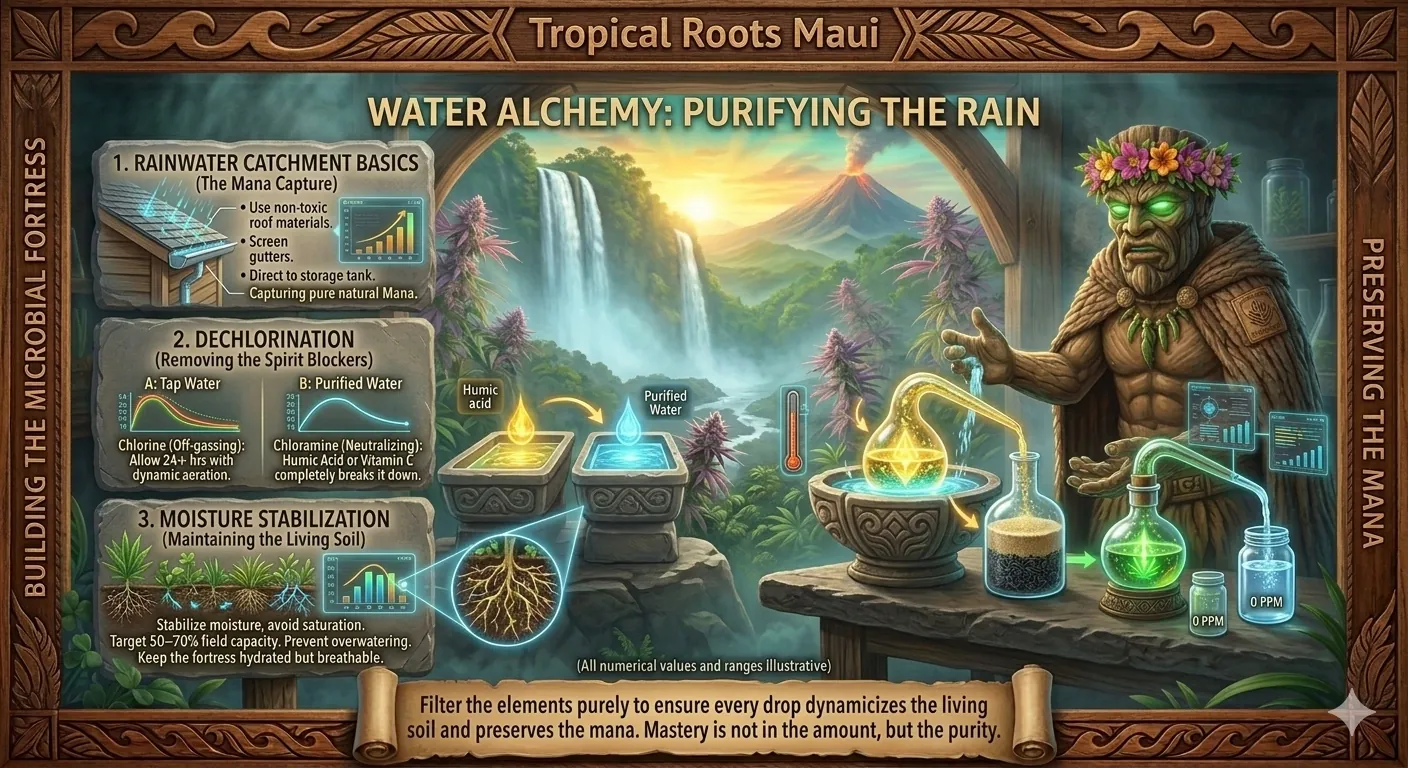
Water Alchemy
Purifying the Rain
The Lifeblood of the Microbial Fortress · From Source to Root Zone
"If the soil is the Microbial Fortress, water is the lifeblood that sustains its defenders. But modern water carries chemical spirit blockers that can instantly devastate the food web."
Water is not simply a liquid: it is the ultimate carrier of mana. This masterclass transforms standard water into pure, dynamic hydration for your grove, removing every chemical barrier between the source and the root zone.
Rainwater is the purest form of hydration: naturally distilled by the sun and infused with atmospheric nitrogen as it falls. Catching it requires a clean, non-toxic pathway from sky to storage.
Ensure your catchment surface is free of toxic sealants or heavy-metal runoff. A clean metal roof (galvanized steel or aluminum) or a dedicated food-grade tarp system works best. Avoid asphalt shingles and painted surfaces: they leach petrochemicals into your water.
Always use a "first flush" diverter. This mechanism discards the first few gallons of rain, which carry dust, pollen, and bird debris that settled on the roof during dry spells. After the first flush clears, the remaining rain runs clean into storage.
Store captured rain in opaque tanks to prevent algae blooms: black or dark green HDPE is ideal. Introduce an air stone to keep the water dynamic and oxygenated, preventing stagnation and anaerobic bacteria.
When rain refuses to fall and you must rely on municipal tap water, you need to break the chemical bonds designed to kill bacteria, because in living soil, bacteria are our greatest allies.
If your local supply uses standard chlorine, it is highly volatile. Fill your reservoir, add an air stone for a dynamic rolling boil of bubbles, and wait 24 to 48 hours. The chlorine naturally evaporates into the air. UV sunlight accelerates this: an open container in partial sun can reduce time to 12–24 hours.
Many modern cities use chloramine (chlorine bonded with ammonia), which will not evaporate. Add a small amount of Humic Acid or Vitamin C (Ascorbic Acid) to break the bond instantly. Humic acid also provides a rich carbon food source for soil microbes: a two-for-one benefit. Dosage: ~1/4 teaspoon Vitamin C per 50 gallons.
| Property | Chlorine | Chloramine |
|---|---|---|
| Chemistry | Cl₂: free chlorine gas | NH₂Cl: chlorine + ammonia |
| Evaporates? | Yes: off-gasses in 24–48 hrs | No: stable, will not evaporate |
| Removal | Aeration + time (air stone 24–48 hrs) | Humic Acid or Vitamin C (instant) |
| Microbe Danger | Kills beneficial bacteria on contact | Kills bacteria and persists longer |
| How to Identify | Strong "pool" smell; fades when sitting | Mild smell; does not fade |
Know your local supply: Maui County primarily uses chloramine. If you're on county water (Central Maui, Kihei, Lahaina), always treat with Humic Acid or Vitamin C: off-gassing alone will not work. Check your provider's annual water quality report to confirm.
Never shock the Microbial Fortress with extreme temperatures. Water temperature directly dictates microbial activity: it's the thermostat of the soil food web.
The sweet spot where beneficial aerobic bacteria, mycorrhizal fungi, and protozoa peak. Nutrient cycling, disease suppression, and root growth all optimize here. Use a simple aquarium thermometer to check your reservoir before every watering.
Cold water puts microbes to sleep. Nutrient uptake slows, root growth stalls, and beneficial fungi go dormant. Repeated cold-water shock can invite pythium (root rot) as weakened biology can't outcompete pathogens.
Warm water depletes dissolved oxygen and breeds anaerobic pathogens. In Maui's heat, reservoir water easily exceeds 80°F in sun-exposed tanks. Always shade your tank, add a frozen gallon jug on hot days, or fill your watering can the night before.
Purified water is only powerful if applied with patience. Living soil in fabric pots requires a delicate balance between hydration and aeration.
Your soil should feel like a wrung-out sponge: damp to the touch, but never yielding drops when squeezed. This is "field capacity." Enough moisture for roots and microbes, enough air space for oxygen to reach the root zone.
Overwatering fills porous spaces, suffocating roots and drowning aerobic bacteria. Water slowly: use bottom-feeding, gravity-fed reservoirs, or a gentle watering can. Let the soil absorb via capillary action rather than flooding from above.
Allow the top mulch layer to dry slightly between waterings. This encourages roots to stretch deeper, expanding their mycorrhizal networks. A healthy dryback builds stronger, more resilient root systems.
Best source on Maui. Naturally soft, low TDS, no chloramine. Filter for sediment and biological contaminants. UV sterilization recommended. pH typically 5.8–6.5, ideal for living soil.
Central, Kihei, and West Maui are on chloramine-treated county water. TDS 80–200 ppm. Always treat with Humic Acid or Vitamin C. Otherwise clean but will devastate living soil microbes untreated.
Quality varies: some wells produce excellent low-TDS water, others are high in calcium, magnesium, or iron from volcanic rock. Always test with TDS meter. Consider RO filter if above 200 ppm.
Strips everything to near-zero TDS. Excellent base but may need slight re-mineralization for living soil (pinch of sea mineral concentrate). Best as backup during dry Kona wind seasons.
For educational purposes only. This guide covers water purification and irrigation techniques for legal cannabis cultivation. Always follow local water-use regulations. Results vary by water source and growing conditions. The information provided is not a substitute for professional water quality testing.