🍵   Knowledge Base · Organic Nutrition
The Feast of Mana Organic Teas (Aina, Wai, & La Blends)

The Feast of Mana:
Organic Compost Teas

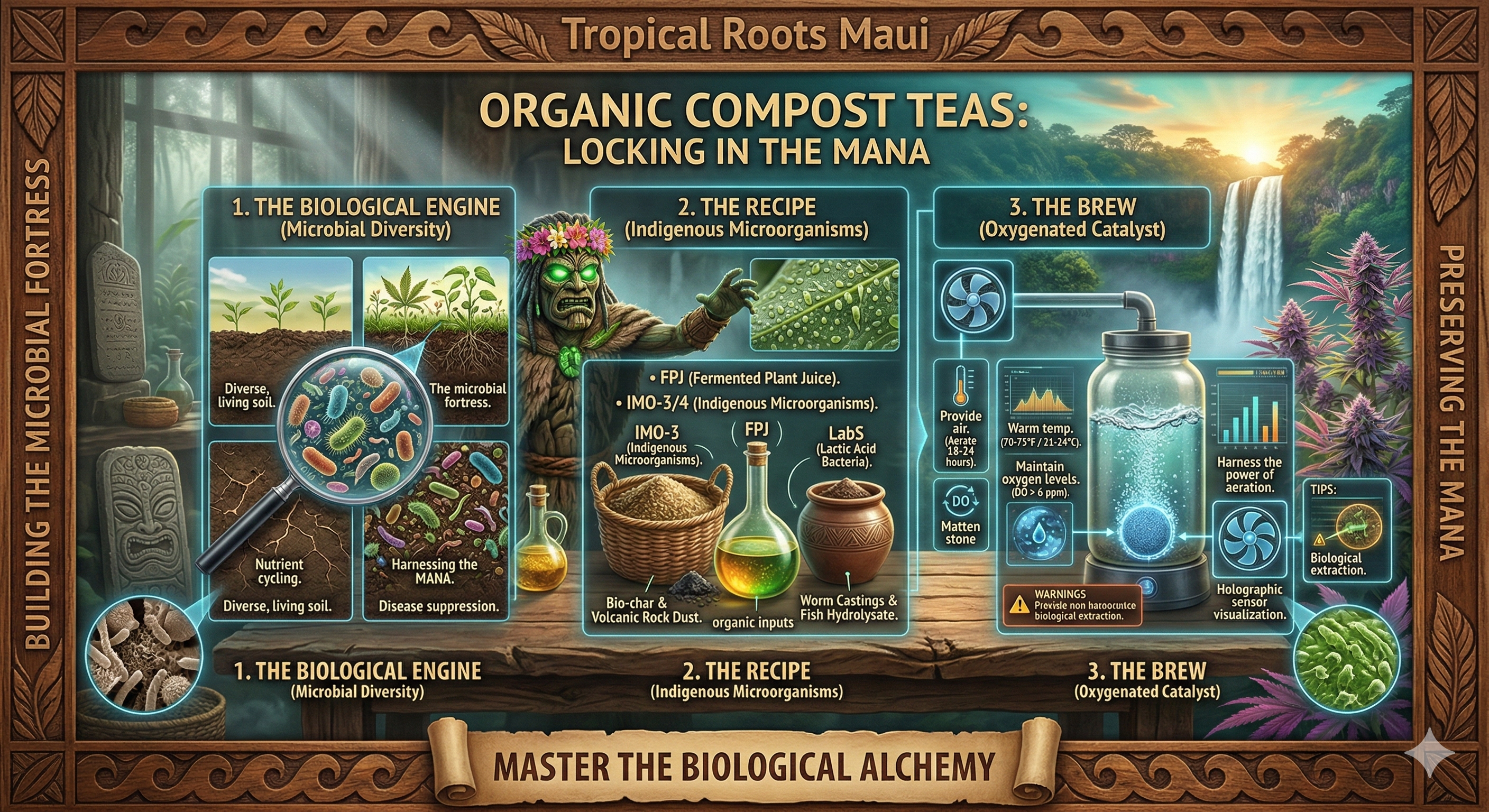
In the Sacred Grove, we do not merely "feed" the plants; we nourish the living spirit of the earth. Organic Compost Teas are the most powerful way to awaken the microbial life in your soil. Success is not measured by the height of the leaf, but by the strength of the hidden roots. (All values illustrative).

🍵
Feed the soil, not the plant. Compost teas multiply the beneficial bacteria, fungi, and protozoa that make nutrients available to your roots. A thriving soil microbiome is the foundation of the finest medicine Maui has to offer.
📖 Type Organic Nutrition
⏱️ Brew 24–48 Hours
🪣 Batch 5 Gallons
📊 Level Beginner
1

The Vegetative Feast: High-Nitrogen Tea

During the Vegetative Awakening, your plants are building their green foundation. They crave Nitrogen to create lush, vibrant fan leaves. This tea delivers it through the living biology of the soil. For more on the veg stage, see the Vegetative Stage Guide.

🧪 The Recipe

Mix 2 cups of high-quality earthworm castings and 1 tablespoon of unsulphured blackstrap molasses into 5 gallons of dechlorinated water. See the Worm Bin Mastery Guide to produce your own.

🔬 The Purpose

The molasses acts as a spark for the beneficial bacteria, allowing them to multiply rapidly and release the Nitrogen stored in the castings. Within 24 hours, a single teaspoon of this brew can contain billions of beneficial microorganisms.

🫧 The Brew

Bubble this mixture with an air stone and pump for 24–48 hours until it develops a frothy "head" on the surface. This foam tells you the aerobic bacteria are thriving. Stir occasionally to keep everything suspended.

💧 The Application

Dilute 1:1 with pure dechlorinated water and apply directly to the roots as a soil drench. Use within 4–6 hours of turning off the air pump — the microbial life begins to decline without oxygen. These teas are a key tool in building and maintaining the Microbial Fortress that protects your root zone.

🌿 Vegetative Tea — At a Glance

5 gallons Dechlorinated water
2 cups Earthworm castings
1 tbsp Unsulphured blackstrap molasses
24–48 hrs Brew time with air stone
1:1 Dilute with water before applying

Apply every 1–2 weeks during veg. Best used within 4–6 hours of brewing.

💡
Dechlorinate your water. Chlorine and chloramine in tap water kill the very microbes you're trying to cultivate. Let water sit out uncovered for 24 hours, or use a dechlorinating agent. If your city uses chloramine, you'll need a carbon filter or ascorbic acid treatment.
🌺 Hawaiʻi Island Tip — Supercharge Your Veg Tea with KNF Running KNF? Add FAA at 1:1000 and FPJ at 1:1000 to your finished veg tea right before applying — the amino-chelated nitrogen from FAA and the growth hormones from FPJ amplify what the worm castings are already doing. On Maui, our tap water is treated with chloramine (not just chlorine), which does not off-gas by sitting out. Use a carbon filter or ¼ tsp ascorbic acid per 5 gallons to neutralize it. Many Maui growers collect catchment rainwater instead — free, mineral-rich, and already pH-neutral.
2

The Flowering Blessing: High-Phosphorus Tea

As the grove transitions to the Flowering Stage, the plants shift their energy from leaves to heavy, resin-drenched buds. They now require Phosphorus and Potassium to fuel this transformation.

🧪 The Recipe

Use 1 cup of bat guano (high-phosphorus variety) and 1 tablespoon of molasses in 5 gallons of water.

🌊 The Micro-Boost

Add a teaspoon of kelp meal to provide micronutrients and natural growth hormones that help the stalks support the weight of the coming harvest. Kelp also contains cytokinins that promote cell division in developing flowers.

💧 The Application

Bubble for 24 hours. Apply every 2 weeks during the first half of the flowering cycle to give the flowers the mana they need to swell. Discontinue feeding teas during the final 2 weeks before harvest to allow the plant to use its remaining reserves, producing a cleaner, smoother smoke.

🌺 Flowering Tea — At a Glance

5 gallons Dechlorinated water
1 cup High-phosphorus bat guano
1 tbsp Unsulphured blackstrap molasses
1 tsp Kelp meal
24 hrs Brew time with air stone

Apply every 2 weeks during early-to-mid flower. Stop all teas 2 weeks before harvest.

⚠️
Bat guano safety: Always wear a dust mask and gloves when handling bat guano. The fine particles can carry harmful spores if inhaled. Mix outdoors or in a well-ventilated area.
🌺 Hawaiʻi Island Tip — Bloom Tea, Island Style For KNF growers, your bloom tea has a natural upgrade: replace the bat guano with WCA-P (Calcium Phosphate) at 1:1000 — it delivers the same phosphorus signal to switch from veg to flower, plus plant-available calcium that strengthens cell walls against Maui's humidity-driven bud rot. Add WCA at 1:1000 for extra calcium during weeks 3–5 of flower when buds are swelling and cell walls are under the most stress. Banana peel FPJ (fermented ripe banana skins) is another island-free potassium source that pairs perfectly with this tea.
3

Kānehiwa's Tips for Success

🧼 Cleanliness

Always scrub your brewing bucket after every batch. Stagnant mana can invite the "Grey Rot" — anaerobic bacteria that produce foul-smelling compounds harmful to your roots. A clean vessel ensures every brew starts fresh.

⏰ Timing

Apply your teas immediately after brewing while the microbial life is at its peak activity. Once the air pump stops, the beneficial aerobic organisms begin to die off within hours. A tea left sitting overnight without aeration can turn anaerobic and become harmful.

💧 The Wet-Dry Cycle

Never saturate the soil to the point of drowning. Let the top few inches of sacred earth dry out between feedings. If you're growing in living soil, remember to keep the deeper layers consistently moist — the microbes you're adding need a living environment to colonize. For more on watering technique, see the Vegetative Stage Guide.

🌡️ Brew Temperature

Keep your brew between 65–80°F for optimal microbial reproduction. Too cold and the biology stalls. Too warm and harmful bacteria can outcompete the beneficials. Room temperature in most homes works well.

🔧 Equipment Essentials

You don't need much: a 5-gallon bucket, an aquarium air pump, an air stone, and some tubing. A mesh bag or old pantyhose can hold the castings to reduce sediment. Total investment is under $20 and lasts for years of brewing.

🌺 Hawaiʻi Island Tip — Brewing & Applying in the Tropics Island temps work in your favor — Maui's year-round 75–85°F is the sweet spot for microbial activity, so your teas brew fast and strong. But that same heat means the tea degrades faster once the pump stops. Apply within 2–4 hours rather than the usual 4–6 hour window. Brew in the shade or indoors — direct tropical sun heats a black bucket past 90°F and can kill your beneficials before they reach the soil. Apply in the early morning or late evening when soil temps are cooler, helping microbes colonize before midday heat hits. Add LabS at 1:1000 to any tea for a probiotic boost that helps the new biology outcompete tropical pathogens like Pythium and Fusarium.
🌺 Hawaiʻi Island Tip — Feed the Soil Army with IMO Compost teas introduce biology, but IMO (Indigenous Microorganisms) gives you Maui's own native soil army — fungi and bacteria already adapted to our tropical conditions. Top-dress IMO-4 into your soil before applying teas, and the introduced biology has a thriving ecosystem to move into. Think of it as building the house (IMO) before inviting the guests (tea). Together, they create a soil food web that's nearly impossible to replicate with bottled nutrients alone. See the full KNF Feeding Schedule for how teas and KNF inputs work together across the full growth cycle.
💡
The smell test: A healthy compost tea smells earthy and sweet, like rich forest soil. If it smells rotten, sour, or like sewage, it has gone anaerobic — dump it and start over. Never apply a bad-smelling tea to your plants.
📚 Related Guides
🌿 Words of Kānehiwa 🌿 The Feast of Mana

"In the Sacred Grove, we do not merely feed the plants; we nourish the living spirit of the earth. The tea is a ceremony — the molasses is the offering, the castings are the wisdom, and the bubbles are the breath of life."

"The Vegetative Feast is Nitrogen's dance. Watch the froth rise on your brew like the morning tide — when the foam crowns the surface, the mana is ready. Feed the soil, and the soil will feed the grove."

"When the flowers come, the grove shifts its hunger. Phosphorus and Potassium are the currencies of the bloom. The bat guano carries generations of stored energy — use it wisely, and the buds will swell with gratitude."

"A clean bucket is a sacred vessel. Scrub it as you would scrub a temple floor. The mana of the tea must always flow through a pure channel — stagnant water breeds the grey rot that steals the harvest."

"Listen to the mana of the soil. If it is alive and breathing, the plants will dance for you."

This guide is provided for educational purposes only. Always research local laws and regulations before cultivating. Tropical Roots Maui assumes no responsibility for actions taken based on this information.