Reading Your Plants
Deficiency Guide
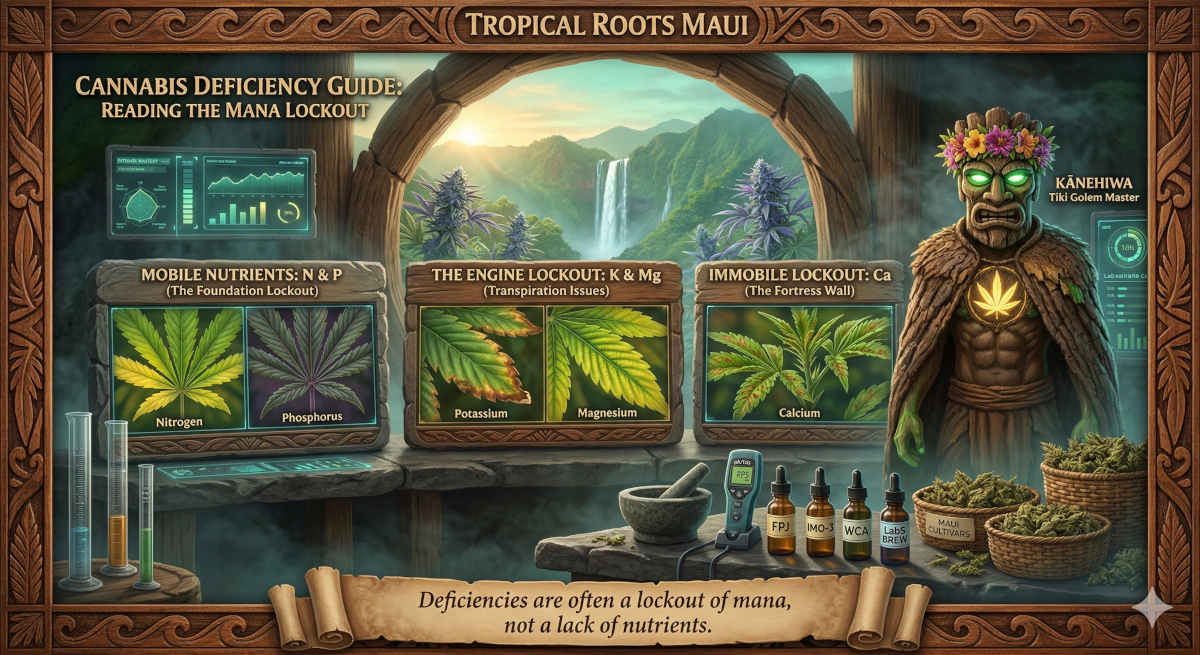
Read the leaves. Secure the fortress. Kānehiwa walks you through our precise guide to reading complex deficiency diagnoses: Mobile N/P, Engine K/Mg, and Immobile Ca lockouts. Dominate your environment and check your soil's microbial life to lock in the potent mana for your Maui Cultivars. (All values illustrative).
"A plant does not speak with words, but with the color of her leaves and the reach of her branches. To be a master grower is to learn the silent language of the garden. Observe first, act second, and always move with the rhythm of the island." Kānehiwa
When the plant is deficient, it moves nutrients away from older leaves to support new growth. So symptoms show up on the lower, older leaves first.
The plant cannot move these nutrients once they're locked into tissue. Deficiencies show up on new, top growth first: young leaves suffer most.
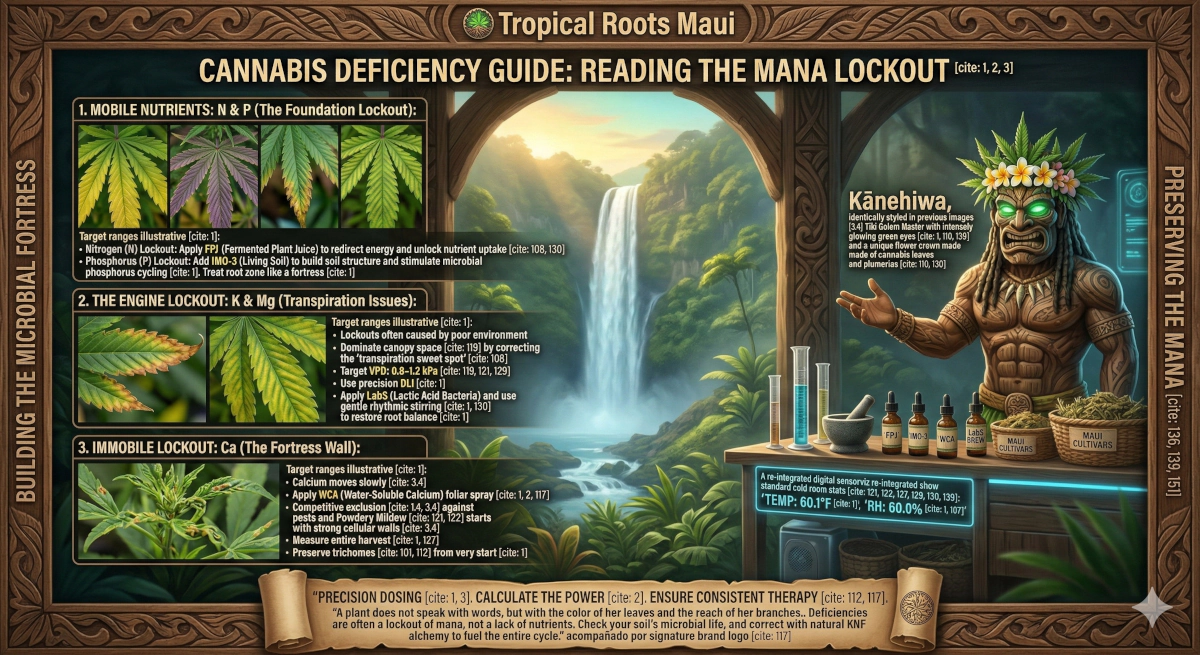
Read the leaves. Fix the source. Kānehiwa guides you through our foundational Tropical Roots Maui deficiency guide. Learn to identify Nitrogen, Phosphorus, Potassium, Magnesium, and Calcium lockouts, and discover how to remediate them using natural KNF inputs like FPJ and WCA. Build your microbial fortress, dial in your VPD, and drive potent nutrient uptake to preserve the mana. (All values illustrative).
Lower, older leaves turn pale green then yellow, starting at the tips and working inward. See the Nitrogen section of the Reading the Mana Lockout image above for a visual reference.
Yellowing climbs up the plant as it cannibalizes older growth to feed the top canopy. Overall growth slows noticeably.
Increase base nutrients or add a high-nitrogen organic amendment like bat guano or fish emulsion.
"When the lower leaves turn pale like the fading moon, the plant is hungry for the spirit of the sky. Give her the nitrogen she needs to keep her green cloak vibrant and strong." Kānehiwa
Leaves darken to a deep green and develop dark purple or copper-colored spots. Leaf stems (petioles) may turn bright red or purple. Refer to the Phosphorus section of the Reading the Mana Lockout image above.
Growth slows significantly, especially during flowering. Buds may fail to develop properly if not corrected early.
Check pH first: P lockout is often a pH problem. If pH is correct, add a bloom-specific organic booster.
"If the stems turn purple like the sunset and the leaves darken with shadow, the roots are struggling to build their temple. Phosphorus is the foundation of the bloom; do not let her foundation crumble." Kānehiwa
Burnt or yellow leaf edges (marginal chlorosis) while the inner leaf remains green. Sometimes called "the scorched look." Compare with the Potassium section of the Reading the Mana Lockout image above.
Brown spots appear and spread. Leaves may look stretched, thin, or weak. Stems may become brittle.
Add kelp meal or a potassium-rich organic supplement. Avoid overwatering, which can lock out K.
"When the edges of the leaves burn like the lava's touch, the plant is thirsty for the strength of the earth. Potassium is the water-bearer; it helps her stand tall against the heat of the day." Kānehiwa
Yellowing between the leaf veins (interveinal chlorosis) on older leaves. The veins stay dark green while the leaf tissue around them turns bright yellow. See the Magnesium section of the Reading the Mana Lockout image above.
Rust-colored spots may appear. Affected leaves curl upward at the edges and eventually drop.
Add Epsom salt (Magnesium Sulfate) to your watering schedule at 1 tsp/gallon, or apply as a foliar spray for a faster response.
Small, rusty-brown pitting or spots on new growth (the top leaves, not the bottom). New leaves may be twisted, crinkled, or show hooked tips. Refer to the Calcium section of the Reading the Mana Lockout image above.
Growing tips may die back entirely. Root health suffers in parallel, compounding other deficiencies. Often appears alongside Magnesium deficiency.
Use a Cal-Mag supplement or add oyster shell flour to your living soil. Ensure pH is in range: Ca is very sensitive to lockout.
"Spots like the freckles of the sun on a young leaf mean the bones of the plant are weak. Calcium and Magnesium are the mana that binds the cells together. Keep them balanced, or the structure will fail." Kānehiwa
If pH is too high or too low, the plant's roots are locked out and cannot absorb nutrients even if they are present in the soil. Adding more nutrients to a pH problem will make things worse, not better.
"The soil is a living breath. If the water is too sour or too sweet, the plant's mouth is closed to the nutrients around her. Seek the middle path (the balance of the mountain stream) so she may drink freely." Kānehiwa
| Nutrient | Type | Where It Shows | Key Visual | First Fix |
|---|---|---|---|---|
Nitrogen (N) |
Mobile | Old, lower leaves | Pale yellow, tips first | Base nutrients / bat guano |
Phosphorus (P) |
Mobile | Old, lower leaves | Dark leaves, purple stems | Check pH → bloom booster |
Potassium (K) |
Mobile | Old, lower leaves | Burnt / yellow edges | Kelp meal / K supplement |
Magnesium (Mg) |
Mobile | Old, lower leaves | Yellow between veins | Epsom salt foliar / water |
Calcium (Ca) |
Immobile | New, top growth | Brown spots / twisted tips | Cal-Mag / oyster shell |
This guide covers the most common deficiencies for home growers. Always confirm your diagnosis by checking pH first and ruling out environmental factors (overwatering, root issues, light burn) before adjusting nutrients. When in doubt, less is more: nutrient toxicity can look similar to deficiency.