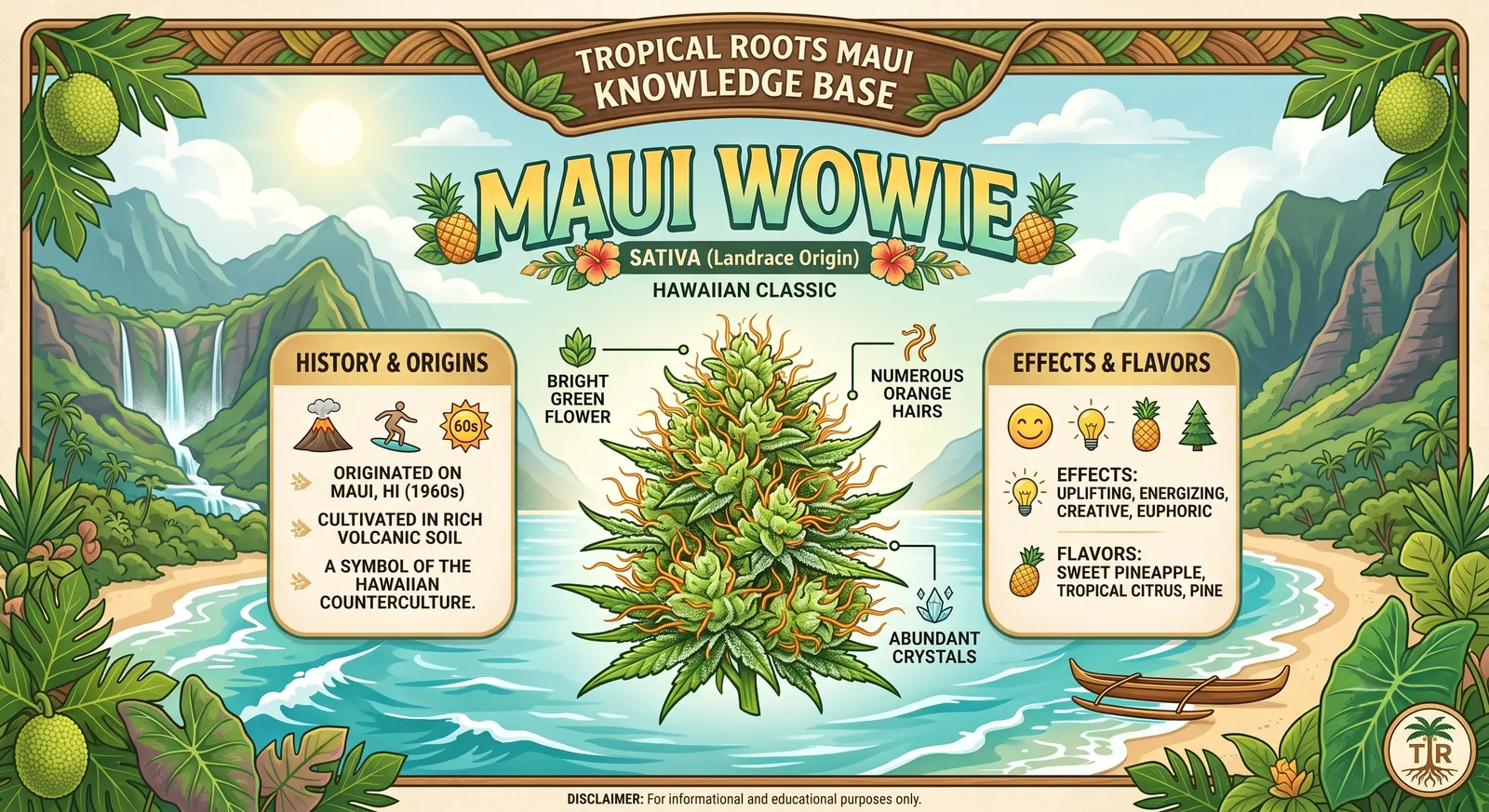
Why Maui Wowie is famous
Of all the strains the Hawaiian Islands gave the world, none traveled farther than Maui Wowie. It was one of the first widely-marketed strain names in American cannabis culture, a name that carried the mystique of the islands to the mainland long before anyone spoke of terpenes or cannabinoid ratios. To smoke Maui Wowie was to taste somewhere else.
The name has an origin story, and it is more specific than most. The keeper of it is an uncle of Lower Nāhiku, who hosted a summer solstice gathering there every year from the late 1960s until 2004. His account runs like this. In those years the newcomers of the counterculture and the Kānaka Maoli were not easy neighbours. The Hawaiian Kingdom had been overthrown within living memory, the new arrivals had a habit of stripping off on family beaches and mangling Hawaiian names, and there was real bad blood on both sides.
One solstice, the smell of pakalōlō and the sound of music carried up the Hāna highway, and a few truckloads of Hawaiians came down to Nāhiku to see about it. The party braced for a fight. Instead the Hawaiians rolled their own and passed it around. The newcomers had the good imported bud of the day, Panama Red and Acapulco Gold and Thai stick brought back by returning servicemen, but when the local Nāhiku Maui budz came round it was something none of them had met before. Everyone wanted the name of it.
As Uncle tells it, the name wrote itself. Nobody could get a sentence out past the one word the bud kept pulling out of them: wow. Between the Hawaiians correcting the pronunciation of the island, a deep MA-oo-WEE, said with mana, and the newcomers stuck on wow, the two ran together into Maui Wowie. For a while afterward Hawaiians would throw a shaka from passing trucks and holler it, and the newcomers would holler it back. Whether the etymology is literal or a good story told for forty years hardly matters: the name came out of that valley, and so did the plant.
The name traveled the world, but the genetics came from one very specific stretch of it: Lower Nāhiku, out along the long and winding road to Hāna on Maui's windward east side. It is one of the wettest, greenest, least accessible corners of the island, a country of waterfalls and dense rainforest where a garden could sit a short walk off the road and never be seen from it. That remoteness is a large part of why the line came to exist at all, and later, a large part of why anything at all survived the helicopters.
Sweet, tropical, citrus
Maui Wowie leads sweet, tropical, and citrus-forward: bright, sunny, almost fruit-basket in the jar. Pineapple up front, cane sugar underneath, and a real citrus zest running through rather than hiding at the edges, with the clean floral top note island growers have always chased. The first impression is fruit; the finish is sweetness and light.
The effect is uplifting, energetic, and head-focused: classic island time energy that runs sociable and creative rather than couch-bound. It is a daytime sativa in the truest sense, good for conversation, movement, and long afternoons. Less good for winding down before sleep.
Which makes her a morning strain more than an evening one. She suits the dawn patrol heʻe nalu (surf) ʻohana, and anyone the local slang calls Ala Mea Puhi Palaoa: the wake and bakers, out early and intending to seize the day.
Under the hood: the terpenes
The aroma is not an accident, it is chemistry. Terpenes are the aromatic compounds that shape how a strain smells, tastes, and lands, and if the word is new to you the terpene guide is the place to start. Every plant runs a little different, but the three reported most often in Maui Wowie are these.
| Terpene | Aroma & flavor | Commonly associated with |
|---|---|---|
| Myrcene | Tropical fruit, sweet, earthy | Relaxation and mood; the sweet base of the profile |
| Pinene | Fresh pine, sharp, herbal | Alertness, focus, a clear head |
| Caryophyllene | Peppery spice, woody | Warmth and body; the one terpene that also binds a cannabinoid receptor |
How to grow Maui Wowie
Environment
Maui Wowie is a long-flowering sativa that wants warmth, light, and time. Outdoor growers in zones 9 to 11 (Hawaii, southern California, southern Florida) can finish her in a single season. Mainland growers further north should plan for an indoor flower: the 10 to 11 week cycle won't fit a short outdoor summer at higher latitudes.
Photoperiod
She is run Hawaiian style, 11/13: eleven hours of light to thirteen of dark, closer to the short tropical day she grew up under at Nāhiku than the standard 12/12. Hawaiʻi only swings between roughly 10.5 and 13.5 hours of daylight across the whole year, so a plant selected there can be slow to commit under a flat 12/12. Growers who run true Maui Wowie indoors report she flowers with far more conviction on 11/13, and she takes to indoor and outdoor equally.
Structure
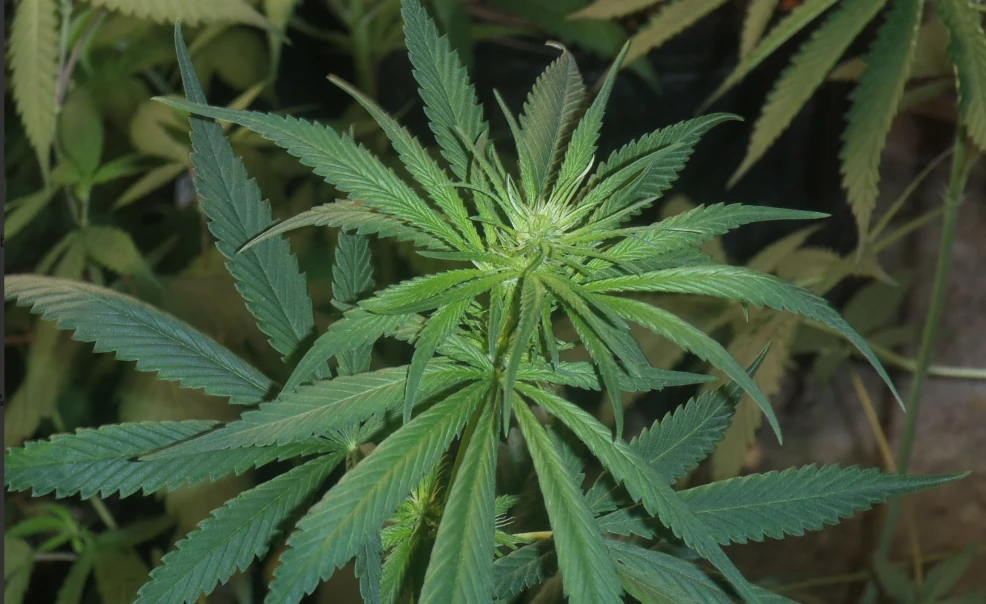
Expect a tall sativa with significant stretch: plan for 2 to 3 times vertical growth in the first month of flower. Topping early (after the 4th node) and low-stress training from week three of veg will keep the canopy under control. SCROG nets pay off with a plant this eager to reach.
Feeding
Like all Hawaiian heritage lines, Maui Wowie responds best to living, microbially-active soil rather than salt-based nutrients. The genetics were selected over generations against the backdrop of native island microbiology: they expect partners in the rhizosphere. Build a soil from the DIY Organic Living Soil Guide or feed with KNF inputs. Avoid overfeeding nitrogen in flower; Maui Wowie finishes with a graceful natural fade when she's given room to do so.
Pest resistance
Naturally good resistance to powdery mildew (Maui's trade winds and valley pressure selected for this) and decent to spider mites. Vulnerable to caterpillars in late flower on the denser colas. Treat preventatively with Beauveria bassiana or stick to the white oil schedule.
Harvest
As a long-flowering sativa, Maui Wowie ripens gradually and rewards patience: different colas finish at different times. Selective harvest (chopping the top third first, returning a week later for the lowers) preserves the bright terpene profile better than a single chop. Read more in the Trichome Harvest Guide.
What carries the name now
The original is gone, so the practical question for a grower is what to do about it. The answer most people arrive at is Maui Wowie 2.0 from Sticky Finger Seeds, a Maui outfit stamping OG 1973 on their packs. It is worth reading that pack closely, because it is more honest than most.
- Genetics
- Maui ʻOhana Secret
- Type
- 50/50 sativa and indica
- Flower time
- 55 days
- Sex
- Regular, non-feminized
- Taste & aroma
- Skunky vanilla spice
"Maui ʻOhana Secret" is a refusal to disclose, and a straight one. He is telling you there is Maui family genetics in it and that he is not going to name them. Compare that to the 1980s, when the name got stamped on mainland Skunk and Haze crosses and nobody admitted anything at all. A breeder who says I know what is in here and I am keeping it is doing something different from a breeder who lets you assume.
The detail we would point a preservationist to is regular, non-feminized. That means males, which means pollen, which means you can actually hunt through a pack and breed forward from what you find. Feminized seed is a dead end for anyone trying to keep a line going. Selling regular seed in 2026 is a choice, and it is the choice that serves seed savers.
One thing the pack does not tell you: the crimson bleeding turns up in this line. We have watched the Blood phenotype surface in his seed, and the breeder is aware it runs in there. It is simply not something he advertises, and the parentage stays a secret. So treat it the way you would treat any phenotype, because that is what it is: not a feature you are buying, but a trait known to appear. If it shows, you found it. Seed will not promise it, and anyone who tells you otherwise is selling a coin flip.
So: not the lost original, and not sold as it. What the 2.0 carries forward is the name, a Maui pedigree its breeder keeps to himself, and the older habit of putting regular seed in growers' hands and letting them do the rest.
Lineage & preservation
The genetics that made the name famous in the 1960s and 70s were preserved, protected, and passed by an uncle of Lower Nāhiku. That is the honest shape of how a line like this travels: not through a catalog or a breeding program, but through one person in one valley who thought she was worth keeping and handed her on. The name went around the world. The keeping happened at the end of the Hāna road.
This is the part most tellings get wrong in one direction or the other. Operation Green Harvest spent decades pulling and spraying the mountain plots where Maui Wowie grew, and much of that open, freely-grown genetics did go with them. Through the 1980s the label was stamped on mainland Skunk and Haze crosses with little to do with the islands, which muddied what "Maui Wowie" even meant. So the line is rare and the imposters are everywhere. But rare is not the same as gone, and the account from the source is that the real cut was carried through it all at Nāhiku, kept by the same hands that hosted the solstice.
This is where we can say more than most. The cut that came through Uncle did not die with the open gardens. A seed-saver ʻohana carried it forward, and that preserved line is the Maui Wowie we steward: a low-volume preservation line grown from real island stock, released in small batches with full lineage documentation, restocks announced in the Sacred Grove. We make no claim that it is a pristine, unchanged landrace, because no honest keeper can. We claim only what is true: it is the line that came down through the man who named it. For growers who would rather buy a pack any day than wait on a preservation run, the Sticky Finger Seeds Maui Wowie 2.0 carries the name forward on genetics of its own. The wider effort to keep the island genetics from vanishing altogether owes a great deal to Pua Mana ʻOhana and their Pua Mana 1st Hawaiian Pakalōlō Seed Bank, part of the same work of keeping an endangered line like this one within reach instead of letting it slip away.
This is not a strain we'll ever scale. It's a strain that got kept alive, and we are one set of hands helping to keep it that way.