The Fungal Ally
Beauveria bassiana
Entomopathogenic Fungi · Self-Replicating Pest Destruction
"The fungal ally does not kill instantly like a chemical spray; it takes days to digest the enemy. Do not panic if pests are still moving 48 hours after application. The infection is already inside them."
When mechanical barriers and suffocants are not enough to breach an established pest colony, we call upon the most advanced weapon in our biological armory: a living, breathing entity that naturally dwells within healthy soils. Put this soil fungus to work and it spreads on its own through the pest population without harming the plant, the soil food web, or your own mana.
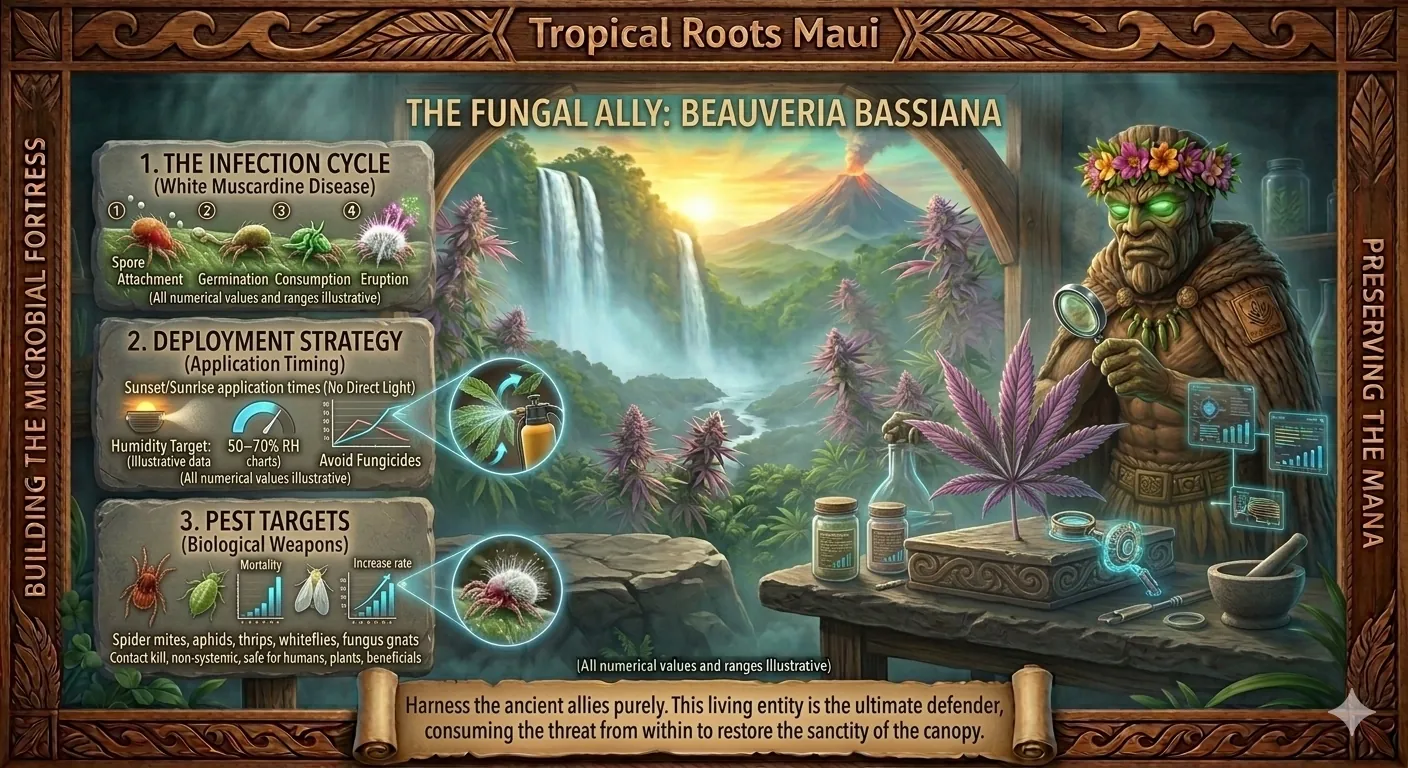
Beauveria bassiana is an equal-opportunity destroyer of soft-bodied and hard-bodied pests alike. It is highly effective against the sanctuary's most stubborn invaders: spider mites, aphids, thrips, whiteflies, and fungus gnats.
The product you acquire will be a concentrated powder or liquid suspension of dormant fungal spores (conidia). These spores are, in effect, microscopic seeds waiting for the right conditions (warmth, humidity, and a host) to awaken and begin their work.
Unlike synthetic poisons that must be ingested, B. bassiana is a contact killer. The spore simply needs to touch the exoskeleton of the pest to begin the invasion. No feeding required: mere contact is a death sentence. This makes it effective against pests that avoid bait-based traps.
B. bassiana is entirely safe for your plants, human handlers, and earthworms. It specifically targets the biology of arthropods (insects, mites, arachnids). It will not harm beneficial soil microbes, mycorrhizal fungi, or the living soil food web. It is OMRI-listed for organic production.
When deployed correctly, this fungal ally executes a ruthless, four-stage alchemical breakdown of the host. Understanding each stage helps you recognize when the weapon is working.
When sprayed, the microscopic spores adhere to the pest's protective cuticle (exoskeleton). The spores are naturally sticky and cling to any surface they contact. At this stage, the pest appears completely normal: no visible signs of infection.
Activated by ambient humidity, the spore awakens. It secretes powerful enzymes (chitinases and proteases) that dissolve the insect's armor, allowing a germ tube to punch directly into the pest's body cavity. The pest may slow down but is still mobile: the breach has begun.
Once inside, the fungus rapidly multiplies, feeding on the pest's internal nutrients and releasing toxins (beauvericin and bassianolide) that paralyze the nervous system and suppress the immune response. The pest stops feeding, becomes sluggish, and dies within 3–7 days depending on species and size.
In the final, most alchemical stage, the fungus erupts back out through the dead insect's shell, coating the carcass in a dense white fuzz (White Muscardine). This fuzz releases thousands of new spores into the canopy to hunt down remaining pests. The weapon literally replicates itself from each kill: a self-perpetuating plague.
Because you are deploying a living fungus, the environment dictates your success. B. bassiana thrives in humid climates but is vulnerable to certain elements during application.
Mix spores into pure, dechlorinated water (chloramine kills the spores on contact). Spray the canopy thoroughly, targeting the undersides of leaves where pests hide. Use a fine mist sprayer for maximum coverage. Get full leaf contact: every surface is a potential infection zone.
Drench the soil surface to target root aphids and fungus gnat larvae hiding in the root zone. The spores will persist in the top layer of soil, creating a living minefield for any larvae that emerge. Compatible with living soil and SIP bottom-watering systems.
Ultraviolet light instantly sterilizes and kills fungal spores. Never apply under intense grow lights or direct midday sun. The perfect deployment window is at sunset or right as indoor lights turn off. The spores need 12–24 hours of darkness to germinate and penetrate the host.
The spores require a minimum of 50% relative humidity to germinate on the pest. The higher the humidity during the key nighttime window, the faster the infection takes hold. In Maui's naturally humid climate, this threshold is almost always met: a massive advantage over dry mainland grows.
The Fungicide Rule: Never mix or apply B. bassiana alongside sulfur, copper, neem oil, or other fungicides. These compounds will instantly destroy your own living weapon. If you've recently applied a fungicide, wait at least 7–10 days before deploying B. bassiana to allow residues to break down.
Maui's ambient humidity (65–80%+) is far above the 50% germination threshold. This means B. bassiana activates faster, infects more aggressively, and re-sporulates more completely on the islands than in dry mainland grows. Your climate is the weapon's best friend: what usually hurts growers (humidity) here becomes an IPM advantage.
B. bassiana thrives at 68–82°F: exactly Maui's year-round ambient range. No heating or cooling adjustments needed. The spores are also active down to 60°F (upcountry nights) and survive brief spikes above 90°F, though germination slows outside the sweet spot.
Maui's intense tropical UV is the primary threat to spore survival. For outdoor grows, apply exclusively at dusk or dawn. For indoor grows with natural light supplementation, time applications to the dark cycle. Shade cloth (30–50%) over outdoor plants can extend spore viability during the day.
Look for BotaniGard, Mycotrol, or BioCeres: all are commercial B. bassiana formulations available at Maui hydroponics stores or online. Store unused product in the refrigerator (not freezer) to keep spores viable for up to a year. Check expiration dates: dead spores don't infect anything.
For educational purposes only. This guide covers biological pest management techniques for legal cannabis cultivation. Always follow product label instructions and local agricultural regulations. B. bassiana is OMRI-listed for organic production but may require registration in some jurisdictions. The information provided is not a substitute for professional consultation.