What makes Duckfoot different
Most cannabis plants grow leaves with five or seven discrete fingers radiating from a central point. Hawaiian Duckfoot doesn't. Its leaves present a webbed, three-lobed morphology: adjacent leaflets partially fuse along their inner edges, producing the foot-like shape that named the strain. Geneticists call the underlying trait polyleaflet syndrome, controlled by a recessive allele that needs both parents to express it.
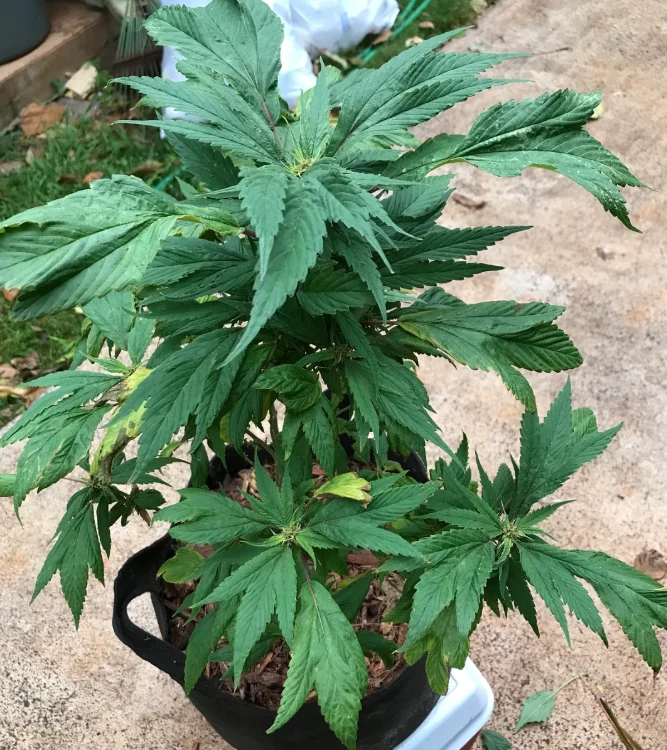
For decades, Duckfoot was prized by guerrilla growers for one practical reason: it doesn't look like cannabis from a distance. A webbed-leaf plant in a backyard or hillside garden reads as some kind of ornamental shrub to the casual eye. Through the Operation Green Harvest years, Duckfoot phenotypes were quietly preferred by Hawaiian growers who needed to grow visible to neighbors but invisible to helicopters.
Tropical fruit over hash and earth
The base is tropical, hashy, and earthy, the old dark pakalōlō profile you would expect from a line that has been in these islands this long. What sits on top of it is fruit: pineapple, plum, and peach, a sweetness that reads as the islands' own bounty rather than anything candied. Funk underneath, orchard on the exhale.
The effect is not what her indica structure leads you to expect. Growers consistently report a creative, uplifting, euphoric experience rather than a sedative one. She suits doing something: one grower described her as pairing nicely with painting a picture, going for an easy walk with friends, or watching documentaries while tidying up the house. The Kūpuna also keep her as a go-to for pain, which is the other half of why she has never left circulation.
How a British botanist's seed box reached Hawaiʻi
The likeliest account of how Duckfoot got here does not start in Hawaiʻi at all. It starts with Sir Joseph Banks, born to money in 1743, elected to the Royal Society at twenty-three, and by middle age the head botanist of the British Empire and a trusted advisor to King George III. He sailed with Captain Cook aboard HMS Endeavour in 1768 and came home three years later with something on the order of thirty thousand plant specimens and more than fourteen hundred species new to European science.
Banks was an enthusiastic advocate of cannabis, and the reason is easy to underrate now. In the Age of Sail, hemp was strategic material on the scale oil would later become: every sail and every rope in the Royal Navy depended on it, and Britain bought most of its supply from the Baltic. When that supply came under strain in the late eighteenth century, the obvious answer was to grow hemp somewhere Britain controlled, and Banks ran the experiments. Trials went out to Canada, to India, and into the Pacific, and he supervised the colonies where they were planted.
That is what makes the seed box more than an accident. Banks insisted exploratory voyages carry a wide range of seed, partly because British naval practice was to plant crops on newly charted land so the next ship through would find provisions waiting, and partly because he was running a hemp programme and the Pacific was one of his proving grounds. His collecting went well past rigging besides, taking in medicinal and recreational varieties gathered wherever his network reached.
Banks never came to Hawaiʻi, and the reason is a grudge. In 1772 he fell out with the Admiralty over the quarters and equipment he demanded aboard the Resolution for Cook's second voyage, refused to sail on their terms, and went to Iceland instead. He never crossed the Pacific with Cook again, and he was not aboard the third voyage that reached Hawaiʻi. His seed went without him.
Cook made contact with the islands in January 1778, off Kauaʻi. He returned the following winter and anchored at Kealakekua Bay in January 1779, arriving during Makahiki, the season given to Lono, and the welcome was remarkable enough that the ships stayed and traded peaceably for the better part of a month. That month is the window. It ended badly: Cook was killed at the bay in February 1779 after trying to seize the chief Kalaniʻōpuʻu over a stolen cutter. But before that there were weeks of open, daily exchange between crews carrying a botanist's seed stock and a people who farmed. Somewhere in that traffic, cannabis reached the islands.
And if nothing crossed at Kealakekua, the door stayed open anyway. The Frenchman Lapérouse became the first European to set foot on Maui in 1786, landing on the south shore at Keoneʻōʻio, the bay that still carries his name. George Vancouver, who had been on Cook's third voyage as a young officer, returned in his own command and worked the islands from 1792, having called at Australia the year before. Any of them could have carried it, and all of them belonged to the same European botanical culture that treated seed as cargo worth moving. The case does not stand or fall on a single month in a single bay.
One footnote deserves keeping, on a page this concerned with telling near-identical plants apart. In India, Banks' people ran into Cannabis indica growing alongside the hemp they had been sent for: two strikingly similar plants, one wanted for rope and one emphatically not. The confusion between them dogged the whole enterprise. The problem of knowing exactly what you are holding is a great deal older than any of us.
Then the islands went to work on her. Planted into mineral-rich volcanic soil, tropical heat, and heavy rain, the imported stock adapted over generations. The webbed leaf is a mutation that reduces leaf surface area, and in a wet climate that is not a curiosity but an advantage: less surface for moisture to sit on, better odds against mould and pests, and a plant that sheds a torrential downpour instead of holding it.
The one they hand you first
There is a practical reason Duckfoot has stayed in circulation on the Big Island while flashier lines came and went. She is the strain given to growers just starting out. A newer grower learns to run a faster-flowering Hawaiian indica on her, roughly nine weeks of flower rather than thirteen, gets a full cycle behind them, and only then takes on the long, demanding island sativas like Maui Wowie or Kona Gold, which will punish inexperience across eleven or thirteen weeks of flower.
She is also unfussy about where she lives, taking to indoor and outdoor cultivation equally well in Hawaiʻi. And the webbed leaf earns its keep here: a beginner watching an unfamiliar plant has an unmistakable signature to check against, which is worth more than it sounds when you are still learning what healthy looks like.
How to grow Hawaiian Duckfoot
Environment
This is where Duckfoot separates from the rest of the library. Where the island sativas demand eleven to thirteen weeks of flower, she finishes in roughly nine, and that single fact makes her workable almost anywhere. Outdoor growers in zones 9 to 11 finish her easily, and unlike Maui Wowie or Kona Gold her cycle will fit inside a real mainland summer at higher latitudes.
She takes to indoor and outdoor cultivation equally well, which is unusual and is a large part of why she became the strain a community teaches on. In Hawaiʻi she is grown both ways without much argument about which is correct.
Structure
Expect a sturdy, branching indica frame rather than the rangy vertical reach of the island sativas. She is the more manageable plant in every direction, which is the point of handing her to a first time grower. Topping early (after the 4th node) and low-stress training from week three of veg will keep the canopy manageable. SCROG nets work especially well with Duckfoot's natural branching habit.
Feeding
Like all Hawaiian heritage lines, Duckfoot responds best to living, microbially-active soil rather than salt-based nutrients. The genetics were selected over generations against the backdrop of native island microbiology: they expect partners in the rhizosphere. Build a soil from the DIY Organic Living Soil Guide or feed with KNF inputs. Avoid overfeeding nitrogen in flower; Duckfoot finishes with a graceful natural fade when she's given room to do so.
Pest resistance
Naturally good resistance to powdery mildew (Hawaiian valley pressure selected for this) and decent to spider mites. Vulnerable to caterpillars in late flower: the same humid tropical environment that shaped her also shaped the bugs that hunt her. Treat preventatively with Beauveria bassiana or stick to the white oil schedule.
Harvest
Trichome ripening on Duckfoot is gradual and uneven: different colas finish at different times. Selective harvest (chopping the top third first, returning a week later for the lowers) gives better resin quality than a single chop. Read more in the Trichome Harvest Guide.
Lineage & preservation
There is now laboratory support for what island growers always said. A Duckfoot cut was one of the samples Phylos Bioscience ran in their broad cannabis sequencing effort: a Duck Foot cut is on public record in their NCBI deposit (BioSample SAMN10609816), one of roughly 1,380 cannabis samples in the project. In Phylos's own reading of that data she came back as one of the most ancient varieties in their database. Read it straight: the sequencing and the deposit are public record, while the ancient verdict is Phylos's interpretation, from a genetic-relatedness map the company has since retired. Even hedged that way, for a line kept by hand for two centuries it is about as close to documentary evidence as it gets.
She also survived Operation Green Harvest, one of the most intensive eradication campaigns ever run on American soil, because local pakalōlō preservationists judged her worth the risk of keeping. Hawaiian Duckfoot has been cultivated in these islands for as long as medicated memory can record. She was not built in a breeding programme; she was kept, by the Kūpuna, the wise elders, who have held her in circulation for hanauna, generations, and who will tell you plainly that she is a go-to strain for pain.
How she arrived is less certain, and we will not pretend otherwise. Similar duckfoot leaf characteristics turn up in a handful of Australian strains, which suggests the trait travelled by sea rather than arising here on its own. Our belief, held as belief rather than documented fact, is that she has been in Hawaiʻi nei for more than two hundred years, carried in by people who knew good pakalōlō when they saw it and passed onward around the globe on what amounts to a quack-pot quest to spread aloha worldwide.
Hawaiian heirloom lines survive in growable form because keepers like these hand them on; Pua Mana ʻOhana and their Pua Mana 1st Hawaiian Pakalōlō Seed Bank have done that work at scale for the island genetics more broadly.
We grow Hawaiian Duckfoot exclusively in isolated mother rooms (no pollen contact with our other lines) and seed only when we can verify the parent plant expresses the webbed-leaf trait. Every pack we release carries the documented chain back to the 1970s source.
Pua Mana ʻOhana put it plainly: "Pua Mana ʻOhana is very thankful this strain still exists to this day." That is the correct register for a line like this. Not a product claim, just relief that the keeping worked.
This is not a strain we'll ever scale. It's a strain we'll keep alive.