
The receipts, in the state's own words
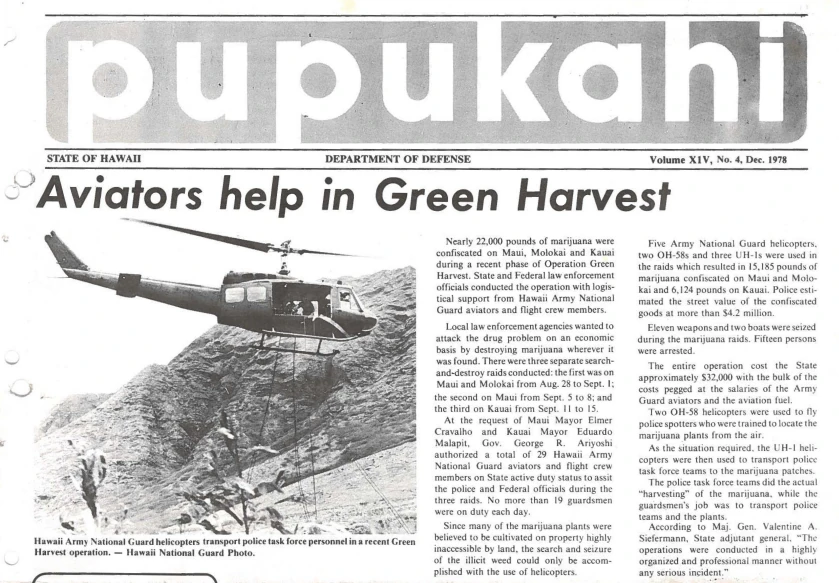
A year into the program, the State of Hawaiʻi Department of Defense wrote about Green Harvest in its own newsletter. The December 1978 issue of Pūpūkahi ran the headline "Aviators help in Green Harvest," and the figures in it are one of the clearest surviving pictures of how an early sweep actually worked.
What a single 1978 sweep looked like
- Nearly 22,000 pounds of cannabis confiscated in one phase: 15,185 pounds from Maui and Molokaʻi, 6,124 pounds from Kauaʻi.
- Three search-and-destroy raids between August 28 and September 15: Maui and Molokaʻi, then Maui again, then Kauaʻi.
- 29 Hawaii Army National Guard aviators and flight crew placed on state active duty by Governor George Ariyoshi, at the request of Maui Mayor Elmer Cravalho and Kauaʻi Mayor Eduardo Malapit. No more than 19 on duty on any given day.
- Five helicopters: two OH-58s carrying police spotters trained to find plants from the air, and three UH-1s ferrying task force teams into the patches.
- $4.2 million in claimed street value, against an operation that cost the state roughly $32,000, mostly aviator salaries and aviation fuel.
- Fifteen people arrested, with eleven weapons and two boats seized.
The newsletter is also blunt about why helicopters mattered so much. Many plots sat on ground the article calls "highly inaccessible by land," so the seizures "could only be accomplished with the use of helicopters." That one logistical fact shaped the next two decades of Hawaiian cannabis, and the genetics that came out the other side.
Operation Wipe Out: 1990
If Green Harvest was a campaign, Operation Wipe Out was its crescendo: the most aggressive single-season eradication push in Hawaii's history, and one of the largest ever mounted anywhere in the United States. Where the annual Green Harvest sweeps were periodic (a few flight windows a year that experienced growers learned to plant around), Wipe Out was designed to be continuous: sustained, rolling coverage through the growing season, so that no planting calendar could slip between the raids.
The machinery of the blitz
Wipe Out stacked every available agency into one joint operation: DEA agents, Hawaii National Guard helicopters and crews, county vice squads, and state land-and-natural-resources officers, working from shared aerial intelligence. Two-seat OH-58 Kiowa helicopters flown by Hawaii Army National Guard aviators carried police spotters trained to pick out the plant's color and growth pattern from altitude. They flew grid patterns over the prime growing country (Puna and Kaʻū on the Big Island above all, and on Maui the West Maui Mountains), radioing coordinates to helicopter insertion teams who rappelled or landed into plots that had no trail access at all. Plants were cut, choked into cargo nets, slung out beneath the helicopters, and burned. Plots too remote to haul were destroyed in place.
Where ground crews could not reach, the campaign turned to the air in a different way. Helicopters ran spray booms that doused gardens with a mixture of glyphosate herbicide, a sticking agent, and a bright red or orange dye, sometimes cut with diesel. The dye was the point as much as the poison: it stained every plant it touched, marking the crop as sprayed so it could not be quietly harvested and sold, and warning anyone who found it that the buds were now chemically contaminated. To the growers below, a wash of red over a hidden garden meant the season was over. The chemical spraying drew hard criticism from residents and farmers worried about herbicide drifting onto food crops, water, and the forest itself, and it became one of the most bitterly contested tactics of the whole eradication era.
The deep valleys of the West Maui Mountains (some of the steepest, wettest, least-accessible terrain in the islands) made the range a legendary growing ground long before the sweeps and, by many accounts, remain one to this day. It was cannabis country the state could see from the air but never easily reach on foot: exactly the kind of place where the stealth-selected genetics of the eradication era took hold, and exactly the kind of place they endured.
The plant-count arithmetic of the era tells you what the sweeps were hitting: annual statewide eradication tallies in the late 80s and early 90s ran into the hundreds of thousands to millions of plants: numbers that made tiny Hawaii the perennial national leader in federal eradication statistics, ahead of states fifty times its size.
What it did to the islands
Authorities declared the operation a success, claiming the overwhelming majority of Hawaii's visible outdoor crop was destroyed in a single season. For once, the numbers on the street agreed with the press conference: pakalolo all but vanished from island markets, and what remained traded at prices that had multiplied several-fold almost overnight. Pounds that sold for hundreds of dollars in the late 70s now moved for thousands.
But the victory was narrower than it looked, and the side effects were not small:
- The commercial growers adapted or left. Serious cultivation migrated indoors, off-island, or into formats too small and too hidden to justify a helicopter insertion: five plants under canopy instead of five hundred on a ridge.
- The casual growers simply quit, and with them went the enormous genetic churn of backyard open pollination that had built the landraces in the first place.
- The supply vacuum got filled. Into a market suddenly stripped of cheap pakalolo came crystal methamphetamine. Hawaii became the first state in the nation with a full-blown ice epidemic in the early 1990s, and many island families, researchers, and even law-enforcement veterans have drawn a straight line from the eradication era to it.
- The community paid in goodwill. Weeks of sustained low-altitude flights over homes, schools, farms, and hunting valleys turned neutral residents into opponents: the resentment that would later fuel the county-level votes to refuse eradication money altogether.
Wipe Out proved that eradication could win a season. It never won another one as decisively: every year after 1990, the plots got smaller, the canopy got tighter, the cycles got faster, and the helicopters found less. The blitz hadn't ended island growing; it had finished its education.
What actually happened to the plants
The goal was never simply to find cannabis. It was to hit growers in the wallet hard enough that the crop stopped being worth planting. That meant every confiscated plant had to be systematically destroyed so it could never reach the market. Depending on the era and the terrain, that destruction took three very different forms.
1. Chemical eradication, left to rot
In the early years, the late 1970s and early 1980s, crews frequently did not bother extracting the plants at all. National Guard helicopters fitted with spray booms flew low over the patches and doused them in herbicide: Paraquat and glyphosate, cut with a sticking agent and a bright dye. The plants were simply left to wither and rot in the jungle. The method drew intense public backlash, over environmental damage to forest and water and the real health risk to consumers who unknowingly smoked poisoned cannabis that got harvested anyway, and it was progressively abandoned. Where spraying did persist into later sweeps, as it did during Operation Wipe Out, it stayed the single most bitterly contested tactic of the whole era.
2. The rip and tear extraction
Once spraying became politically unviable, the task forces switched to manual extraction, and the Guard's own account is specific about how. Police task force teams, armed with machetes and side arms, were lowered from the helicopters into the patches to chop the plants down and clear a landing zone. Root stock was pulled where crews could reach it, so nothing remained to regrow. The cut plants were then hauled out either suspended beneath the helicopter on a rope or loaded inside the aircraft, and flown to a secure staging area. It was far slower and more dangerous than spraying.
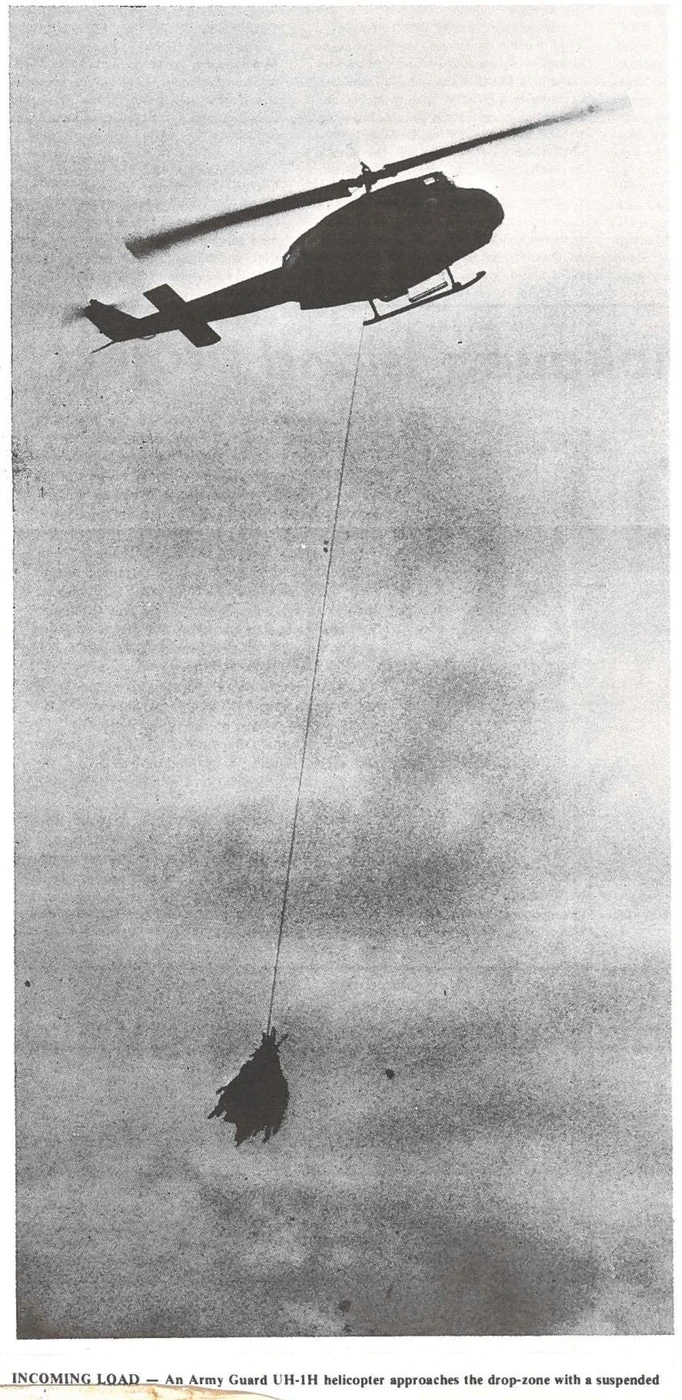
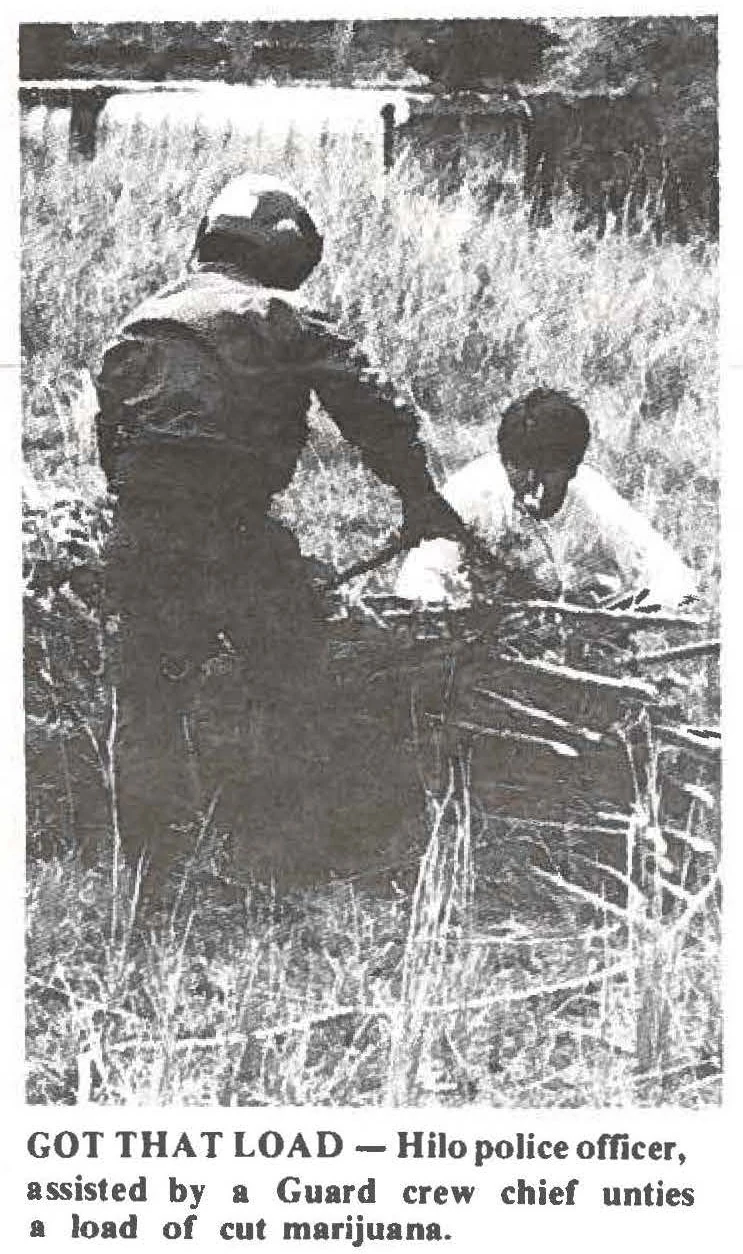
Both photographs: Pūpūkahi · State of Hawaiʻi, Department of Defense · December 1979 · Click to enlarge
3. Secret landfills and incinerators
Airlifted to the nearest accessible road, the bundles were dropped onto flatbed trucks or military transport and driven to secret, heavily guarded landfills or municipal incinerators. Law enforcement claimed 1.9 million plants destroyed in 1987 alone. They were dumped into pits to rot under guard, or burned in incinerators and bonfires.
None of it was repurposed, and none was saved for medical or scientific research. It was treated end to end as hazardous contraband. Whatever the true street value, an enormous amount of a living agricultural crop, including irreplaceable landrace genetics, simply went up in smoke or rotted in a guarded pit.
What it took, year after year
Green Harvest was never a one-off spectacle. The Hawaii Army National Guard carried it as a standing annual mission, and the state's own Department of Defense annual reports quietly record the scale of it in flight hours, mandays, and aircraft.
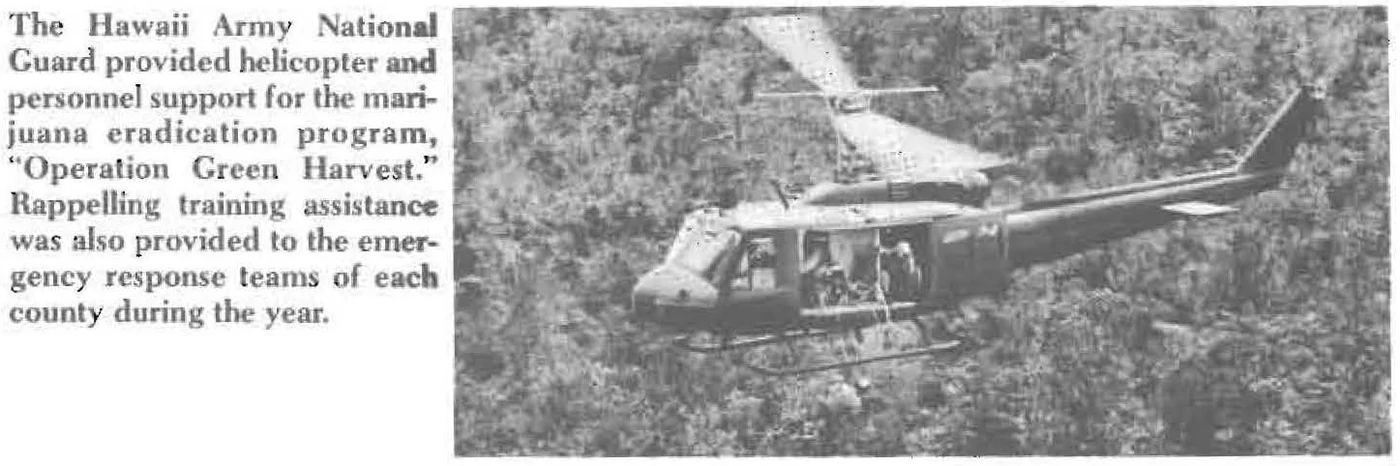
State of Hawaiʻi, Department of Defense Annual Report, 1984 · Click to enlarge
- December 1979. A later phase across Kauaʻi, Oʻahu and the Big Island took 40,416 pounds: 36,660 from the Big Island, 2,000 from Kauaʻi, 1,756 from Oʻahu. It used 17 helicopters, eight OH-58s and nine UH-1H Hueys, and 65 Guard personnel, at a cost of $61,600. Governor Ariyoshi authorized it at the request of Mayors Herbert Matayoshi, Eduardo Malapit and Frank Fasi.
- 1980 report. Two separate statewide operations conducted during fiscal year 1980.
- 1981 report. 578.4 aircraft hours flown in support of county law enforcement.
- 1982 report. Roughly 800 flight hours across Hawaiʻi, Maui, Kauaʻi and Honolulu counties. In the August 1981 Kauaʻi operation, armed troops were employed for the first time, after police intelligence warned of possible armed retaliation from growers.
- 1983 report. Rappelling training provided to Federal Bureau of Investigation personnel in July 1982.
- 1984 report. 1,274 mandays and 542 flying hours, plus rappelling training for the emergency response teams of every county.
Sources: Pūpūkahi, December 1979 · State of Hawaiʻi Department of Defense Annual Reports, 1980 to 1984
Read together, those entries describe something a single raid never conveys: a permanent aviation program with a training pipeline, budget lines, and its own escalation curve. In one year the state went from five helicopters on three islands to seventeen, and by 1981 it was putting armed troops into a Kauaʻi operation because it expected to be shot at. That is the machinery the surviving Hawaiian landraces had to hide from, season after season, for the better part of a decade.
How eradication bred better hiders
Green Harvest is one of history's clearest examples of artificial selection by law enforcement. Every sweep was a filter: the plants that got spotted were destroyed, and the plants that didn't (the ones under tighter canopy, in smaller plots, finishing faster, growing shorter) passed their seeds to the next season. Repeat that filter every year for twenty-five years and you have run a breeding program, whether you meant to or not.
Growers adapted in parallel. The classic tall, 14-week island sativa (a plant that wants to be a tree) became a liability. The era favored:
- Smaller plots: five plants under a guava canopy instead of five hundred on a ridge line;
- Shorter, faster phenotypes: harvested before the seasonal sweep windows;
- Canopy interplanting: pakalolo tucked between ti leaf, banana, and cane grass to break up the visual signature;
- Indoor migration: the beginning of Hawaii's indoor growing culture, decades before it was fashionable anywhere else.
The cost of that adaptation was genetic. The enormous open-pollinated valley populations (the engine that had created the Hawaiian landraces over 150 years) were exactly the populations helicopters could see. They were destroyed first and hardest. What survived in hidden pockets was a fraction of the original diversity, and many heritage cuts were simply lost.
A strain built to hide: '98 Aloha White Widow
The clearest living example of stealth selection isn't a landrace at all. In 1998, a Canadian traveler on the Big Island traded seed with local growers, swapping his stock for Hawaiian genetics. One of those lines, a White Widow cross, got worked and acclimated to the island over the following seasons into what became the '98 Aloha White Widow. It caught on for reasons that were pure Green Harvest logic: it finished compact, mold-resistant, and easy to tuck out of sight, exactly the traits a grower needed to bring a crop through the helicopter years. She is a hybrid, not a landrace and not an heirloom either: White Widow is a deliberate 1990s Dutch cross, and an heirloom means a landrace carried in and grown here for fifty years or more. She fails that test on both counts. What is Hawaiian about her is everything the island did to her afterward, and the eradication era is the reason she took the form she did.
There is a harder consequence, and it belongs in this chapter rather than hers. She was potent and she finished fast, and through the eradication years growers kept choosing her over the old Hawaiian lines for exactly those reasons. Green Harvest was cutting the landraces out of the ground from one side while, from the other, the '98 Aloha gave growers a rational reason to stop replanting them. The helicopters worked the supply. She worked the demand. Nobody intended that, and the lines she displaced are the ones now listed as critically endangered.
What Green Harvest left behind
The open valley populations that bred the landraces were the easiest targets. Surviving lines passed through a needle's eye; much of the original diversity is gone for good.
Shorter, faster, tighter phenotypes out-survived the classic island sativas. The "guerrilla-grown" traits prized worldwide today were selected in Hawaii's valleys first.
Hawaii's growers moved under roofs decades before legalization made it mainstream, building early expertise in lights, containers, and short-cycle cultivation.
Through the 1970s, cannabis had replaced sugar as Puna's main cash crop, and a whole district lived on it. Eradication pulled that livelihood out from under the community. Puna, hit harder than almost anywhere, is today among the lowest-income places in the United States.
Losing so much taught the islands what genetics are worth. Today's seed-saver network (isolating mothers, hand-pollinating known phenos) is Green Harvest's direct descendant.
There is a strange symmetry to it: the program built to erase pakalolo ended up making its surviving genetics more precious, better documented, and more fiercely guarded than they ever would have been otherwise. The preservation packs in the Sacred Grove exist because a generation of growers learned, the hard way, that a landrace lost is lost forever.