
Built to hide
The '98 Aloha White Widow earned its place on the Big Island for one practical reason: it was easy to grow out of sight. It finished compact and short, coated in resin, and resistant to the mold that punishes taller plants in island humidity. Those are exactly the traits a grower needed to bring a crop through the Operation Green Harvest years, when helicopters swept the valleys and a plant that could be tucked behind a fence line or under taller cover was a plant that survived.
This is pure Green Harvest logic made physical. Where the tall island sativas broadcast themselves against the sky, the Aloha White Widow stayed low, dense, and quick. It is not a pure Hawaiian line: its parentage came from elsewhere. But the eradication era is the reason it took the compact, stealthy form it did, and island growers are the reason it still exists.
What she inherited from Amsterdam
To understand the '98 Aloha you have to start a long way from Hawaiʻi. White Widow was first worked by Green House Seeds in Amsterdam, a cross of a Brazilian sativa landrace with a resinous South Indian indica, and it became the defining strain of the 1990s cannabis renaissance. It took first place at the High Times Cannabis Cup in 1995 and never really left the conversation afterward.
What made her famous is what she passed down: a trichome coat dense enough that the buds read white under light, roughly a 60:40 indica to sativa balance, and an effect that opens cerebral and lands physical. The '98 Aloha carries all of it. The island only changed the setting.
What the island split her into
Left to acclimate across the Big Island's very different microclimates, she did not stay one plant. Growers have long sorted the '98 Aloha into three recognised phenotypes, each with its own local names, and knowing which one you have matters more than the strain name does. These are the three you meet in true old-school '98 Aloha cuttings, the ones passed hand to hand rather than bought.
- Candy Widz (Sweet Thang)
- Light green and frosted from the stem down through the leaves and across every bud, inside and out. A slight sativa influence and the most potent of the three: strong enough to be briefly disorienting before it settles into the easy, unhurried Big Island pace she is loved for.
- Dirty Widz (Puna Widow, Death Widz)
- A darker shade and a heavier stone, carrying a dank musky diesel that keeps pulling you back for the next one. Named by the Big Island ʻohana who have grown her for two decades, and after twenty years in the Puna District she is thoroughly acclimatized: this is the one that thrives outdoors.
- Garlic Widz (Garlic Buddaz, Garlicz)
- The rarest of the three and the most sought after. A heavy, heady, indica-leaning pheno with a skunky garlic nose and a flavour growers describe as garlic bread under ganja butter. South Kona ʻohana have kept these cuts close, and she moves inside a tight-knit South Kona pakalōlō community rather than out in the open.
They did not simply differ. They diverged by district. Candy Widz grew the Kona side: North and South Kona, Kohala, Kaʻū and Hawi. More sun than her sisters ever saw, and she came out lighter in colour and sweeter in flavour than either of them. She turns up Puna side as well, but usually indoors, because she does not take the rain the way her sister does.
Dirty Widz made the huakaʻi, the journey, from South Kona across the island to Puna, and Puna growers took her in. She adapted to the wet side and thrived there. Her mould resistance now runs close to Puna Buddaz, which is a remarkable thing to be able to say about a plant that arrived in 1998, measured against a Hawaiian landrace indica that has been here for centuries.
This is worth sitting with, because it is the same lesson The Blood teaches from the other direction. A name on a pack tells you less than people assume. What you actually get is a phenotype, and with the '98 Aloha there are at least three honest answers to the question of what she smells like. It is also why the old cuts still move hand to hand: a clone holds the pheno somebody already picked, while seed only offers you the odds again.
Earth, hash, diesel
The island cut reads rich and earthy, accented with hash, diesel, and skunk. It is not a subtle aroma. Amsterdam White Widow leans pine and cracked pepper; the Big Island pushed her somewhere heavier and dirtier, which is a large part of why the Dirty Widz phenotype collected the names it did.
What sets this cut apart is the frost. Buds finish under a heavy coat of trichomes, the white resin blanket that named the widow, dense enough to blur the calyxes underneath. Layered over the pine and pepper is a touch of island tropical sweetness, a soft fruit note earned across seasons of acclimation on the Big Island. Funk and pine first, sugar last.
How to grow the '98 Aloha White Widow
Environment
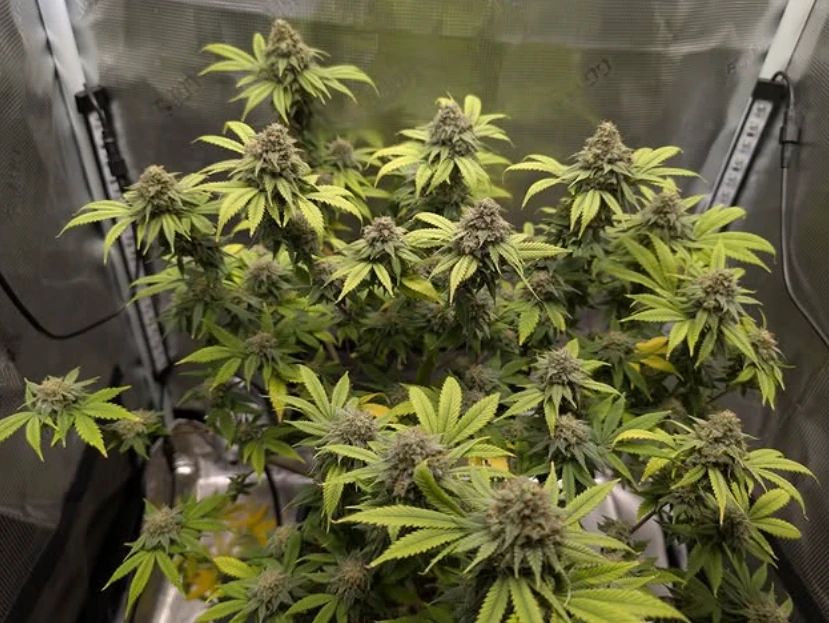
This is a forgiving, stealth-friendly plant, which is exactly why it survived the helicopter years. It handles island humidity well and does not demand the long season the tall sativas need. Outdoor growers in warm zones can finish it comfortably, and its compact habit makes it well suited to tucked, low-visibility plots or an indoor tent. Feed it in living, microbially-active soil or with KNF inputs and it rewards the care.
Structure
Expect a short, compact plant with tight node spacing and a dense flowering habit. There is far less stretch here than in the island sativas, which is part of what made it easy to hide. Light low-stress training early keeps the canopy even and the airflow open, but this is not a plant that fights you for headroom.
Feeding
Like the other heritage lines we steward, the Aloha White Widow does best on a living-soil program rather than salt-based nutrients. Avoid overfeeding nitrogen in flower: let it finish with a graceful natural fade and the frost and pepper come through cleaner.
Pest resistance
This is the trait the island selected hardest for. Strong resistance to mold and powdery mildew is the reason it earned a place through the wet Big Island seasons, and the dense buds hold up where looser flowers would rot. Treat preventatively with Beauveria bassiana or stick to the white oil schedule for the pests that pressure any tropical grow.
Harvest
Flowering is fast for a Hawaiian-grown line, roughly 8 to 9 weeks, and the plant finishes fairly evenly. Watch the heavy trichome coat rather than the pistils to call the window: the widow frosts early, so let the resin ripen before you chop. Read more in the Trichome Harvest Guide.
An honest island hybrid
In 1998, a Canadian traveler on the Big Island traded seed with local growers, swapping his stock for Hawaiian genetics. One of the lines he brought was a White Widow cross. Local growers worked and acclimated it to the island over the following seasons, and it became the '98 Aloha White Widow, named for the year it arrived and the place that adopted it.
We frame its parentage honestly. White Widow is a 1990s Dutch hybrid, a Brazilian sativa crossed with a South Indian indica, so the genetics that landed here came from elsewhere. What is Hawaiian about this cut is everything the island did to it afterward: the seasons of selection that pulled it compact, frosty, and mold-resistant, and the eradication pressure that rewarded a plant you could keep out of sight.
This is a documented island hybrid, kept alive by Big Island growers and seed savers rather than any single seed bank. We make no claim to a confirmed provenance line or a pure landrace pedigree. What we have is the trader-origin story, the island's work on the plant, and the growers who carried it forward. That is the honest account, and it is the one we keep.
The three phenotypes are not one person's finding. They are known locally, sorted and named by Big Island growers who have run this cut for years, and the names travelled the way island plant names usually do: grower to grower, long before anyone wrote them down. That is the primary source, and it belongs to the community that did the work.
What Katsu Seeds added is a written record and a way to get her. They tracked down an original clone after a long hunt and selfed it to S1 feminised seed. An S1 is made by pollinating a plant with itself, so it carries that single clone's genetics forward rather than blending them with anything else. On a cut whose whole value is the specific plant, that is the nearest thing to keeping the original alive in seed form.
Even so, an S1 is not a photocopy. The first stock was made in 2012 by feminising a Dirty Widz and a Candy Widz cut, and growing out that offspring turned up phenotypes reaching back to earlier generations. Most reflected their mothers closely. Some did not. Later batches have come nearer without closing the gap, and the stated plan is to backcross feminised S1 offspring into the original mother cuts to stabilise the best traits in seed. Until that work is finished, the position from the people who did it is unambiguous: a cutting from Big Island ʻohana is the only way to be certain which of the three you hold. Seed gets you close. A clone is the only true genetic match.
Which leaves the question of what she is. She did not come from here. She arrived in 1998 in a traveller's seed stock, and no number of island seasons rewrites where she started. But she acclimatised, she took the island's pressures and came out shaped by them, and she has been in local lungs long enough that the people who grow her do not think of her as foreign. There is a Hawaiian word for exactly this: hānai, family by love rather than by blood. She is Hawaiian on those terms, and on those terms she earned the Aloha in her name.