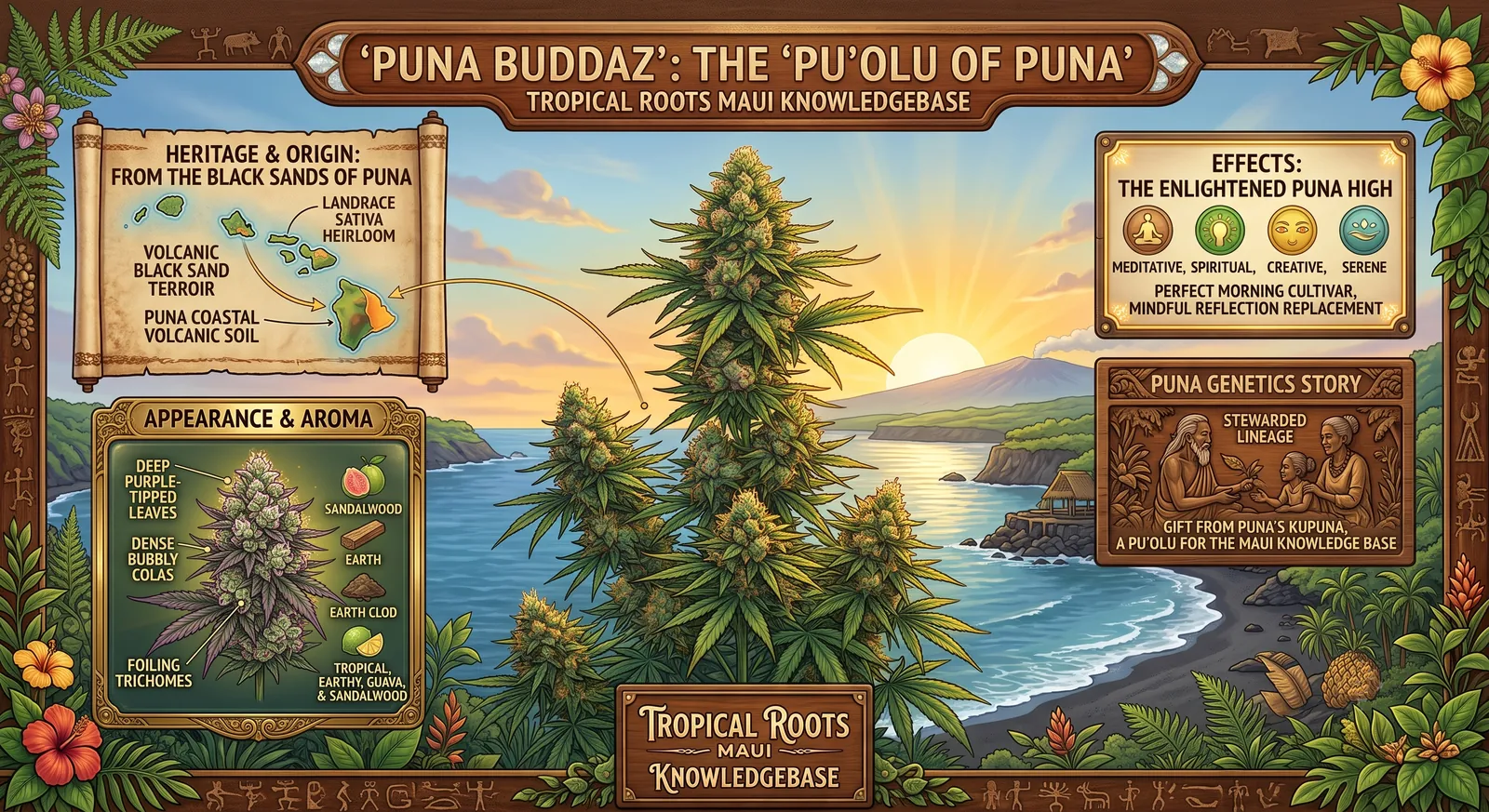
What makes Puna Buddaz different
Puna Buddaz, also known as Puna Budder, is an earthy, pungent indica landrace from the volcanic Puna District, the rainiest region of the Big Island. It is famous for one thing above all: it survives. After particularly wet seasons, when relentless tropical monsoon downpours rot everything around it, Puna Buddaz is often the last plant standing while other strains succumb to mold.
A big part of that resilience is speed. Where the island sativas can run eleven weeks or more in flower, this indica finishes fast, in about 55 to 60 days. Getting in and out before the worst of the wet is its own kind of defense, and it is why growers reached for Puna Buddaz when the weather turned against them.
Sweet, earthy, tropical
The base is deep and earthy, hash-like and mineral, the smell of a plant grown in lava. What sits over it is sweetness and tropical fruit, which is not what her dark resinous look leads you to expect. It reads as pakalolo the moment the jar opens, then turns sweet.
The effect does not follow the aroma anywhere near as neatly. She lands intensely physical and intensely mental at once: the weight settles into the limbs the way the nose promises, but underneath it runs a spinning, tripped-out, frankly psychedelic head effect that the earthy profile gives no warning about. Cloud nine in paradise, with the floor moving.
This is the part worth taking seriously. Puna Buddaz packs a mean Hawaiian punch, and locals will tell you she can be genuinely too much for the uninitiated, even for a Punatic who ought to know better. Start low. She is not a gentle end-of-day indica despite reading like one on paper.
How to grow Puna Buddaz
Environment
Unlike the long-flowering island sativas, Puna Buddaz is compact, fast, and mold-resistant: traits that made it valuable through the Green Harvest years, when a quick, hard-to-spot finish mattered. The fast ~55-60 day flower fits a shorter outdoor window than most landraces, which opens her up to growers in cooler or wetter climates who can't run an eleven-week sativa outdoors.
Structure
Expect a shorter, sturdier indica with dense, resinous buds and far less stretch than the sativas. She stays manageable on her own, but a little low-stress training early will open the canopy and keep airflow moving through those tight, heavy colas.
Feeding
Like all Hawaiian heritage lines, Puna Buddaz responds best to living, microbially-active soil rather than salt-based nutrients. This one was built on mineral-dense lava soil, so it rewards a soil with real geological depth. Build one from the DIY Organic Living Soil Guide or feed with KNF inputs. Avoid overfeeding nitrogen in flower; she finishes with a graceful natural fade when she's given room to do so.
Pest resistance
This is her signature strength: naturally excellent mold resistance, earned in the wettest district of the Big Island. Still, watch late-flower humidity, because dense indica buds hold water in the core. Treat preventatively with Beauveria bassiana or stick to the white oil schedule.
Harvest
A faster, more uniform finish than the island sativas: colas tend to ripen together, so a single well-timed chop works well. Watch the trichomes closely through those last two weeks, because the fast flower can move quickly. Read more in the Trichome Harvest Guide.
Lineage & preservation
Worth saying plainly: a pure, unhybridized Puna line is critically endangered and nearly gone in the wild. The Green Harvest years and decades of crossbreeding with mainland poly-hybrids scattered the old Big Island genetics. Most "Puna" material in circulation now is a stabilized heirloom or a hybrid, not an untouched landrace.
We don't pretend to hold the pure original. What we can offer traces to the quiet preservation work of island seed savers who kept the old island lines going through the eradication years and since. A great deal of that work runs through Pua Mana ʻOhana and their Pua Mana 1st Hawaiian Pakalōlō Seed Bank, who have kept Hawaiian heirloom and landrace genetics in circulation instead of letting them disappear. Our Puna Buddaz is grown from that preserved stock off the volcanic ground of Puna and selected back toward the district's fingerprints: the fast flower, the mold resistance, and the deep, earthy, resinous character. We keep it in isolated mother rooms (no pollen contact with our other lines) and seed only from parents worth keeping.
This is not a strain we'll ever scale. It's a strain we're trying to keep alive.