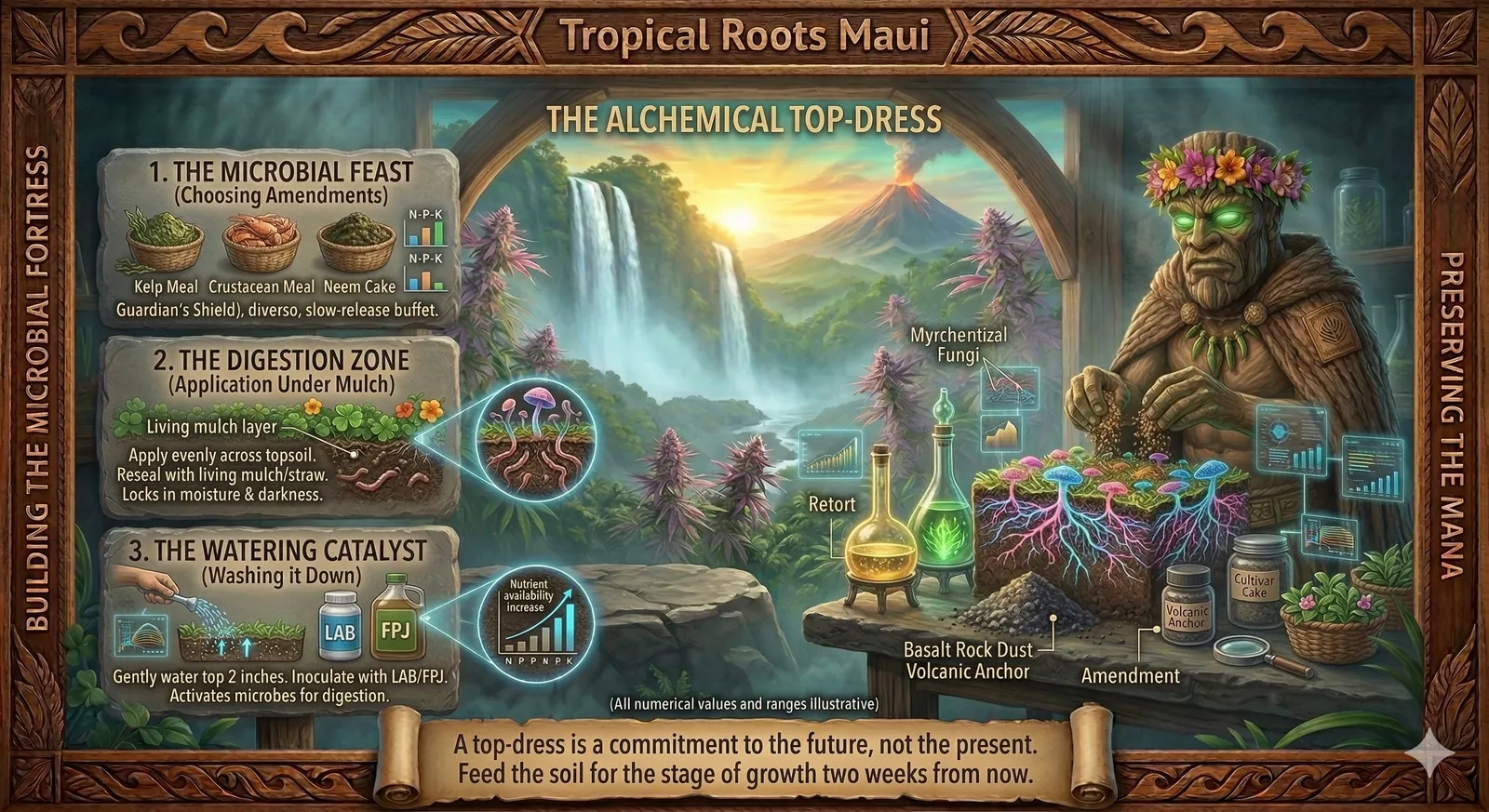
The Alchemical
Top-Dress
Feeding the Microbial Fortress · We Feed the Soil, the Soil Feeds the Plant
"We do not feed the plant; we feed the microbial fortress, and the fortress feeds the plant."
Because you have established the Aquifer Protocol (bottom-watering), your topsoil remains undisturbed: the perfect environment for the Alchemical Top-Dress. We layer dry, organic matter onto the soil surface to be digested by worms, fungi, and bacteria, transforming raw earth into plant-available liquid mana.
To preserve the mana, you must provide a diverse, slow-release buffet. We avoid synthetic liquid salts that burn the soil and instead rely on the elements of the earth and sea.
The ocean's bounty. Rich in potassium and natural growth hormones (cytokinins, auxins). Kelp provides stress relief during heat waves and transitions, while feeding potassium-hungry flowering plants. A gentle, slow-release workhorse.
Crab and shrimp shell meal provides essential calcium and chitin. Chitin is highly alchemical: it triggers the plant's immune system (chitinase production), making it naturally resistant to fungal pathogens and soil-dwelling pests. Also a strong nitrogen and phosphorus source.
The guardian's shield. Crushed remnants of the neem seed provide a slow-release nitrogen source while simultaneously deterring soil-dwelling pests like fungus gnats and root aphids. The azadirachtin compound disrupts pest lifecycles without harming beneficials.
Essential in a Hawaiian-style grow. Basalt provides heavy minerals and trace elements: especially silica, which builds strong, wind-resistant stalks and dense trichome heads. Also supplies iron, calcium, magnesium, and over 70 trace minerals from volcanic origin.
Organic amendments cannot break down in the dry, open air. They must be placed in the Digestion Zone: the dark, moist layer beneath your living mulch where fungal hyphae and earthworms do their work.
Gently pull back your living cover crop or straw mulch layer, exposing the topsoil beneath. Be careful not to disturb the root zone: you're working only at the surface. If you have crimson clover or buckwheat as living mulch, fold it aside rather than uprooting it.
Sprinkle your blended dry amendments evenly across the exposed topsoil. A standard dose is roughly ¼ to ½ cup of mixed amendments per 10 gallons of soil, applied every 3 to 4 weeks during the vegetative stage. For flowering, increase kelp and reduce neem. No need to till or mix into the soil: surface application is the method.
Replace the mulch layer immediately. This locks in the moisture and darkness required for the fungal hyphae and earthworms to rise to the surface and begin consuming the feast. The mulch acts as a lid on a slow cooker: the microbial digestion happens in the dark, humid space between soil and mulch.
Don't overdo it: More amendments does not mean faster growth. Over-amending creates nutrient toxicity that burns root tips and kills beneficial fungi. Stick to the ¼–½ cup per 10 gallons guideline. If you see dark, burnt leaf tips after a top-dress, you've applied too heavily; flush gently from the top and skip the next cycle.
Because your SIP system waters from the bottom, the top-dress needs a catalyst to begin breaking down. This gentle top-watering is the bridge between dry amendment and living nutrition.
After replacing the mulch, gently hand-water the top of the pot. You do not need to soak the entire pot: just enough to wet the top 2 inches. Use dechlorinated water at room temperature (68–72°F). This begins dissolving the amendments and draws the microbial army upward to the feast.
To boost the digestion, mix your activation water with a biological inoculant. A mild compost tea, or KNF inputs like Lactic Acid Bacteria (LABs) or Fermented Plant Juice (FPJ), will instantly awaken the soil microbes to start processing the dry food into plant-available liquid mana.
| Amendment | Primary Role | Elemental Magic | Dose / 10 gal |
|---|---|---|---|
| 🌊 Kelp Meal | Hormones & stress relief | Low N / High K + cytokinins | 1–2 tbsp |
| 🦀 Crustacean Meal | Calcium & pest defense (chitin) | High N / High P / Ca | 1–2 tbsp |
| 🛡️ Neem Cake | Guardian defense & deep green growth | High N + azadirachtin | 1–2 tbsp |
| 🌋 Basalt Rock Dust | Cellular strength & terpene production | Trace minerals / Silica | 2–3 tbsp |
| 🌾 Malted Barley | Enzyme activation & microbial boost | Enzymes / Moderate N | 1–2 tbsp |
| 🐛 Insect Frass | Chitin + balanced NPK + beneficials | Balanced N-P-K / Chitin | 1–2 tbsp |
Maui's warm, humid climate accelerates microbial decomposition significantly compared to mainland grows. Amendments break down 30–50% faster in tropical conditions. You may need to top-dress every 2–3 weeks instead of the standard 3–4 week mainland cycle. Watch your plants for signs of hunger (light green new growth) as your timing guide.
Exposed organic amendments in Hawai'i's humidity are a fungus gnat magnet. Always seal the top-dress under mulch immediately after application. Adding a thin layer of diatomaceous earth on top of the amendments before replacing mulch creates an additional barrier. The neem cake in your blend also helps: its azadirachtin disrupts gnat larvae.
Maui has access to exceptional local amendments: Hawaiian basalt from Haleakalā quarries, local worm castings from island farms, and crustacean meal from Maui's fishing industry. Visit the Upcountry or Haiku farmers markets: many soil vendors sell pre-blended top-dress mixes calibrated for Hawaiian growing conditions.
During Maui's wet season (Nov–Mar), natural rainfall may wash top-dresses down faster than planned for outdoor grows. If growing outside, apply amendments more frequently but in smaller doses: light and often beats heavy and rare. For covered or indoor grows, maintain the standard cycle.
For educational purposes only. This guide covers organic soil amendment techniques for legal cannabis cultivation. Always follow local agricultural regulations and laws. Results vary by soil composition, climate, and amendment quality. The information provided is not a substitute for professional consultation.