🌱   Knowledge Base · Dry Amendment Schedule

Down To Earth
Master Trio Schedule

The master guide for using the DTE "Power Trio" for a full cannabis cycle — Bio-Live for vegetative power, Fish Bone Meal for flower structure, and Bat Guano for the final push into resin and density.
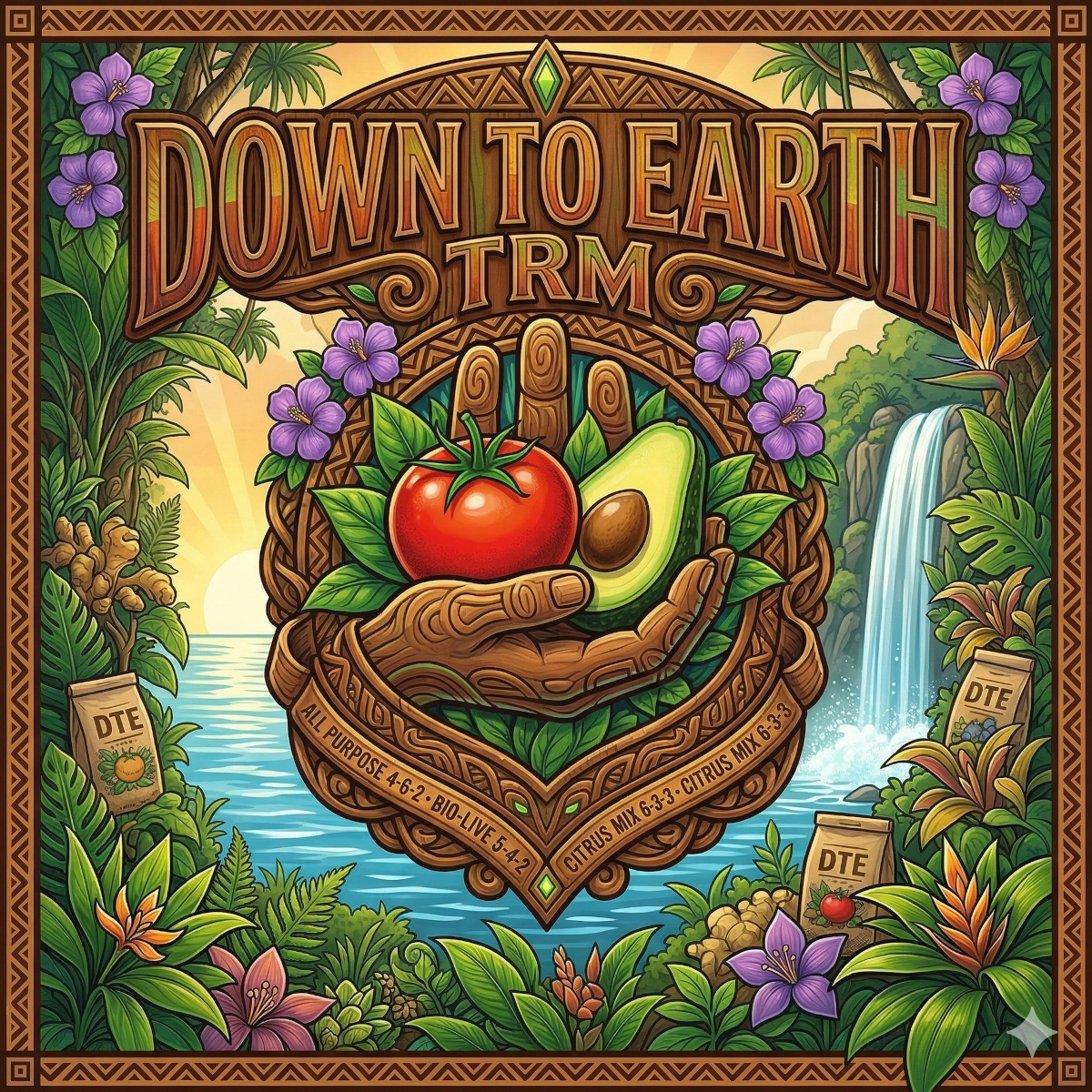
A high-quality brand collaboration graphic featuring Down To Earth (DTE) and Tropical Roots Maui. An illustrative Tiki hand rises from the earth, cradling a ripe tomato and avocado to symbolize organic vitality. The scene includes bags of DTE Bio-Live, Fish Bone Meal, and Bat Guano. Polynesian-style wood-carved borders frame a tropical coastal background, emphasizing a soil-first philosophy for premium organic harvests.
The "Lag" Time. Unlike liquid nutrients, DTE is a "slow food" for plants. It takes 7 to 14 days for the microbiology to convert these powders into a form the plant can drink. Never wait for a deficiency to appear — feed ahead of the plant's needs.
🌱 Type Dry Amendment
📅 Duration 10+ Weeks
🪴 Medium Peat / Coco
📊 Level Beginner
🧪 The Master Trio
Bio-Live — Hawaiian Blend
5 – 4 – 2
The ultimate "all-in-one" for the vegetative stage, pre-loaded with beneficial microbes and mycorrhizae. DTE makes a Hawaiian Blend with mycorrhizal fungi chosen specifically for Hawaiʻi's soils — use this version over the standard Bio-Live. Ingredients: Fish Bone Meal, Fish Meal, Alfalfa Meal, Crab Meal, Shrimp Meal, Langbeinite, Seaweed Meal, plus 2.5% Humic Acids. View on DTE →
Fish Bone Meal
3 – 16 – 0
High-phosphorus fuel for massive flower development. The slow-release phosphorus becomes available just as bud-building peaks, making it the structural backbone of your bloom phase.
Bat Guano
0 – 7 – 0
A potent bloom booster for resin and terpene production. Bat Guano is a more immediately available phosphorus source — the final kick that drives trichome density in late flower.
📋 DTE Amendment Schedule
Phase Timing Product Rate / Gal Soil
I. Soil Prep Day 0 (Mix) Bio-Live (5-4-2) 2 Tbsp
II. Early Veg Week 3 Bio-Live (5-4-2) 1 Tbsp
III. Pre-Flower Week 5 (Flip) Fish Bone Meal (3-16-0) 2 Tbsp
IV. Mid-Bloom Week 8 Bat Guano (0-7-0) 1 Tbsp
V. Ripening Week 10+ None (Water Only)
📖 Phase-by-Phase Execution
1
The "Living Soil" Foundation — Day 0

Before planting, mix your dry amendments into your base soil (peat or coco).

🧬 The Activation

Because Bio-Live contains living bacteria and fungi, it works best if you mix it into your soil and let it "cook" (stay moist) for 10 days before planting. This builds the microbial colony before the roots arrive. The mycorrhizae and beneficial bacteria in Bio-Live need time to establish — planting into freshly mixed soil means the biology hasn't colonized yet, and your plant misses the critical first-contact inoculation.

🌺 The Hawaiian Blend Advantage

DTE produces a Bio-Live Hawaiian Blend with mycorrhizal species chosen specifically for Hawaiʻi's soils — including Rhizophagus irregularis, Rhizophagus clarus, Septoglomus deserticola, and Funneliformis mosseae (924 spores/lb total). These species are adapted to tropical volcanic soil conditions and colonize faster in warm, humid environments than the mainland formulation. The Hawaiian Blend also uses Seaweed Meal instead of standard Kelp Meal, plus 2.5% Humic Acids derived from Leonardite to feed the microorganisms as they establish. If you're growing on Maui, always use the Hawaiian Blend.

🔢 The Math

Use 2 tablespoons of Bio-Live per gallon of soil. For a 5-gallon pot, that's 10 tablespoons mixed thoroughly into the dry medium before adding water.

🌺 Hawaiʻi Island Tip — Cooking DTE on Maui Maui's warm soil temps (75–82°F) dramatically accelerate the cooking process. The living bacteria and mycorrhizae in Bio-Live will establish a robust colony in 5–7 days instead of the recommended 10. Keep the bin in a shaded area (not direct sun) and check moisture every 2 days — the soil should feel like a wrung-out sponge. The faster your biology establishes, the sooner nutrients become plant-available.
2
Vegetative Maintenance — Week 3

Cannabis is a "heavy feeder." By week 3, the plant has consumed the readily available nitrogen in the initial mix and is ready for a top-dress.

🌿 Method

Sprinkle 1 tablespoon of Bio-Live per gallon of soil evenly across the surface. Gently scratch it into the top inch of soil with your fingers or a small rake.

🤚 The Seal

Always cover your top-dress with a thin layer of worm castings or mulch to keep the biological life from drying out under the grow lights. The living microbes in Bio-Live need moisture to survive and break down nutrients — exposed powder will dry out and become inert.

🌺 Hawaiʻi Island Tip — The Worm Casting Seal Is Non-Negotiable On Maui, exposed dry amendments attract moisture and mold faster than on the mainland — you may see fuzz within 48 hours. The worm casting seal keeps the Bio-Live in contact with moist soil where the bacteria can thrive. If you're growing in fabric pots outdoors, ants will find the amendments within hours. A ring of food-grade diatomaceous earth around the pot base keeps them at bay.
3
The Flowering Flip — Week 5

As you switch to a 12/12 light cycle, the plant requires a massive spike in Phosphorus for structural flower development.

🐟 Fish Bone Meal

Apply 2 tablespoons of Fish Bone Meal (3-16-0) per gallon of soil. This is a "slow-release" phosphorus source — applying it at the flip ensures that by Week 7 (when bud-building is at its peak), the nutrients are fully broken down and available. The 16% phosphorus content is one of the highest in any organic amendment, providing the structural energy for flower sites to multiply and expand.

🌺 Hawaiʻi Island Tip — Fish Bone Meal Breaks Down Faster Here Maui's warm, biologically active soil accelerates the breakdown of Fish Bone Meal — expect nutrients to become plant-available in 7–10 days instead of 14. This is ideal because it aligns with the flowering stretch. Apply the Fish Bone Meal the same day you flip the lights to ensure the phosphorus arrives right when bud sites are forming. The warm soil biology does the rest.
4
Peak Bloom Booster — Week 8

Bat Guano is a more "immediate" organic source of Phosphorus compared to Fish Bone Meal. By Week 8, the bone meal is winding down and the plant needs one final push.

🦇 The Final Kick

Apply 1 tablespoon of Bat Guano (0-7-0) per gallon of soil. This provides the specific energy needed for trichome production and bud density during the final stages of flower development. Bat Guano's phosphorus is more readily available than bone meal, so it acts faster — exactly what the plant needs when it's stacking the final layers of resin.

🌺 Hawaiʻi Island Tip — Bat Guano in the Heat Bat Guano becomes plant-available even faster in Maui's warm soil — within 5–7 days. If you're running a shorter-flowering strain (8–9 weeks total), consider applying the Bat Guano at Week 7 instead of Week 8 to ensure the phosphorus is fully available during the peak trichome production window. The warm biology doesn't wait — and neither should you.
5
Ripening — Week 10+

Water only. The slow-release amendments are winding down naturally, and the plant is using stored energy to ripen the flowers. Because DTE amendments are organic and don't leave heavy mineral salts, no aggressive "flush" is needed — just maintain normal watering and let the plant finish on its own terms.

💡 Down To Earth Success Rules
1
pH Sensitive

Organic amendments work best when soil pH is between 6.0 and 6.8. If your water is too alkaline, the microbes cannot efficiently break down the bone meal and guano into plant-available forms. Maui county water runs pH 7.8–8.4 — consider using a pH-buffered medium like ProMix BX or adjusting your input water with organic pH down. Check your local water quality at the Maui County Water Quality Reports.

2
Watering Style

Avoid "heavy runoff" when using dry amendments. You want to keep the soil moist, but flushing water through the pot will wash away the fine powders and microbial activity you've built up. Water slowly and evenly until you see the first drops of moisture at the bottom — then stop. The goal is saturation without displacement. This preserves the nutrient-rich top layer and keeps the microbial colony intact.

🌺 Hawaiʻi Island Tip — Watering in Humid Conditions Maui's humidity means your soil retains moisture longer, which is great for amendment breakdown. But it also means overwatering is easy — especially in fabric pots that normally dry out fast on the mainland but stay wet in our climate. Water less frequently but more thoroughly. Lift your pots — when they feel light, it's time to water. If the top inch is still moist, wait. The microbial colony in DTE-amended soil thrives on consistent moisture, not flooding.
📦 Full DTE Dry Amendment Catalog for Cannabis

Beyond the Master Trio, Down To Earth offers a deep lineup of single-ingredient amendments and minerals that let you customize your soil and address specific deficiencies. Here is every DTE dry amendment relevant to cannabis, organized by function.

🟢 Nitrogen Sources — Vegetative Growth
Blood Meal
12 – 0 – 0
The fastest-acting organic nitrogen source. Rapidly corrects nitrogen deficiency (yellowing lower leaves). Use sparingly — it's potent and can burn if over-applied. Best as an emergency top-dress in early veg when plants are pale and hungry.
Feather Meal
12 – 0 – 0
Same NPK as Blood Meal but much slower release (4–6 weeks). Ideal for mixing into soil at Day 0 for a sustained nitrogen supply throughout veg. Won't cause nitrogen spikes or burn. The "set it and forget it" nitrogen source.
Fish Meal
8 – 6 – 0
Balanced N-P with no potassium. Excellent microbial food — the marine proteins feed soil biology aggressively. Provides nitrogen plus a moderate phosphorus boost for root development. Strong odor (attract pests outdoors).
Alfalfa Meal
2 – 0 – 1
Low NPK but contains triacontanol — a natural growth stimulant that promotes cell division and photosynthesis. Excellent compost activator and soil conditioner. Feeds microbial life and improves soil structure. Use as a base amendment in soil mixes.
Neem Seed Meal
6 – 1 – 2
Dual-purpose: fertilizer + pest control. Contains residual azadirachtin that disrupts soil-borne pests (fungus gnats, root aphids, grubs, root-knot nematodes). Slow-release nitrogen feeds plants while protecting roots. Strong odor — better for outdoor grows. OMRI listed.
Insect Frass
3 – 1 – 2
Derived from black soldier fly larvae. Contains chitin which triggers the plant's immune response (Systemic Acquired Resistance), boosting natural pest and disease resistance. Also feeds beneficial soil biology. A sustainable, renewable amendment with properties similar to bat guano and worm castings.
🟡 Phosphorus Sources — Flowering & Root Development
Fish Bone Meal
4 – 12 – 0
The backbone of the Master Trio bloom phase. Slow-release phosphorus becomes available over 2–3 weeks. Higher nitrogen (4%) than standard bone meal supports the flowering stretch. The go-to phosphorus source for the flip.
Bone Meal
3 – 15 – 0
Higher phosphorus than Fish Bone Meal (15% vs 12%). Excellent calcium source — strengthens cell walls and prevents blossom end rot. Very slow release (breaks down over weeks to months). Best mixed into soil at Day 0 for long-term phosphorus availability.
Seabird Guano
0 – 11 – 0
Pure phosphorus with zero nitrogen — ideal for late flower when you want no additional N. More immediately available than bone meal. Excellent for mid-to-late bloom top dressing when bud density and resin production are the priority. Can be brewed into teas for faster delivery.
Bat Guano
7 – 3 – 1
Note: DTE's Bat Guano is actually high-nitrogen (7-3-1), not the 0-7-0 bloom guano in the Master Trio. This version is better suited for vegetative growth or as a balanced amendment. Check the label — different bat guano sources have wildly different NPK ratios.
Rock Phosphate
0 – 3 – 0
Ultra-slow-release phosphorus that breaks down over months to years. Not for immediate feeding — this is a long-term soil builder. Mix into soil at initial prep for a background phosphorus supply that outlasts multiple grow cycles. Best for no-till and living soil beds.
Island Phosphate
0 – 3 – 0
Similar to Rock Phosphate but sourced from tropical island deposits. Contains additional trace minerals from marine sediment. Another ultra-slow-release option for long-term soil building in no-till systems.
🟠 Potassium Sources — Strength & Stress Resistance
Langbeinite
0 – 0 – 22
The most concentrated organic potassium source available. Also provides magnesium (11%) and sulfur (22%) — three critical nutrients in a single amendment. Immediately available (doesn't require microbial breakdown). Excellent for bloom phase when K demand spikes for sugar transport and resin production.
Kelp Meal
1 – 0.1 – 2
Low NPK but loaded with cytokinins, auxins, and over 60 trace minerals. The growth hormones promote cell division, root development, and stress tolerance. Kelp Meal is less about feeding and more about signaling — it tells the plant to grow. Mix into soil at Day 0 and top-dress throughout the cycle.
Seaweed Meal
1 – 0.1 – 2
Similar to Kelp Meal — rich in natural plant hormones, trace minerals, and amino acids. Improves stress tolerance (heat, drought, transplant shock). The Hawaiian Blend Bio-Live uses Seaweed Meal instead of Kelp Meal for its tropical-adapted mineral profile.
⚪ Calcium, Minerals & Soil Conditioners
Oyster Shell
Calcium Carbonate
Slow-release calcium source that also raises soil pH over time. Ground oyster shells break down gradually, providing a steady calcium supply and buffering acidic soils. Excellent for preventing calcium deficiency (curling new growth, blossom end rot) in long-term grows.
Dolomite Lime
Ca + Mg Carbonate
Provides both calcium and magnesium while raising soil pH. Essential for peat-based mixes that run acidic. Buffers pH in the 6.0–6.8 range where organic amendments become plant-available. Mix into soil at prep — do not top-dress.
Garden Gypsum
Calcium Sulfate
Provides calcium and sulfur without changing pH — unlike lime. Improves soil structure by breaking up compacted clay, increases drainage, and reduces soil salinity. Use when you need calcium but your pH is already in range.
Garden Lime
Calcium Carbonate
Pure calcium carbonate — raises pH in acidic soils. Faster-acting than Oyster Shell. Use when your soil test shows pH below 6.0 and you need a quick correction. Does not provide magnesium (use Dolomite Lime if you need both).
Garden Sulfur
Elemental Sulfur
Lowers soil pH — the opposite of lime. Use when alkaline water or soil pushes pH above 6.8. Also provides sulfur, a secondary macronutrient essential for protein synthesis and terpene production. Apply conservatively — sulfur acidifies slowly but powerfully.
Azomite
Trace Minerals
Volcanic ash deposit containing over 70 trace minerals and micronutrients. Remineralizes depleted soils with iron, manganese, zinc, silica, and dozens of other elements. Mix into soil at Day 0. Available in granular and powder forms — powder breaks down faster.
Greenstone Metabasalt
Volcanic Rock Dust
Paramagnetic volcanic rock dust rich in silica, iron, and magnesium. Strengthens cell walls, improves pest resistance, and increases the soil's cation exchange capacity (CEC). Similar to basalt rock dust. Mix into soil at prep for cycle-long mineral supplementation.
Granular Humic Acids
Soil Conditioner
Derived from Leonardite (ancient organic deposits). Improves nutrient absorption by chelating minerals and making them more plant-available. Feeds microbial life, improves soil structure, and increases water retention. The "glue" that makes all other amendments work better.
🔵 Multi-Purpose Blends
Bio-Live — Hawaiian Blend
5 – 4 – 2
The Master Trio's vegetative workhorse. Pre-loaded with mycorrhizae chosen for Hawaiʻi's soils, beneficial bacteria, and 2.5% humic acids. Fish Bone Meal, Fish Meal, Alfalfa Meal, Crab Meal, Shrimp Meal, Langbeinite, Seaweed Meal. View on DTE →
Bio-Fish
7 – 7 – 2
Higher NPK than Bio-Live with a balanced N-P ratio. Excellent for heavy-feeding plants in mid-veg. Contains fish bone meal, fish meal, and beneficial microbes. A stronger option when plants are growing aggressively and Bio-Live alone isn't keeping up.
All Purpose
4 – 6 – 2
DTE's flagship blend — blood meal, bone meal, rock phosphate, greensand, and kelp meal. A versatile, balanced amendment for any stage. The higher phosphorus (6) vs Bio-Live (4) makes it slightly better suited for transition and early flower.
Rose & Flower Mix
4 – 8 – 4
High phosphorus (8) and balanced potassium (4) — designed for flowering plants. A convenient single-product option for the bloom phase when you want a blend instead of individual amendments. The 4-8-4 ratio closely mirrors what cannabis needs in mid-flower.
Starter Mix
3 – 3 – 3
Perfectly balanced, gentle formula for seedlings and transplants. Won't burn young roots. Contains mycorrhizae for early root colonization. Use in the transplant hole or mix into seedling soil when plants are too young for Bio-Live's stronger NPK.
Vegetable Garden
4 – 4 – 4
Balanced all-purpose blend similar to Gaia Green's 4-4-4. A straightforward, even-ratio amendment for vegetative growth. Good option for growers who want simplicity without mixing individual ingredients.
🟣 Biological Products
Hawaiian Blend Granular Root Zone
Mycorrhizae + Bacteria
Mycorrhizal fungi and beneficial bacteria selected specifically for Hawaiʻi's soils. Apply directly to the root ball at transplant. The granular form ensures physical contact with roots for rapid colonization. The biological companion to the Hawaiian Blend Bio-Live.
Granular Root Zone
Endo & Ecto Mycorrhizae
Standard (non-Hawaiian) mycorrhizal inoculant with both endo- and ectomycorrhizal species plus Trichoderma and beneficial bacteria. Dust roots at transplant. Extends the root network up to 1000× for improved nutrient and water uptake.
Soluble Root Zone
Water-Soluble Mycorrhizae
Dissolves in water for drench application — reaches established roots without disturbing soil. Use as a mid-cycle booster when you can't physically dust the root ball. Apply as a soil drench at transplant or during top-dress weeks.

🪶   Kānehiwa's Words

"Three gifts from the earth — the living soil, the bones of the sea, and the offerings of the cave dwellers. Each arrives at the right season. The farmer who understands timing understands everything." — Kānehiwa

📚 Related Guides

This guide is provided for educational purposes only. Down To Earth is a registered trademark — this schedule is community-developed and not officially endorsed by DTE. Always research local laws and regulations before cultivating.