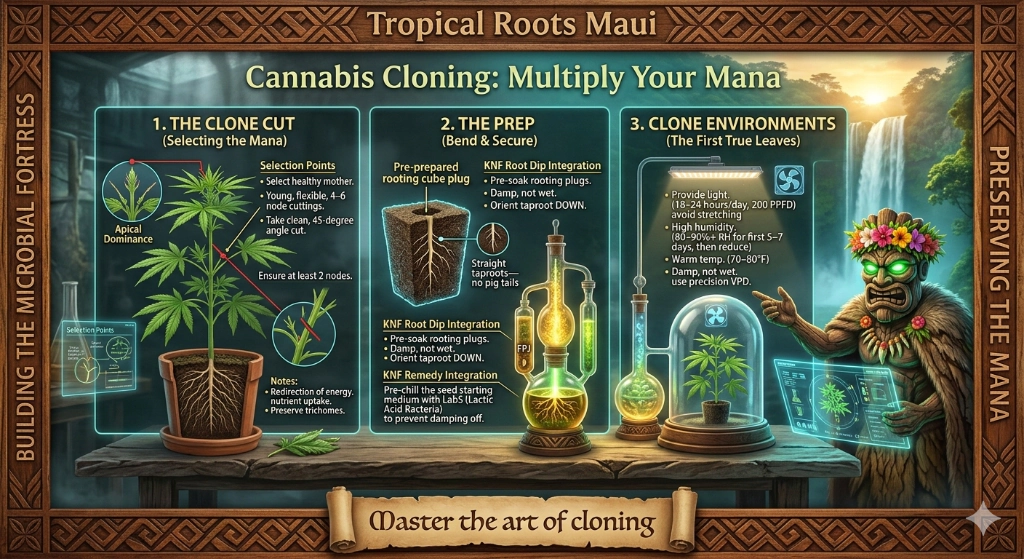
Cannabis Cloning
Multiply Your Mana
Read the leaves. Secure the fortress. Kānehiwa level-sets our precise guide to successful Cannabis Cloning. Learn how to lock in stable genetics by selecting the perfect source mother, execute the takedown method, and dominate the environmental synergy sweet spot (DLI/VPD) to multiply your mana.
"Success is not measured by the height of the leaf, but by the strength of the hidden roots." — Kānehiwa
| Factor | Target Range | Why It Matters |
|---|---|---|
| 💧 Humidity | 80–90% RH | Clones have no roots — they drink through their leaves |
| 🌡️ Temperature | 75–80°F / 24–27°C | Warm roots trigger faster cell division and root initiation |
| ⚗️ pH Level | 5.5–6.0 | Optimal uptake range for the rooting medium |
| 💡 Light Cycle | 18 hrs ON / 6 hrs OFF | Keeps clones in veg without stressing them |
| 🌱 Rooting Time | 7–14 days | White roots visible at the bottom of the medium = ready |
-
1Gather & Sterilize Your Tools
Before you touch the mother plant, sterilize everything. Wipe your razor blade or shears with isopropyl alcohol and let them air dry. Fill a clean glass with pH-balanced water (pH 5.5–6.0) — your cuttings will go straight into this the moment they're taken. Cleanliness is the difference between a 90% success rate and a tray full of dead stems.
⚠️ Sterility Matters Bacteria and pathogens enter through the fresh cut. A dirty blade can introduce infections that won't show symptoms for days — by then, the clone is lost. Sterilize between every cut if taking multiple clones. -
2Select & Take Your Cuttings
Choose a healthy, vibrant mother plant that is currently in the vegetative stage (18/6 light cycle). Look for a sturdy branch with at least two or three nodes — the points where leaves meet the stem. New, flexible growth roots much faster than old, woody stems. See the Mother Plant Guide for long-term maintenance and genetic preservation protocols.
Using your sterilized blade, make a clean, swift cut at a 45-degree angle. This increases the surface area for roots to develop and prevents the stem from getting crushed. Immediately place the cutting into your glass of pH-balanced water — this prevents air bubbles (embolisms) from entering the stem, which can be fatal to a young clone.
"A clean cut is a sacred start. Angle your blade to the mountain's slope — 45 degrees — to let the mana flow and the roots take hold." — Kānehiwa🌺 Hawaiʻi Island Tip — Take Clones at Dawn On Maui, take your cuttings before 7 AM when the plant is fully hydrated from the cool night air and turgor pressure is highest. By mid-morning our intense sun drives transpiration so hard that cuttings wilt within minutes of being cut. If your mother lives outdoors, the morning window is critical. Indoor growers: take clones during the first hour of lights-on for the same reason — the plant hasn't started "sweating" yet. -
3Prepare & Dip the Stem
With your cuttings safely hydrated, prepare the "engine room" of the clone. Gently remove the large fan leaves from the bottom node. Trim the tips of the remaining top leaves — cutting about a third off — to reduce the surface area so the clone loses less moisture through transpiration while it has no roots to drink with.
Rooting Prep- The Scrape (optional): Lightly scrape the outer skin of the bottom half-inch of the stem to expose the cambium layer — this can trigger more rooting sites
- Apply Rooting Hormone: Dip the bottom inch of the stem into rooting gel or powder. This concentrated burst of hormones tells the plant to stop growing leaves and start growing roots
"A light touch, a steady hand. Strip away what is unneeded so the plant may focus its spirit on the roots below." — Kānehiwa🌺 Hawaiʻi Island Tip — Natural Rooting Hormone KNF growers have a free rooting hormone growing in every Maui gulch: willow water. Willow branches contain salicylic acid (a natural rooting compound). Chop young willow tips, soak in water overnight, and use the tea as your clone soak instead of commercial gel. Even better: FPJ made from banana keiki shoots is loaded with natural auxins — dilute at 1:500 and use as a pre-dip soak for 30 minutes before planting. The growth hormones in banana FPJ rival commercial Clonex. -
4Plant Into the Rooting Medium
Soak your Rockwool cubes or peat pellets in pH-balanced water (pH 5.5–6.0). Squeeze them gently so they are damp like a wrung-out sponge — not dripping wet. Carefully place the hormone-dipped stem into the pre-made hole. Ensure the stem is snug and making good contact with the walls of the cube. Gently press the medium around the base to eliminate air pockets.
"Secure the stem as the Koa secures itself to the hillside. When the roots feel the embrace of the earth, they will reach out with confidence." — Kānehiwa -
5The Humidity Dome & Environment
Your clones have no roots — they cannot drink from the medium. Instead, they absorb moisture through their leaves from the air. This makes humidity the most critical factor for the next 7–10 days.
Dome Protocol- Place clones inside a clear humidity dome — target 80–90% RH
- Mist the inside of the dome (not directly on plants) once daily with pH water
- Open vents or lift the lid for a few minutes daily for fresh CO₂ and to prevent mold
- Use soft light only — dimmed LED or T5 fluorescent. Think "dappled forest light"
- Keep dome temperature at 75–80°F. A seedling heat mat helps if the floor is cold
"Treat the dome like the morning mist over Hāna. It protects the young ones from the sun's bite while they find their strength in the darkness of the soil." — Kānehiwa🌺 Hawaiʻi Island Tip — Humidity Is Already on Your Side Maui's natural 65–80% ambient humidity means you're halfway to clone paradise without even trying. Your dome will hit 90%+ easily — the bigger risk here is too much moisture breeding mold. Crack the vents slightly from day one and mist less frequently than mainland guides suggest (every other day, not daily). Watch for condensation pooling on the dome lid — if it's dripping, open vents wider. A tiny USB fan on the lowest setting outside the dome keeps air circulating without drying things out. Our warm floor temps (75°F+) mean you likely don't need a heat mat unless you're growing in an AC'd room. -
6Hardening Off & Final Transplant
After 7–14 days, you should see small white roots poking through the bottom or sides of your rooting cubes. This is the moment your clones transition from infants to toddlers — but don't rip the dome off all at once.
Hardening Off Schedule- Day 1: Open the dome vents fully
- Day 2: Prop the dome up with a small block to let in more air
- Day 3+: Remove the dome for a few hours at a time, increasing each day
- Ready when: The plant no longer wilts with the dome off and roots are visible
Once hardened, transplant into your Tropical Roots Maui living soil or preferred vegetative medium. Water in gently with a light nutrient solution or plain pH-balanced water to settle the roots.
"When the roots break free from their small home, they are ready to taste the mana of the mountain soil. Your clones are now one with the lineage of the Mother." — Kānehiwa🌺 Hawaiʻi Island Tip — First Feed for Rooted Clones Once transplanted into living soil, give your clones the KNF welcome drink: LabS at 1:1000 + FPJ at 1:1000 as a soil drench. The LabS inoculates the fresh soil with beneficial bacteria while FPJ provides gentle growth hormones to encourage root expansion. Wait 3–4 days before introducing FAA — young roots can burn from too much nitrogen too soon. Follow the full program in the KNF Feeding Schedule.

Minimize shock and maximize growth. Kānehiwa shows you how to establish the ultimate microbial alliance in your plant's final home.
Track your results to learn which mothers root fastest and strongest. The growers who keep records are the ones who master their genetics.
"The pen is as sharp as the blade. By recording the days of the root, you learn which Mother plant is most eager to share her spirit with the next generation." — Kānehiwa
Designed to be printed and kept on a clipboard in your grow room.
- Sterilize all tools with isopropyl alcohol before and between cuts
- Select branches with 2–3 nodes from a healthy vegetative mother plant
- Cut at a 45° angle and immediately place in pH-balanced water
- Remove lower fan leaves and trim top leaf tips by one-third
- Dip the bottom inch in rooting hormone — gel or powder
- Rooting medium should be damp like a wrung-out sponge, never soaked
- Humidity dome: 80–90% RH, 75–80°F, soft light only (18/6)
- Mist the dome daily, vent briefly for fresh air, check for mold
- Roots appear in 7–14 days — harden off gradually over 2–3 days
- Transplant into living soil when roots are visible and clone stands without wilting
- Mid-tier cuttings often root faster than top cuttings — log it and find your elite producers
This guide is provided for educational purposes only. Always research local laws and regulations before cultivating.