Preparation & Equipment
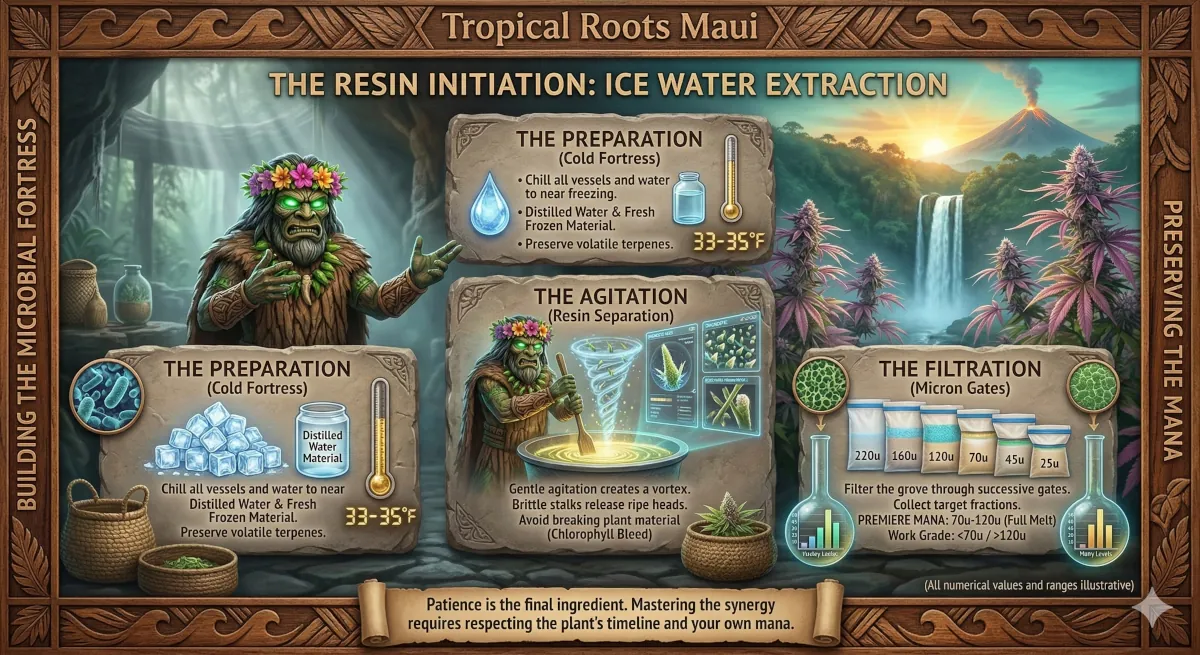
Temperature is the most critical variable. You want the resin heads brittle so they snap off, and the water cold enough to prevent them from sticking together.
🌺 Kānehiwa's Island Tip: Buy twice the ice you think you need. In Hawaiʻi's heat, ice melts fast, even indoors. A 20-lb bag from the gas station won't last one wash cycle in a warm Maui garage. Budget 40–60 lbs for a single 5-gallon run. Pre-freeze extra bags of RO water in gallon ziplocks as backup ice. If you're using catchment water, run it through an RO filter first; the mineral content will cloud your final product.
The Extraction Process
🧊 The Soak (15–20 Minutes)
Fill your work bucket with ice and water. Add your material (dried or fresh frozen). Let it soak for 15–20 minutes. This rehydrates the plant material so it becomes pliable and doesn't shatter into "green" contaminants during agitation.
🌀 Agitation (5–10 Minutes)
Stir the mixture gently. Use a "vortex" motion, then reverse. Avoid hitting the sides of the bucket with force; this pulverizes leaf matter. If using a machine, run it for 5–10 minutes. The water should turn a golden, amber, or light green hue.
🔬 Filtering
Line a second bucket with your micron bags: smallest (25µ) on the bottom, largest (220µ) on top. Pour the water through. The 220µ bag (Work Bag) catches bulk plant material; discard this or save for a second wash.
🌺 Kānehiwa's Island Tip: Run your wash at night or early morning when Maui ambient temps drop below 75°F. If you must work during the day, set up in an air-conditioned room: aim for 60–65°F. A warm wash room is the #1 reason island hash comes out dark and greasy instead of light and sandy. Keep your second (filter) bucket in a cooler with ice while you're agitating the first; this keeps the receiving water near freezing.
Collection & Grading: The Micron Gates
Pull each bag up slowly, letting the water drain. Use a spray bottle with ice-cold water to "wash" the resin into the center of the mesh. Each micron bag captures a different grade of trichome, from debris to pure full melt.
| Micron Size | Gate Name | What It Captures |
|---|---|---|
| 220µ | The Work Bag | Plant debris, leaf matter, stems: discard or save for second wash |
| 160µ | Food Grade | Edible-grade resin with some plant contaminants: ideal for infusions and cooking |
| 120µ – 70µ ⭐ | The Premiere Mana | Mature, potent trichome heads: the most valuable collection, peak Full Melt range |
| 45µ – 25µ | Small Heads | Immature or broken trichome heads: excellent for tinctures, edibles, and Temple Ball pressing |
| Grade | Micron Range | Use Case |
|---|---|---|
| 6-Star (Full Melt) ⭐ | 70µ – 120µ | The purest expression: vaporizes completely with zero residue. Dabbable. |
| 4–5 Star | 45µ / 159µ | Excellent for Temple Ball pressing, high-end joints, or rosin pressing. |
| Work Grade | 25µ / 160µ+ | Ideal for Tincture Alchemy, Sacred Edibles, or infused MCT oil. |
Drying: The Critical Step
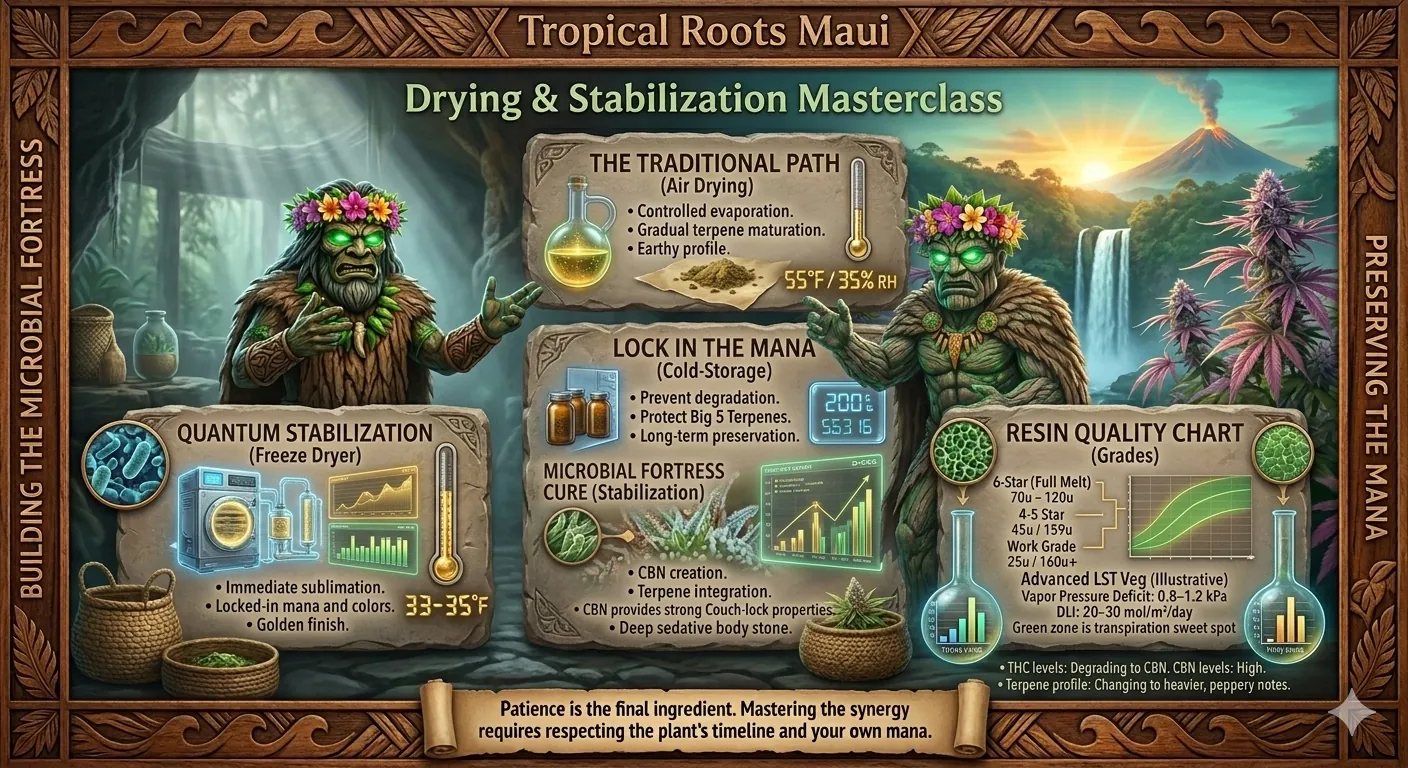
Kānehiwa demonstrates the three drying pathways (micro-planing, controlled air drying, and freeze drying) to stabilize your resin and lock in the terpene profile.
Moisture is the enemy. If hash is stored wet, it will mold within days.
🧀 Micro-Planing
Freeze your wet hash "pucks" for a few hours. Use a sterilized citrus zester (micro-plane) to grate the frozen hash over parchment-lined trays. This increases surface area for even drying.
💨 Air Drying (5–7 Days)
Keep trays in a dark, dust-free room at 12°C – 15°C (55°F – 60°F) with roughly 35% – 45% humidity. No fans blowing directly on the hash; just gentle airflow in the room.
❄️ Freeze Drying (Gold Standard)
If you have access to a unit like a Harvest Right, this is the gold standard. It removes moisture via sublimation in about 24 hours, preserving the terpene profile and light color perfectly.
🌺 Kānehiwa's Island Tip: Air drying hash in Hawaiʻi is extremely risky without climate control. Ambient humidity on Maui regularly sits at 65–80%, well above the 35–45% target. If you don't have a freeze dryer, your best option is a small drying tent with a dehumidifier set to 40% and temps around 60°F. A mini-fridge with the door cracked and a small USB fan works in a pinch. Without humidity control, your hash will mold; this is the #1 cause of lost product on the islands. A Harvest Right freeze dryer is a serious investment but pays for itself quickly in tropical climates.
Curing & Storage
Once the hash "snaps" and shows no moisture, store it in airtight glass jars (Miron glass or Mason jars).
🧊 Cold Storage
Keep your hash in the fridge or freezer to prevent "greasing", where terpenes degrade and the texture becomes oily.
🟤 Temple Balls
You can hand-press dried hash using a hot water bottle to decarboxylate the exterior and create a protective seal for long-term aging. Traditional temple balls can age for years, improving in flavor and smoothness.
🌺 Kānehiwa's Island Tip: Always store hash in the freezer in Hawaiʻi, not the fridge. Even fridge temps (38°F) can cause tropical hash to "grease out" if it had residual moisture. The freezer stops all terpene degradation and prevents the soft, sticky texture that ruins dabability. Use Miron (violet glass) jars if you can find them; they block visible light while allowing UV and infrared through, which preserves terpenes during long-term storage. Wrap jars in a ziplock for extra moisture protection against freezer condensation.
🌿 Washing Fresh Frozen (Live Hash)
Washing fresh frozen material is an art form that requires speed and temperature control. Here is how to push your yields and quality when processing "Live" material.
✂️ The "Clean Break" Harvest
The 30-Minute Rule: Once a branch is cut, the clock starts. You must buck the fans, trim the "crow's feet," and get the resin into the freezer within 30 minutes to stop oxidation.
Don't Over-Pack: When bagging for the freezer, do not vacuum seal or crush the buds. You want "loose" airflow so the resin heads freeze individually, preventing a giant "ice brick" that's impossible to wash.
🌺 Island Note: On Maui, the 30-minute rule is more like a 15-minute rule. In 85°F+ heat and tropical sun, oxidation and terpene evaporation happen nearly twice as fast. Harvest at dawn or dusk when temps are lowest. Have your trimming station set up next to a chest freezer with bags pre-labeled and ready. Some island growers cut whole branches and freeze them immediately, then buck and trim while frozen; this preserves more trichome heads than trimming in the heat.
🧊 Water Chemistry & Temperature
The "Arctic" Environment: Your wash room should ideally be below 13°C (55°F). If the room is warm, ice melts faster and resin will "grease" (turn oily), sticking to the mesh bags instead of falling through.
Pre-Chilled Water: Never use tap-temperature water. Pre-chill your RO water to 0.5°C (33°F) before it touches the ice. This preserves the "light-colored" clarity of the trichomes.
🌀 The "Gentle Vortex" Technique
Material-to-Ice Ratio: You aren't "scrubbing" the buds with ice; the ice is there to keep the water cold. The water moving the material is what shears off the resin.
The Soak Matters: Let your frozen material sit in ice water for 10–15 minutes before the first stir. If you agitate immediately, the frozen brittle stalks will shatter, sending green chlorophyll into your 73µ bag.
💧 Advanced Collection Tactics
The "Double Rinse": Once resin is in the bottom of the bag, use a high-pressure spray of ice-cold RO water to rinse it. This pushes any tiny dust or water-soluble pigments through the mesh, leaving only pure heads.
Parchment "Wicking": Place wet hash patties onto a 25-micron screen with paper towels underneath. This "wicks" away bulk moisture immediately, crucial if you aren't using a freeze dryer.
⚠️ Managing the "Grease"
Strain Specificity: Tropical or "fruity" strains (like Honey Banana or Fruity Pebbles) often have thinner resin membranes that "grease" or melt at room temperature.
Pro Tip: If your hash starts to stick to the bags, stop. Add more ice, wait 5 minutes, and use a "cold spoon" (kept in ice water) to collect the resin.
🌺 Island Note: Many popular Hawaiʻi genetics (Maui Wowie, Puna Budder, Kona Gold) are sativa-dominant tropicals with naturally thin trichome membranes. These strains produce incredible terpene profiles but grease out faster than Indica-heavy mainland genetics. If washing tropical sativas, keep your room below 60°F, work in shorter agitation bursts (3–4 min vs 5–10), and collect quickly. The trade-off is worth it: the flavor profile of properly washed tropical hash is unmatched.
🌺 Kānehiwa's Final Word: Making hash in Hawaiʻi is a battle against heat and humidity at every stage, from harvest to cure. But the reward is hash with terpene profiles you can't get anywhere else on earth. Maui's intense UV light and volcanic soil produce trichomes with deeper, more complex flavor compounds than anything grown under artificial light. Respect the cold chain, invest in a freeze dryer if you're serious, and your island hash will compete with the best solventless in the world. E mālama i ka ʻāina: take care of the land, and it takes care of you.