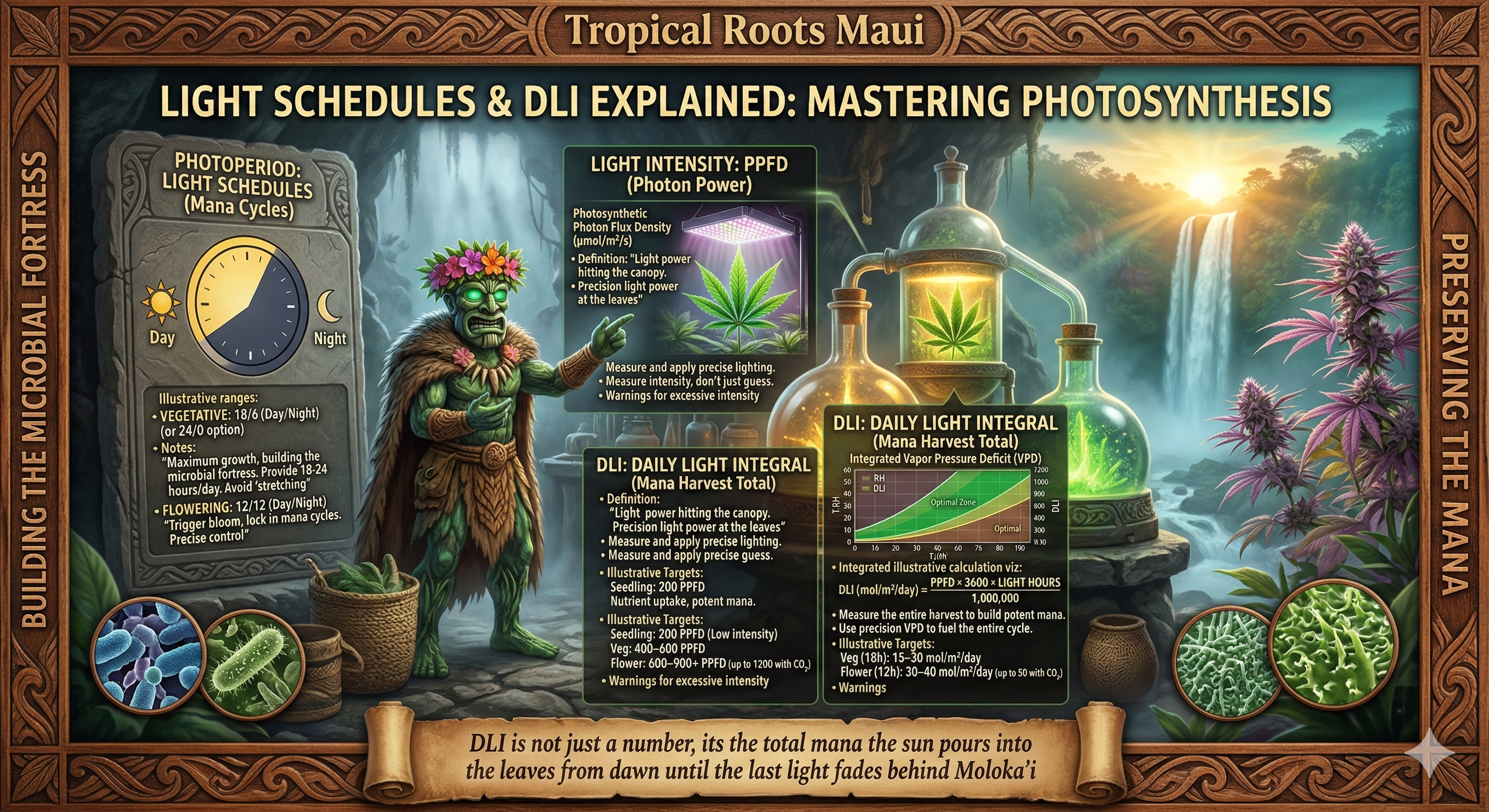
Light Schedules & DLI Explained:
Mastering Photosynthesis
Stop guessing whether your plants have enough light. Kānehiwa guides you through our foundational Light Schedules & DLI guide. Lock in the precise 12/12 and 18/6 mana cycles, calculate your total Daily Light Integral (DLI) harvest, and learn to measure, calculate, and dial in your DLI at every stage of the grow. (All values are illustrative).
"DLI is not just a number; it is the total mana the sun pours into the leaves from dawn until the last light fades behind Molokaʻi. It is the full meal you provide your plant each day. Too little, and she remains small; too much, and the fire will tire her spirit." Kānehiwa
| Growth Stage | Target DLI (mol/m²/d) | Typical PPFD (µmol/m²/s) | Light Schedule |
|---|---|---|---|
| 🌱 Seedling / Clone | 10–15 | 100–300 | 18 / 6 |
| 🌿 Early Veg | 15–25 | 300–450 | 18 / 6 |
| 🍃 Late Veg | 30–45 | 450–700 | 18 / 6 |
| 🌸 Flower | 35–55 | 600–1000+ | 12 / 12 |
"In the time of the young leaf, the plant is like a keiki learning to walk. She needs a steady, gentle light: enough to encourage her to reach, but not so much that she is overwhelmed. Give her the light of a bright morning, consistent and kind." Kānehiwa
"When the flowers begin to crown, the plant's hunger for the sun grows deep. This is the time of the high noon sun. She needs every drop of light you can give to swell the buds and thicken the resin, but remember: even the strongest warrior needs the cool of the night to recover." Kānehiwa
"The plant can only drink as much sun as her breath allows. If you wish to push the light to its limit, you must also give her more air: the sacred CO₂. Without the breath, the extra light is but a wasted fire." Kānehiwa
-
AMeasure Your PPFD
Don't rely on the manufacturer's claimed output numbers; they're measured under ideal lab conditions with a single sensor point. Use a PAR meter or a calibrated smartphone app like Photone (with the paper diffuser it recommends). Take readings at the center and all four corners of your canopy, then average them. That average is the number you plug into the DLI formula.
💡 Photone App Tip Photone requires a small diffuser made from a single sheet of white printer paper over the camera lens. Without it, readings will be significantly off. The app will remind you: don't skip this step.🌺 Hawaiʻi Island Tip: Outdoor DLI Is Off the Charts If you're growing outdoors on Maui, the sun delivers PPFD of 1,800–2,200 µmol/m²/s at peak: far beyond what any indoor LED produces. A plant in full Maui sun for 12 hours can receive a DLI of 50–65+, which is too much for most cannabis without CO₂ supplementation. Use shade cloth (30–50%) during peak hours or position plants for morning sun with afternoon shade. Indoor Maui growers: your tent AC is fighting ambient heat from the light and the 85°F room: dimming your LED slightly and running a longer photoperiod (20/4 veg) can deliver the same DLI with less heat stress. -
BAdjust Intensity vs. Height
You have two levers to control PPFD: dimming and height. If your LED has a dimmer, use it: it's more efficient than raising the light to the ceiling and generates less heat. If you can't dim, raise the light to lower the PPFD for seedlings and lower it progressively as they strengthen and demand more energy.
Which lever to use when- Dimmer available: Prefer dimming over height changes (more efficient, less heat, easier to fine-tune)
- No dimmer: Height is your only tool; start high for seedlings, lower gradually
- Both available: Combine them; find the height that works for your space, then use the dimmer to hit your PPFD target
- Measure after every adjustment: don't assume, verify with your PAR reading
"There are two ways to fill a gourd: a sudden heavy rain or a long, steady mist. DLI is the same. You can use a fierce light for a short time, or a softer light for many hours. Find the rhythm that keeps the leaves praying upward, not bowing in exhaustion." Kānehiwa
-
CThe Photoperiod Flip: DLI Math
When you switch from 18/6 to 12/12 to trigger flower, your DLI will naturally drop: the faucet runs 6 fewer hours per day. A plant receiving 600 µmol during veg at 18 hours had a DLI of 38.9. At 12 hours, that same PPFD only delivers a DLI of 25.9, well short of the 35–55 target for flower. You must increase intensity when you flip to compensate for the shorter day.
Example: To hit DLI 45 in a 12/12 flower cycle, you need PPFD ≈ 1,042 µmol/m²/s. At 18/6 veg, hitting DLI 40 only requires PPFD ≈ 617 µmol/m²/s. The flip is a meaningful step-up in light intensity: plan for it.🌺 Hawaiʻi Island Tip: The Flip Hits Harder in the Tropics When you flip to 12/12, your LED has to work harder, and it dumps more heat into a tent that's already fighting Maui's 80–85°F ambient. Plan your flip for the start of cooler months (Nov–Feb) if possible, or run lights at night when ambient temps drop to 70–75°F. This gives your AC breathing room during the highest-intensity phase. Pair the intensity increase with WCA-P in your feed: the phosphorus signal plus increased light is what triggers explosive bud development. -
DThe Sunrise / Sunset Ramp
If your controller supports it, program a gradual ramp-up at lights-on and ramp-down at lights-off: a 15–30 minute sunrise/sunset curve. It doesn't change your total DLI significantly, but it prevents the sudden thermal spike that happens when a 300W LED goes from zero to full power in a 2×4 tent. That spike can cause humidity swings and dew point issues: condensation on cold surfaces, microclimates at the canopy, and temperature-driven VPD drift during the most sensitive hours of the cycle.
⚙️ Pro Tip Even a simple mechanical timer with a smart plug and a 10-minute delay between circuits can approximate a ramp-up effect if your controller doesn't support it natively.
Leaves pointing almost vertically upward. A plant under intense light or heat stress will angle its leaves to reduce the surface area receiving direct radiation. Often the first sign before visible damage appears.
Leaf edges curling upward along the length of the blade, like the sides of a canoe. The plant is physically reducing the area it presents to the light source. Usually accompanied by some leaf taco-ing on the individual fingers.
The tops of buds or new growth turning white or pale yellow while the rest of the plant remains green. This is photoinhibition: the chlorophyll itself is being degraded. Once bleached, those tissues won't recover. Lower the light immediately.
| Season | Daylight Hours | Implication |
|---|---|---|
| ☀️ Summer Solstice (June) | ~13.5 hours | Longest day: still short of 14h veg threshold |
| 🌑 Winter Solstice (December) | ~11.0 hours | Strong flowering trigger: deeper than 12/12 |
1 · The "Vegetative Fortress" (18/6 or 20/4)
To prevent accidental flowering, your indoor lights must exceed the natural Maui sun. Set to 18 hours ON / 6 hours OFF. This ensures the plant stays in a state of rapid leaf and stem expansion, building the structural foundation before the mana is directed toward flower production. See the Vegetative Stage Guide for full veg protocols.
2 · The "Hardening Off" Sync (14/10)
If you are starting plants indoors to eventually move them to a Hawaiʻi backyard or greenhouse: start at 18/6, then over two weeks, slowly reduce the indoor timer to 14/10. This matches the peak summer light in Hawaiʻi, preventing the "light shock" that causes plants to re-veg or hermie when moved outside.
3 · The "Flowering Trigger" (12/12)
While 12/12 is the indoor standard for flowering, Hawaiʻi's winter sun (11 hours) is actually a "stronger" trigger. If you want to mimic the deep purples and high terpene density, some master cultivators in Hawaiʻi drop to 11/13 during the final two weeks of flower to simulate the ripening winter sun.
| Growth Stage | Hawaiʻi Sun Equivalent | Indoor Target (PPFD) | Target DLI |
|---|---|---|---|
| 🌱 Clones / Seedlings | Shaded Valley Mist | 200–300 | 10–15 mol/m²/d |
| 🌿 Vegetative | Mid-Morning Sun | 400–600 | 20–30 mol/m²/d |
| 🌸 Flowering | High Noon (Lahaina) | 800–1000+ | 35–45+ mol/m²/d |
The Sunset Fade: If using high-end controllers, program a 30-minute "sunrise" and "sunset" ramp-up. This mimics the natural tropical transition and reduces plant stress from sudden light changes.
The Method
Set a simple LED or even a strong porch light to turn on for one hour in the middle of the night (e.g., from 12:00 AM to 1:00 AM). This single hour of interruption is all it takes.
The Alchemy
This interruption resets the plant's internal clock, tricking it into thinking the day hasn't ended. It stays in the vegetative stage, building the Microbial Fortress of its root system and canopy. The gas lantern routine uses far less electricity than running supplemental lights for 4–6 extra hours per day.
The Technique
Use supplemental lighting to ensure the plant sees at least 16 hours of total light. This means adding 2.5–5 hours of artificial light depending on the season.
The Setup
Many Maui growers use "Solar LED" shop lights or small high-efficiency puck lights hung above the plants during the early evening. Once the plant reaches its desired size, you simply "pull the plug" and let the natural Hawaiian ~12/12 cycle trigger the flowering phase: no timer change needed, just disconnect the supplemental light.
Hardening Off
Move your plants into a "misty filtered" area (partial shade) for 3–5 days. Direct Maui sun is intense enough to bleach leaves that are only used to indoor lamps. A covered lānai, shade cloth at 40–50%, or the filtered light under a tree canopy all work well. Increase sun exposure by 1–2 hours per day until the plant handles full exposure without wilting.
Flowering Transition
Only move the plants to their final, full-sun position once they have the structural integrity to support heavy tropical colas. A weak-stemmed plant moved into full Maui sun will snap under the weight of dense flowers. Use the Plant Training Mastery Guide to build a strong, wide canopy before the transition.
- DLI = (PPFD × 3600 × Light Hours) ÷ 1,000,000
- Seedling: 10–15 DLI · 100–300 PPFD · 18/6
- Early Veg: 15–25 DLI · 300–450 PPFD · 18/6
- Late Veg: 30–45 DLI · 450–700 PPFD · 18/6
- Flower: 35–55 DLI · 600–1000+ PPFD · 12/12
- Measure PPFD at canopy level: center and all 4 corners, then average
- Use a dimmer over height changes when available (more efficient, less heat)
- When you flip to 12/12, increase intensity to maintain target DLI: the shorter day cuts it significantly
- Without CO₂, keep Flower DLI below 50 to avoid light bleach and heat stress
- Praying leaves, canoeing, or bleached tops = DLI too high: back off immediately
🪶 Kānehiwa's Closing Words
"The sun is the source of all life, but the grower is the master of the shadow. Watch the leaves: if they turn away, you have given too much. If they stretch thin, they ask for more. Listen to the plant, and she will tell you when her cup is full." Kānehiwa
This guide is provided for educational purposes only. Always research local laws and regulations before cultivating.