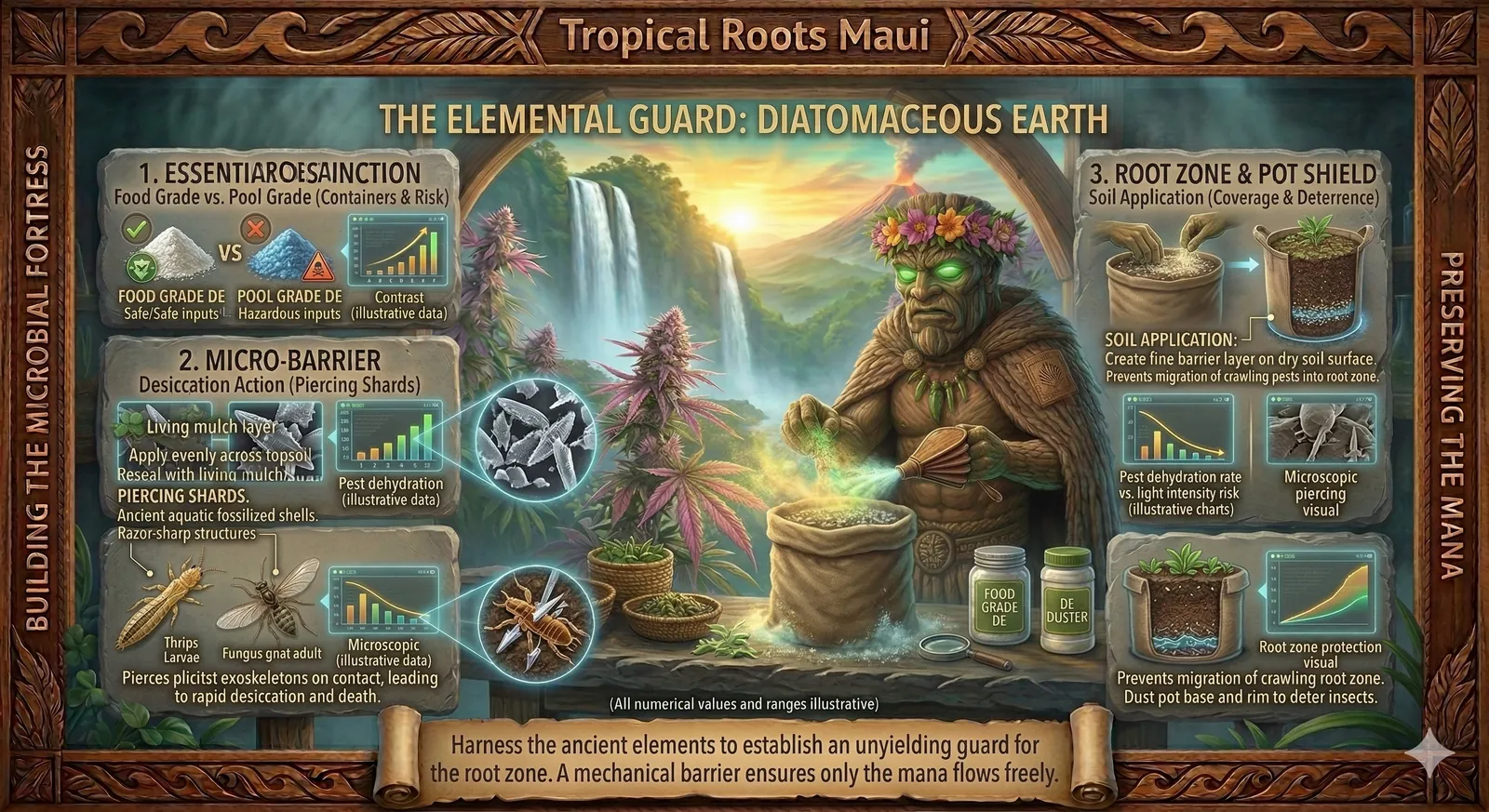
The Elemental Guard
Diatomaceous Earth
Ancient Fossilized Defense · Razor Wire for Microscopic Invaders
"While Food Grade DE is safe, the dust is extremely fine. Always wear a mask during application to preserve your own lungs. Let the dust settle before re-entering the sanctuary."
Crawling threats (fungus gnats, root aphids, and thrips) constantly seek to breach the lower defenses of the Microbial Fortress. Rather than deploying synthetic poisons that harm our beneficial soil biology, we rely on a purely mechanical defense: fossilized powder that acts as invisible razor wire for microscopic pests.
Before deploying this defense, you must ensure you are holding the correct element. Using the wrong type is not just ineffective: it is dangerous.
This is the only form of DE you should ever use in the sanctuary. It is unheated, amorphous silica made from fossilized aquatic organisms (diatoms). It is non-toxic to humans and pets at normal exposure levels, safe for organic gardens, and deadly to soft-bodied insects through purely mechanical action.
Never use this. Pool grade DE has been chemically treated and super-heated (calcined) for water filtration systems. This process turns the silica crystalline, making it a severe respiratory hazard for humans (linked to silicosis) and completely stripping away its pest-control properties. It looks similar but is fundamentally different.
Always verify the label: The packaging must explicitly state "Food Grade" or "Food Chemical Codex Grade." If it says "pool," "filter," or "calcined," do not use it. When in doubt, check the silica content: Food Grade DE is less than 1% crystalline silica; Pool Grade is 60%+ crystalline.
Diatomaceous Earth does not kill through chemical toxicity: it is a master of physical alchemy. This is why it's safe for organic grows and why insects can never develop resistance.
To the human hand, Food Grade DE feels like soft baby powder. But under a microscope, it is a landscape of jagged, razor-sharp glass shards: the fossilized silica shells of ancient diatoms. Each particle is a natural micro-blade invisible to the naked eye.
When a soft-bodied crawling insect (like a fungus gnat larva, thrips nymph, or root aphid) moves across the DE barrier, the microscopic shards pierce their protective waxy exoskeleton. This waxy layer is the insect's only defense against moisture loss: once breached, it cannot be repaired.
Once pierced, the insect's internal moisture rapidly leaks out into the highly absorbent DE powder. The pest dies from dehydration within hours to days, depending on size. Because this is a purely physical attack, insects can never build a genetic immunity to it: unlike chemical pesticides where resistance develops within generations.
DE has one critical weakness: it only works when completely dry. If it gets wet, the shards clump together and lose their razor edge. In a humid, tropical environment, application strategy is everything.
Use a hand bellows or fine mesh shaker to apply a light, even dusting across the dry topsoil of your fabric pot. Do not pile it on thickly: pests will simply walk around a mountain of DE. A fine, almost invisible layer is far more effective because insects walk through it unknowingly.
Because your Aquifer Protocol (bottom-watering) keeps the topsoil relatively dry, your DE barrier will last longer than with top-watering. However, if you do a top-dress watering or spray a foliar KNF input, you must reapply the DE once the topsoil has dried again. Wet DE is inert DE.
To stop pests from migrating from the floor up into the canopy, dust the exterior base of the fabric pot and the upper rim. Since these areas rarely get wet, this perimeter shield will remain an active, unyielding guard for weeks at a time. Reapply only if disturbed or rained on.
For maximum protection, dust a thin line of DE around the entire perimeter of your grow space: along walls, under shelving, and around drain holes. This creates a kill zone that crawling pests must cross before reaching your plants. Effective against ants, earwigs, and migrating thrips.
Protect beneficials: DE does not discriminate between pest and predator. If you've deployed predatory mites, ladybugs, or lacewings, apply DE only to specific zones (pot rims, floor perimeters) rather than broadcasting across the entire canopy floor. This preserves your biological guardians while still blocking crawling invaders.
Maui's ambient humidity (65–80%+ on the windward side) is DE's worst enemy. In high humidity, DE absorbs atmospheric moisture and loses its cutting edge within days. For indoor grows, keep grow room humidity below 60% at the topsoil level. For outdoor grows, apply DE during the driest part of the day and accept that reapplication will be more frequent.
Unlike mainland grows with seasonal pest cycles, Maui's tropical climate means fungus gnats breed year-round. DE should be a permanent part of your IPM rotation, not a one-time treatment. Apply topsoil dustings after every top-dress activation watering and maintain the perimeter shield continuously.
Food Grade DE is available at: Maui feed stores, Tractor Supply (if stocked), Down to Earth (Kahului), and online bulk suppliers. The most economical option is a 10 lb bag: it lasts months for a home grow. Always verify "Food Grade" on the label before purchase.
The Aquifer Protocol (bottom-watering) is the ideal partner for DE. Because water enters from below and the topsoil stays dry, your DE barrier remains active far longer than with top-watering systems. This is one of the hidden advantages of SIP in tropical climates: your mechanical defenses stay deployed.
For educational purposes only. This guide covers organic pest management techniques for legal cannabis cultivation. Always use Food Grade Diatomaceous Earth only. Wear respiratory protection during application. Follow local agricultural regulations and laws. The information provided is not a substitute for professional consultation.