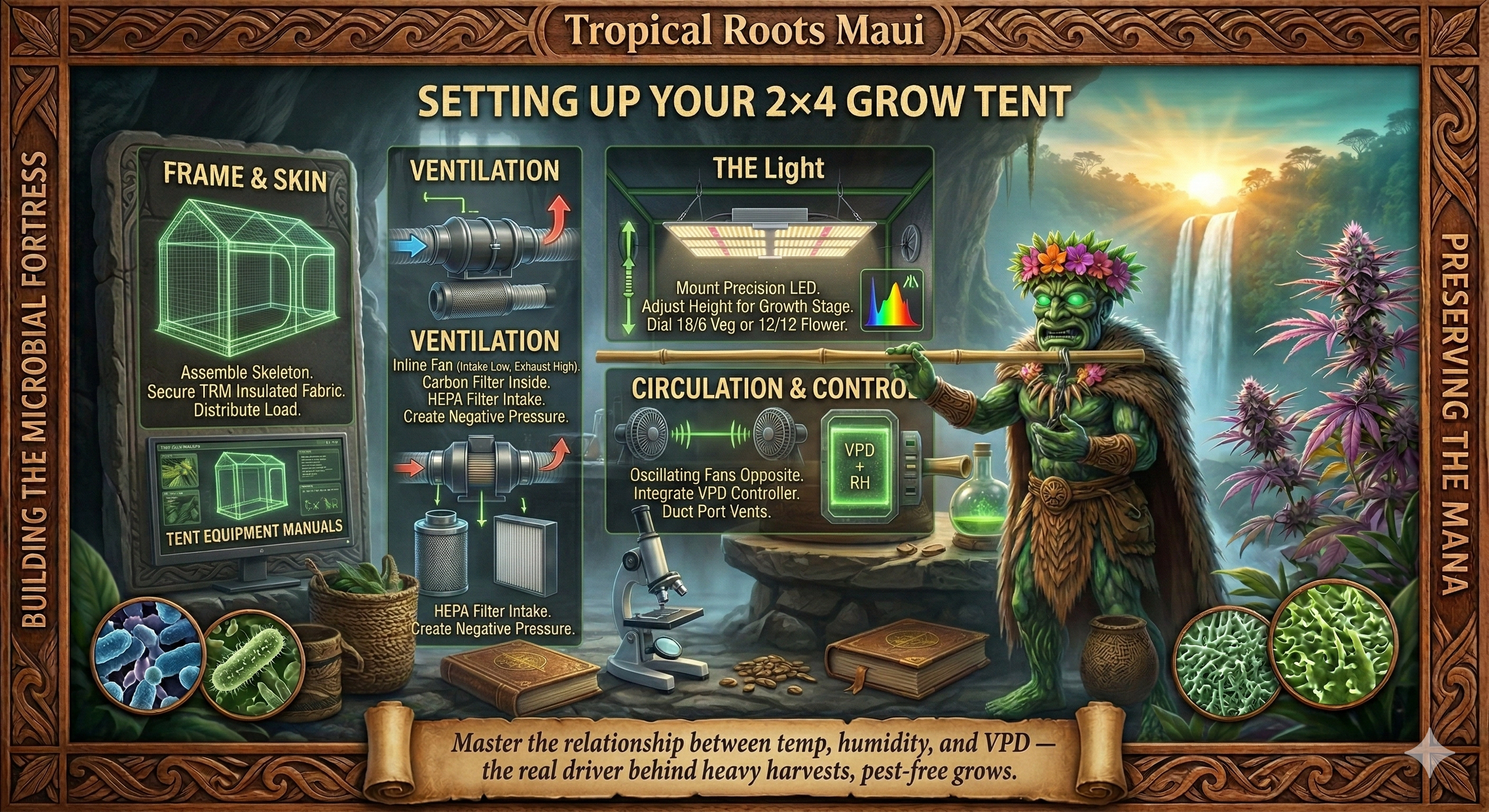
Setting Up Your
2×4 Grow Tent
Everything you need to get your first indoor garden assembled, dialed in, and ready to grow. Kānehiwa details our precise five-step 2×4 grow tent assembly guide, from the structural 'Aroma Lock' ventilation network to building the foundational Living Soil 'Microbial Fortress.'
-
1Assembly & Placement
Before anything goes inside, get the tent in the right spot. You want to be near a window for venting your exhaust and close to a dedicated electrical outlet — ideally one that isn't shared with other heavy appliances. Avoid carpet if you can; hard floors are much easier to deal with if a pot drips or spills. Assemble the metal frame first, making sure every locking pin clicks into place — a wobbly frame is a headache later. Slide the bottom tray under the frame, then wrap the canvas skin over the top and zip it up.
🌺 Hawaiʻi Island Tip Place your tent in the coolest room of the house — Hawaiʻi homes rarely have central AC, so choose a room with cross-ventilation or a window unit. Avoid garages and sheds; Maui's daytime heat turns uninsulated spaces into ovens. If venting out a window, point exhaust downwind of the prevailing trade winds (NE) so back-pressure doesn't fight your fan. -
2Ventilation & Odor Control
This is the most important system in the tent. Proper airflow prevents powdery mildew and keeps temperatures from spiking. Hang your inline duct fan and carbon filter from the top crossbars using ratcheting ropes — the fan should pull air through the filter and push it out of the tent through your ducting. Open the mesh intake vents at the bottom to let fresh air in.
✅ Negative Pressure Check Zip the tent completely and watch the walls. They should bow inward slightly — this means all air exiting is being routed through the carbon filter. If the walls bulge outward, air is escaping unfiltered somewhere.🌺 Hawaiʻi Island Tip Size up your inline fan by one tier — a 6-inch where you'd normally use a 4-inch. Hawaiʻi's warm, humid intake air makes your ventilation system work harder than mainland setups. If possible, vent exhaust directly outdoors rather than into the room; dumping hot, moist air into an already-warm Maui house creates a feedback loop that's hard to break. Carbon filters also saturate faster in high humidity — budget for replacement every 6–9 months instead of 12. -
3Lighting Setup
For a 2×4 space, target a 200W–300W LED grow light. Hang it on adjustable ratchet straps from the top crossbar so you can raise and lower it as the plants grow. Start higher for seedlings (24–30 inches) and lower it as they develop — consult your light's PAR map for exact recommendations, as this varies by manufacturer.
Light Schedule by Stage- Seedling: 18 hours on / 6 off — or 20/4
- Vegetative: 18 hours on / 6 off
- Flowering: 12 hours on / 12 off — triggers bloom in photoperiod plants
- Set your timer once and let it run — consistency matters more than perfection
🌺 Hawaiʻi Island Tip Run your lights during nighttime hours (6 PM–12 PM or 6 PM–6 AM) when ambient temperatures are cooler — this alone can drop tent temps 5–10°F compared to a daytime schedule. Hawaiʻi has some of the highest electricity rates in the US, so LED efficiency matters more here than anywhere. A quality 240W LED board outperforms a cheap 300W blurple while drawing less power. Every watt saved is money back on your HECO bill. -
4Internal Environment
Clip a small oscillating fan to one of the vertical poles and aim it so there's a gentle breeze across the canopy. You want the leaves to move slightly — not thrash. This builds stronger stems and prevents hot, stagnant air pockets. Place your hygrometer at canopy level, not on the floor — the reading down there tells you nothing useful about what your plants are actually experiencing.
Lower humidity in flower is critical. High RH during late flower invites botrytis (bud rot) — especially in dense, tightly packed colas. Keep an eye on it as your plants fill out. The Microbial Fortress Guide covers how to defend against Botrytis through microbial domination and sanitation protocols.🌺 Hawaiʻi Island Tip A dehumidifier is not optional on Maui — it's your most important piece of equipment after the light. Ambient RH of 65–85% is normal island-wide, which means your tent will sit dangerously high without active dehumidification. Place a small unit inside the tent or directly at the intake. During late flower, target 45–50% RH even when the air outside is at 75%. Kona wind days (southerly, humid, still air) are the most dangerous — monitor conditions with a smart sensor like an AC Infinity controller that can automate your fan and dehumidifier response. -
5Safety Check
Before any plants go in, do a full safety pass. Get all power strips, ballasts, and electrical connections off the floor — if a pot overflows, water on live wires is a serious hazard. Secure cables along the frame to keep everything tidy and off the floor. Then step inside the tent, zip it fully closed, and wait for your eyes to adjust — any light leaking in through seams or zipper gaps needs to be taped or sealed before you start a photoperiod cycle, as unintended light during dark periods can trigger hermaphroditism.
🌿 TRM Cable Management Clips- Tropical Roots Maui makes 3D-printed cable management clips designed specifically for grow tent frames — they snap directly onto the metal poles and keep power cables, sensor wires, and fan cords routed cleanly along the frame
- Keeping wires off the floor eliminates trip hazards and dramatically reduces the risk of water contact during watering
- A clean tent is also easier to inspect for pests, mold, and light leaks — cable clutter hides problems
- Available in the The Sacred Grove
⚡ Safety First Never water plants with live electrical equipment directly below. Always lift power strips onto hooks or shelving before your first wet run.🌺 Hawaiʻi Island Tip Hawaiʻi's salt air accelerates corrosion on electrical connections and metal frames — especially near the coast. Inspect plug prongs, fan housings, and tent poles for rust or green oxidation monthly. Use a GFCI outlet (or a portable GFCI adapter) — standard in newer Hawaiʻi homes but often missing in older plantation-era houses. The combination of high humidity and frequent watering makes ground-fault protection essential, not just recommended.
- Place the tent near a window (for exhaust) and a dedicated outlet — avoid carpet
- Inline fan pulls air through the carbon filter and out — walls should bow inward
- 200–300W LED for a 2×4; hang on ratchets so you can adjust height as plants grow
- Seedlings: 24–30 in light height / 18/6 schedule / 75–80°F / 65–70% RH
- Veg: lower light to 18–24 in / 18/6 / 70–85°F / 45–55% RH
- Flower: 12–18 in / 12/12 / 65–80°F / 35–45% RH
- Hygrometer goes at canopy level — not the floor
- All power strips off the floor before watering — no exceptions
- Light leak test: zip yourself inside and let eyes adjust before confirming dark
This guide is provided for educational purposes only. Always research local laws and regulations before cultivating.