Plant Training
Shaping the Mana
Read the leaves. Secure the fortress. This is the complete canopy training compendium — from the gentle art of LST to the precision of topping, the architecture of SCROG, and the raw power of super cropping. Kānehiwa walks you through every technique to break apical dominance, redistribute the mana, and shape the perfect structural fortress for massive, resinous flowers.
This guide is the culmination of physical manipulation and energetic balance within the Tropical Roots Maui sanctuary. It's about more than maximizing yield — it's about guiding the plant's innate growth potential, its mana, to create the perfect structural fortress for massive, resinous flowers.
Cannabis naturally grows like a Christmas tree — one main stalk takes all the energy through apical dominance. By bending, topping, weaving, and strengthening, we convince the plant to redistribute its growth hormones (auxins) evenly to all branches. The result: a flat, symmetrical canopy with 10–20+ primary colas receiving equal light — from the gentle art of LST to the precision of SCROG and the raw power of super cropping.
Start when the plant has 3 to 5 nodes (sets of leaves).
Wait until the stem is flexible but sturdy — like a young vine. Too early and she has nothing to work with. Too late and she may snap.
Anchor the base of the main stem in the opposite direction you plan to bend.
Protect the roots. An anchor prevents the plant from being pulled out of the soil when you apply tension to the top.
Gently bend the top of the plant over until it is horizontal (parallel to the soil).
Be soft. If the stem feels too stiff, massage it between your fingers first to soften the fibers. The plant will tell you when she is ready.
Use soft plant ties or rubber-coated wire to secure the top to the rim of your pot.
Never use thin string or fishing line — they will cut into the skin of the plant like a blade. Soft ties only. She is living, not lumber.
As side branches grow upward, bend them outward away from the center.
Keep the canopy level. If one branch gets too high, pin it down to match the others. LST is an ongoing conversation — not a one-time fix.
Water your plants after you train them. A thirsty plant is more flexible; a fully hydrated plant is "turgid" and more likely to snap under the bend.
If you accidentally snap a branch (a "High Stress" mistake), don't panic. Tape it back together immediately with floral tape or electrical tape. Most times, she will heal and form a strong "knuckle" at the break — often stronger than before.
Constantly tuck or tie back large fan leaves that are shading your new upward-growing bud sites. Light is mana — don't let the elders block it from the youth.
Left to its own devices, a cannabis plant grows like a Christmas tree, focusing its energy on one main top cola — apical dominance. To create a symmetrical, high-yielding canopy, we must "Shape the Mana," convincing the plant to redistribute its growth hormones (auxins) evenly to all lower branches. LST is the foundation, but these advanced techniques unlock the next level of canopy mastery.
Breaking Apical Dominance: The "Mana Redistributor"
The first act of shaping is often the hardest. By strategically removing the main growth tip, we signal the plant to stop vertical growth and focus on lateral branching.
✂️ Topping
Using sterilized snips, cleanly remove the topmost growth tip above the fifth node. This splits the main stem into two new colas, creating a "Y" structure. It is precise and predictable — the most reliable way to double your cola count. Wait 3–5 days between topping and any LST work to let the plant recover and redirect its auxin flow.
🤏 Fimming (F*ck I Missed)
Gently pinch the very tip of the top growth node, removing about 70–80% of it. When successful, this can result in four or more new colas from a single pinch point — but it can be less predictable than topping. The imprecise nature of fimming sometimes produces three colas, sometimes five. Experienced growers use fimming when they want maximum branching from a single cut.
The Goal: Both methods transform the tree structure into a bush, forcing the plant to prioritize multiple secondary bud sites. Topping is the safer bet for beginners; fimming rewards the experienced hand with more branching potential. Either way, always sterilize your tools with isopropyl alcohol before and after every cut.
SCROG (Screen of Green): The "Weaving" Mastery
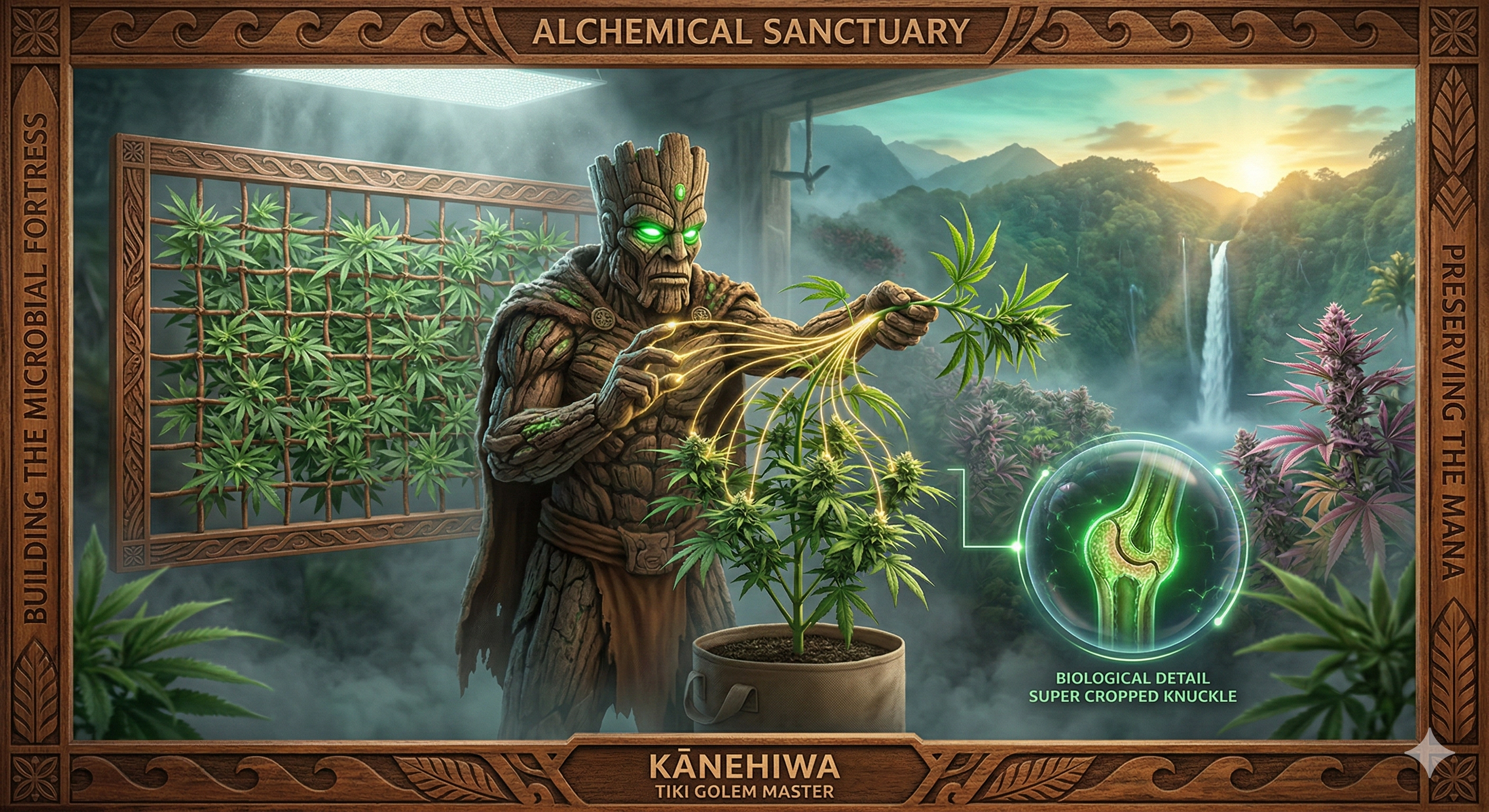
SCROG is the advanced application of LST, using a horizontal screen or netting placed over the vegetative canopy. It combines topping, LST, and strategic weaving into one unified system — the gold standard for maximizing yield per square foot.
🪢 The Setup
Install a screen (bamboo frame or nylon trellis netting with 4–6 inch squares) 8–12 inches above the pot rim once the plant has been topped and trained. The screen should be taut and level — every square represents a future cola site.
🌿 The Weave
As branches grow through the screen, gently "tuck" them back under and guide them sideways into adjacent squares. This forces them to fill the screen horizontally rather than growing vertically. Continue weaving daily during veg — it takes 5–10 minutes per session and is deeply meditative work.
🌸 The Final Form
Once the screen is 70% full, trigger the flowering cycle. The stretch during the first 2–3 weeks of flower will fill the remaining 30%. The result is a perfect "Sea of Green" — dozens of uniform, primary colas receiving equal DLI, maximizing every square inch of the sanctuary space.
Super Cropping: Strengthening the Main Veins
Sometimes, the flow of mana is restricted by thin stems. Super Cropping involves intentionally damaging the inner fibers of a branch (without breaking the outer skin) to strengthen it. This is a High Stress Training (HST) technique — use it deliberately and sparingly.
💪 The Action
Select a healthy, flexible branch. Using your thumb and forefinger, gently roll and squeeze the stem until you feel the internal structure "snap" or soften. The outer skin should remain intact — you're crushing the inner pith, not breaking the branch. Gently bend the branch to a 90-degree angle at the softened point.
🩹 The Recovery
Within a few days, the plant will form a thick, woody "knuckle" or callus at the bend site. This knuckle not only supports massive weight but also creates a "super-highway" for nutrient and water transport to the bud sites above. The thickened vascular tissue at the knuckle can carry significantly more nutrients than the original stem — super-cropped branches often produce the heaviest colas on the plant.
⚠️ Timing Warning
Only super crop during vegetative stage or the first 1–2 weeks of flower. Super cropping during mid-to-late flower risks snapping brittle, woody stems and stressing the plant during its most critical bud-building phase. If a branch gets too tall during late flower, use a yo-yo hanger or plant support stake instead of super cropping.
"The plant, like the vine in the rainforest, always seeks the highest light. By gently guiding her branches outward, you show her a new way to reach the sun. You are not breaking her spirit; you are expanding her horizon so every leaf may drink the morning mana."
The Purpose of LST — KānehiwaLegal Notice: All seeds sold by Tropical Roots Maui are strictly collectible souvenir and novelty items only. They contain 0% THC. Please check your state and local laws before purchasing. Tropical Roots Maui assumes no legal responsibility for actions taken once products are in your possession. Must be 18+.